
Complete guide to Vișeu de Sus
The northern Maramureș town where the Vaser Valley steam train departs — one of the last working steam forestry railways in Europe. A measured guide to the train, the valley, the mountains, the Zipsers and the wooden church next door.
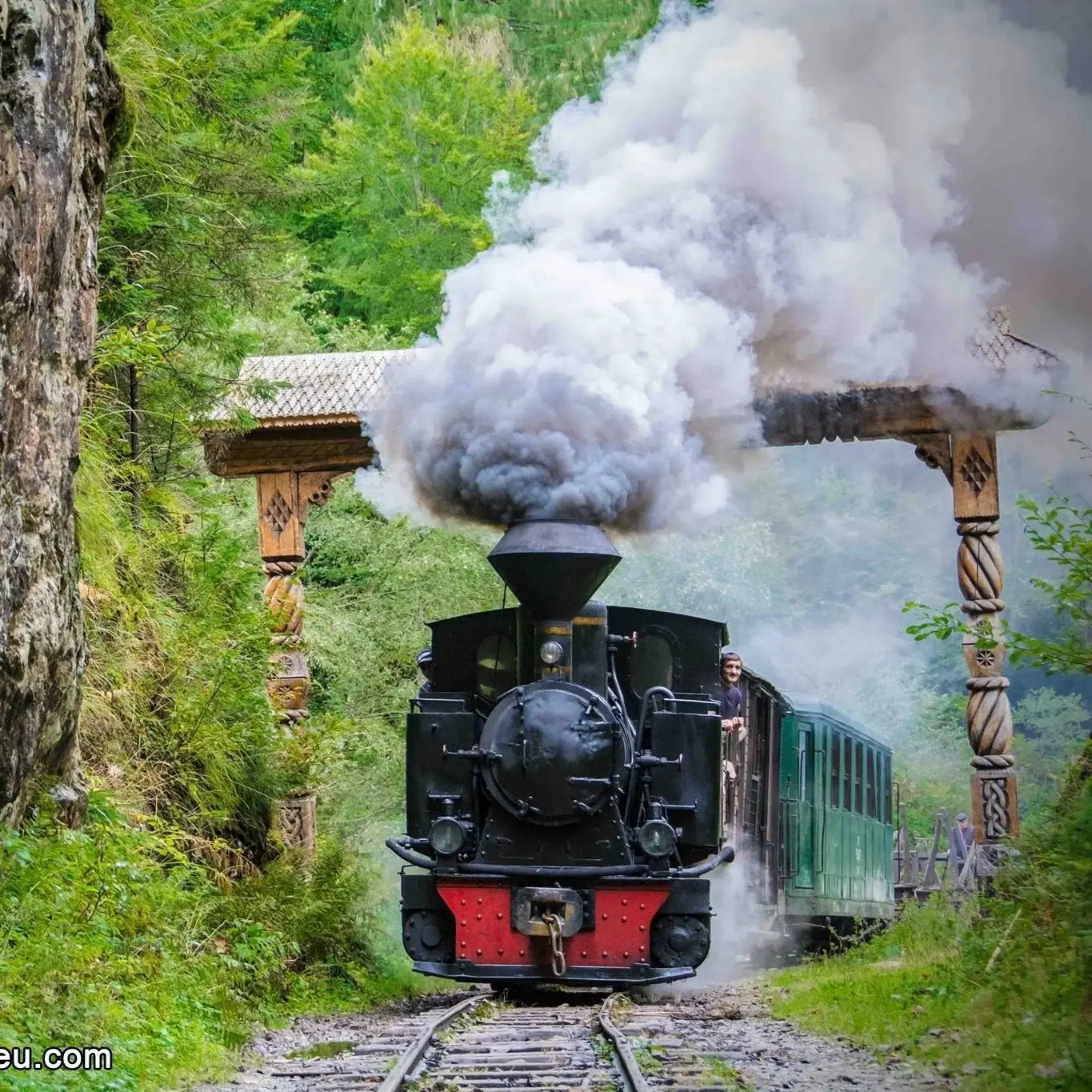
Vișeu de Sus does not try to charm you at first sight. It is a town of timber, cold water and locomotive smoke in northern Maramureș, set exactly where the Vaser river comes out of the mountains. From here departs one of the last steam-hauled forestry railways still running in Europe — and that, by a wide margin, is why people come.
Why come here
Vișeu de Sus is a starting point, not an open-air museum. It has no photogenic old town, no citadel on a hill. What it does have is something increasingly rare in today's Europe: a long forested valley you cannot drive into, old-growth woodland, bears living wild, and a train that climbs up there on narrow-gauge rails, as it has for more than a century.
For anyone arriving from southern Maramureș — from the wooden churches and carved gates of the Mara and Cosău villages — this town is the region's mountain end. If you are planning a wider trip, the Maramureș guide sets the historical and cultural context, while the guide to the Maramureș villages explains why timber is the raw material of everything here: houses, gates, churches, tools.
The Vaser Valley steam train
The Vaser Valley forestry railway was never built as a tourist attraction. The narrow-gauge line was laid to bring timber down from the mountains, and the steam locomotives stayed in service because, in a valley with no access road, the train was always the only answer. Passenger carriages run today as well, but the line's working nature shows in every curve: the track follows the river, not the view.
The journey is slow, loud and full of steam — exactly as it should be. The train enters a tight gorge, crosses bridges over the Vaser and stops at halts where there is nothing but forest, water and a plank table.
A few things to know before you go:
- The train runs on a seasonal timetable, not daily year-round. Always check the official schedule for the dates of your trip.
- Tickets sell out, especially on summer and autumn weekends. Book well ahead; do not count on buying a ticket the morning of departure.
- The return trip takes well over half a day. Do not schedule it alongside another distant sight on the same day.
- Bring warm layers even in summer: the valley runs several degrees colder than the town, and the carriages are open to the landscape.
The Vaser Valley and the mountains around it
The Vaser Valley lies inside the Maramureș Mountains Nature Park, one of the least walked mountain areas in Romania. Here bears are not a story told over dinner at the guesthouse but a reality to manage: no food left in the open, no wandering off the trail alone, no stepping closer for a photograph.
These mountains look gentler than the limestone ridges of the southern Carpathians, yet they are wilder to live in: long crests, vast forests, few and far-apart villages. If you are coming for serious hiking, the route and mountain-preparation side of it lives on munte.online; what stays here is the travel side.
The Zipsers, the town's second inheritance
Vișeu de Sus is one of the few towns in Romania where a German identity is still alive in local memory. The Zipsers — German colonists brought in to work the forests — arrived with the woodcutter's craft, with a different way of building a house, and with a Catholic parish life running parallel to that of the Romanian villages around.
The community has shrunk a great deal, above all after the departures of the second half of the twentieth century, but the traces are visible: streets of low houses with steep roofs, the Catholic church and cemetery, family names, recipes for bread and smoked meat. If you get the chance to talk with someone from one of the old families, you will learn more about the town than from any information panel.
The wooden church of Vișeu de Mijloc
A few kilometres away, in the neighbouring village, the wooden church of Vișeu de Mijloc shows the classic Maramureș form: beams joined at the corners, a tall narrow spire, a shingle roof dropping far below the walls. It does not carry the fame of the UNESCO-listed churches, and that is precisely why the detour is worth it: this is a monument still serving its own community.
Enter with respect — it is a working church, not a museum. If you find it locked, ask in the village for the key; it is usually with someone nearby.
Getting there
Vișeu de Sus sits in northern Maramureș, on the road linking Baia Mare with Borșa and the Prislop pass. Driving is the easiest option. There is also a train, on the line that climbs the Vișeu valley, as well as buses from Baia Mare and Sighetu Marmației.
Coming from Bucovina, the town is the natural first stop after Prislop. From the west, the road runs through Sighet — and the Sighetu Marmației guide is useful for an extra day, for its museums and its border-town atmosphere.
Where to stay and what to eat
Accommodation means family guesthouses, many of them run by the same families for two generations. Book ahead especially in the steam-train season, when the good rooms fill up along with the tickets.
At the table, go for what the household cooks anyway: sour soup, stews, sheep's cheese from the mountain dairies, savoury pies, smoked meats. Horinca — the strong local plum spirit — is offered on arrival; accept it in small measures and take your time.
When to come
Summer and early autumn are the safest windows for the train and for hiking, and autumn gives the valley forests a colour that is hard to forget. Winter leaves the town quiet and beautiful, but mountain access becomes a question of equipment, and train services are reduced.
To tie it all into a one- or two-day itinerary, carry on with what to see in Vișeu de Sus and the Vaser Valley.
Plan your trip
Stays nearby
Stays in Romania
Experiences
Tours & activities
Guided tours, day trips and hand-picked experiences via GetYourGuide — free cancellation on most.
See all experiencesGetting to Romania
Flights, transfer & car
Fly into Romania
Compare fares to Bucharest Otopeni (OTP) and regional airports — Cluj, Sibiu, Iași, Timișoara.
Airport transfer
Private, fixed-price door-to-door transfer — driver waiting from the moment you land.
Rent a car — see the real Romania
A rental car is the key to Romania: the Transfăgărășan, the painted monasteries of Bucovina, mountain roads and the villages of Maramureș that no train reaches.
Find a car











