The Complete Guide to Oradea
Oradea is Romania's Art Nouveau jewel, a Central-European city of elegant cafés and Secession facades lovingly restored over the past decade. A step from the Hungarian border and the thermal baths of Felix, it is one of the most refined urban escapes in the Crișana region.
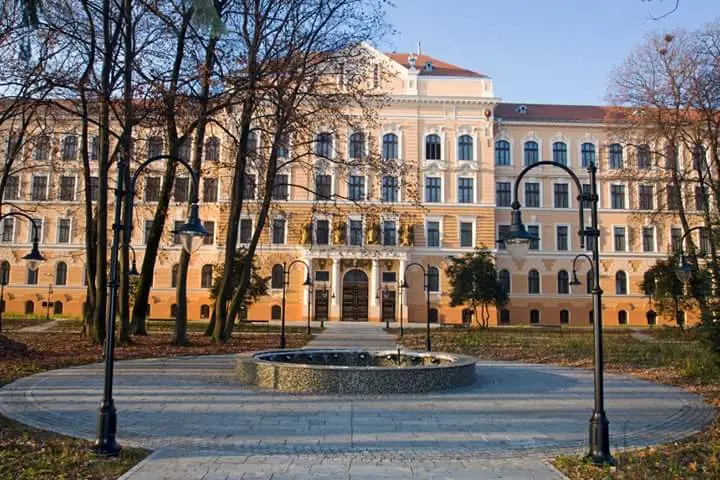
Few cities in Romania surprise you as completely as Oradea. Here, on the western edge of the country, along the banks of the Crișul Repede river, stands one of the densest and best-preserved concentrations of Secession architecture in Europe. It is a city of undulating facades, high-ceilinged cafés and a Central-European elegance that the past decade of restoration has brought back to light.
Why Oradea
In the early twentieth century Oradea was a wealthy, ambitious city, and its architects left behind an entire centre built in the Art Nouveau style (Viennese and Hungarian Secession). For a long time these buildings stood grey and forgotten; in recent years a sweeping restoration campaign has returned their pastel colours, mosaics and floral ornament.
The result is a city meant to be strolled at leisure, not ticked off in a hurry. A few reasons it is worth the trip:
- Architectural density — dozens of Secession buildings a few steps apart, around Union Square and along the river.
- Recent restoration — the facades look better today than they have in a century.
- Café culture — Oradea keeps the relaxed rhythm of the former Austro-Hungarian world.
- Location — on the Hungarian border, close to Budapest and to the thermal resorts of Bihor.
Union Square and the Moon Church
The heart of the city is Union Square (Piața Unirii), a broad plaza opening onto the Crișul Repede and lined with monumental buildings. Here stands the Moon Church (Biserica cu Lună), the city's Orthodox cathedral, famous for the unique mechanism in its tower: a sphere that turns slowly to display the phases of the moon, working since the eighteenth century. It is one of very few such installations in the world.
Also on the square, the City Hall with its tower faces the Greek Catholic church, and from here pedestrian streets link the main landmarks. The bridge over the Criș offers one of the loveliest views of the city.
The Black Eagle Palace
A few steps away rises the Black Eagle Palace (Palatul Vulturul Negru), perhaps the city's best-loved symbol. Built in Secession style in the early twentieth century, the palace shelters a Y-shaped shopping arcade covered by a glass skylight and decorated with a spectacular stained-glass panel depicting a black eagle.
Today the arcade holds cafés and shops, and the glass arcade remains one of the most photographed spots in the city. It is the perfect example of a bygone commercial elegance.
The Fortress of Oradea
On the edge of the historic centre lies the Fortress of Oradea (Cetatea Oradea), a star-shaped fortification with bastions, given its present form in the sixteenth and seventeenth centuries. After a thorough restoration, the fortress has become a lively cultural quarter, with museums, workshops, inner courtyards and events.
It is worth wandering among the walls and bastions for the distinctive atmosphere and to understand the city's layers of history — from princely palace to military garrison. It is a pleasant contrast to the pastel elegance of the centre.
Theatre, cathedrals and museums
Oradea has a cultural heritage to match its former ambitions:
- The State Theatre — a monumental building designed by the Viennese firm Fellner & Helmer, the same architects behind the great theatres of the Empire.
- The Roman Catholic basilica — the largest Baroque cathedral in Romania, part of an imposing ensemble.
- The Baroque Palace — beside the basilica, it now houses the Crișana Country Museum (Muzeul Țării Crișurilor), with history and art collections from across the region.
- The Greek Catholic cathedral — a spiritual landmark for the western community.
This blend of Baroque, Neoclassical and Secession makes Oradea a living textbook of Central-European architecture.
The thermal baths: Felix, 1 Mai and Aquapark Nymphaea
Oradea has been a city of thermal waters for centuries. Just a few kilometres away lie Băile Felix and 1 Mai, together one of the largest thermal resorts in Romania, with mineral-rich waters used for both relaxation and therapy.
In the city itself, Aquapark Nymphaea offers indoor and outdoor thermal pools, slides and wellness areas — ideal for a day of indulgence, especially in winter. The pairing of a museum-city with thermal baths just a step away is rare in Romania and gives the trip a balanced rhythm: culture in the morning, warm water in the afternoon.
Food and cafés
Oradea's culinary scene reflects the multicultural heritage of Crișana — Romanian, Hungarian and Central-European influences meet on the plate. You will find:
- Elegant cafés in the restored palaces, where cake and coffee are served with Viennese ceremony.
- Hungarian cuisine — goulash, lángos, pastries — the natural inheritance of a border city.
- Modern bistros reinterpreting local produce in a contemporary key.
- Riverside terraces along the Criș for summer evenings.
Here the coffee hour is not a formality but a ritual — part of the city's slow charm.
Practical: when, how long and getting there
When: late spring and early autumn are ideal for strolling and terraces; winter has its own appeal thanks to the thermal baths.
How long: 1–2 days are enough for the historic centre. Add a day if you also want Băile Felix or an excursion into Crișana.
Getting there: Oradea has its own airport, with domestic and seasonal connections. The city is also easily reached from Budapest (roughly 250 km away), by car or by train, which makes it a natural stop on a cross-border route. Within Romania, Oradea is well connected by rail and road to Cluj-Napoca and the west.
Oradea is the city that dismantles the assumption that Romania's urban beauty ends at Sibiu or Brașov. Refined, restored and surprisingly relaxed, it is one of the most elegant discoveries in the west of the country.
Plan your trip
Stays nearby
Stays in Romania
Experiences
Tours & activities
Guided tours, day trips and hand-picked experiences via GetYourGuide — free cancellation on most.
See all experiencesGetting to Romania
Flights, transfer & car
Fly into Romania
Compare fares to Bucharest Otopeni (OTP) and regional airports — Cluj, Sibiu, Iași, Timișoara.
Airport transfer
Private, fixed-price door-to-door transfer — driver waiting from the moment you land.
Rent a car — see the real Romania
A rental car is the key to Romania: the Transfăgărășan, the painted monasteries of Bucovina, mountain roads and the villages of Maramureș that no train reaches.
Find a car