The Complete Guide to Suceava and Bukovina
The old capital of Moldavia and the gateway to Bukovina's painted monasteries. A measured guide to the citadel, the museums, the Voroneț blue and the crafts still made by hand.
Suceava does not reveal itself at first glance. It is a city that waits to be read — the old capital of Ștefan cel Mare's Moldavia and the threshold from which Bukovina, the land of painted monasteries, begins. Those who arrive with patience leave with one of the richest cultural maps in Romania.
Why come
For almost two centuries, Suceava was the princely seat of Moldavia. The country was ruled from here, coins were struck, envoys were received. Today the city keeps that quiet gravity of places that were once the center of their world, and around it, less than an hour away, unfolds the most unusual religious heritage in Europe: churches with exterior frescoes, inscribed on the UNESCO World Heritage list.
Suceava is both a destination in itself and the best base for exploring Bukovina. For the full regional context, the dedicated Bukovina pillar guide gathers the threads — history, villages, traditions — that this guide draws around the city.
Suceava, the city
The historic heart is the Princely Citadel (Cetatea de Scaun), the fortress raised in the 14th century and strengthened by Ștefan cel Mare. Its walls withstood Ottoman sieges, and the restored citadel, with its museum staging, is now the city's most striking landmark — with wide views over the surrounding valleys.
The other layers of Suceava are worth seeking out:
- The Old Princely Court — the ruins of the former voivodal palace, in the city center.
- The Bucovina Village Museum — an open-air village museum beside the citadel, with homesteads, wooden churches and workshops moved from across the region.
- St John the New Monastery — with the church of St George, itself a UNESCO monument, where the relics of the city's protector are kept.
- The History Museum and the old center, ideal for pairing the visit with an unhurried coffee and lunch.
A full day in the city is enough to feel its foundations before setting off toward the monasteries.
The painted monasteries
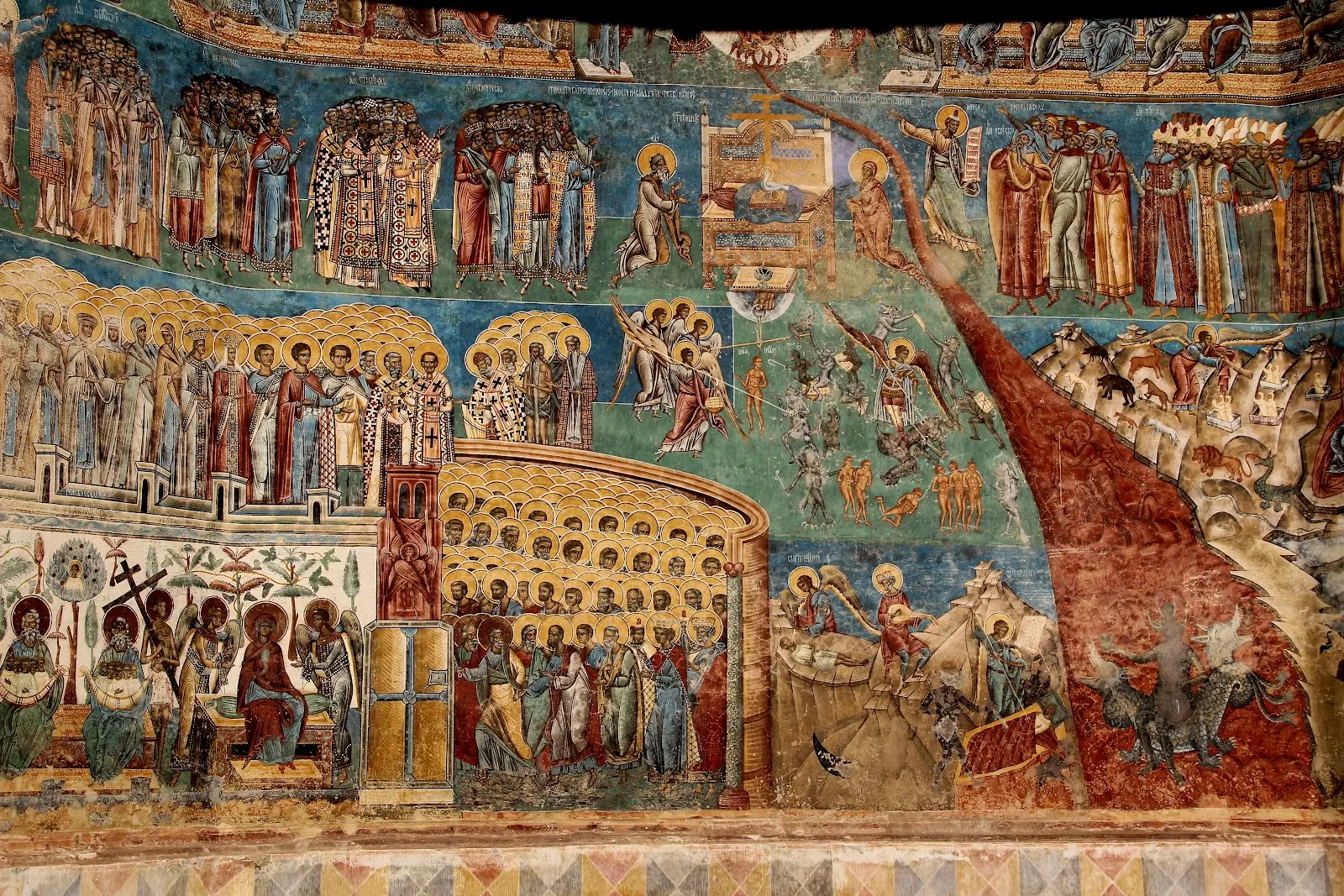
This is Bukovina's true treasure. In the 16th century, craftsmen covered the exterior walls of the churches with complete frescoes — the Last Judgment, the siege of Constantinople, hierarchies of saints — a painted Bible for those who could not read. That they survived five centuries of Carpathian winters is close to a miracle.
- Voroneț — nicknamed the "Sistine Chapel of the East." Its Last Judgment fresco and the famous Voroneț blue, a pigment so pure it has kept its color across the ages, make it unmatched.
- Sucevița — the most fortified, with its castle walls and the great scene of the "Ladder of Virtues."
- Moldovița — celebrated for the "Siege of Constantinople" painted on its southern facade.
- Humor — smaller, more intimate, in warm brick-red tones.
- Arbore — known for its rare green and the delicacy of its drawing.
Not all of them can be seen in a single unhurried day. Choose three or four and give them time; the frescoes reveal themselves slowly, as the eye adjusts to the detail.
The crafts
Bukovina is also one of the last regions where craft is practiced daily, not just for show.
- Painted eggs — decorated with wax and a fine nib, following geometric patterns inherited within families; some villages hold true dynasties of egg painters.
- The black pottery of Marginea — fired without oxygen in a buried kiln, which gives the clay its smoky color. It is one of the few centers in Europe where the technique survives.
The workshops welcome visitors and are worth slotting in between monasteries — they are exactly the pauses that connect the great monuments to the living life of the place.
Food and guesthouses
Bukovina's cooking is settled and generous: root-vegetable borș, wild-mushroom stew, home-cured meats, poale-n brâu cheese pastries, forest-fruit preserves. The rural guesthouses are the soul of the region's hospitality — family homesteads where you eat what the yard grows and sleep under heavy quilts. Choosing a guesthouse in a village instead of a city hotel changes the entire rhythm of the visit.
Getting around
A car makes the difference: the monasteries are scattered across villages and valleys, and public transport links them rarely and slowly. Suceava has an airport with domestic flights and a few international routes, plus a station on the main line north. From the city, a natural route links Voroneț and Humor to the west, then Moldovița and Sucevița over the Ciumârna pass, with Marginea and Arbore on the way back.
Practical notes
- When to come — May–June and September–October offer the best light for the frescoes and the quietest villages. Winter has its own charm, but the mountain roads demand care.
- How many days — two to three days are ideal: one for the city, one or two for the monastery loop.
- The monastery loop — Voroneț → Humor → Moldovița → Sucevița → Marginea → Arbore, with a night in a guesthouse midway, is the most balanced route.
Suceava rewards the traveler who does not rush. You come for the citadel and leave carrying the Voroneț blue in your mind — a color no one has ever managed to reproduce exactly.
Plan your trip
Stays nearby
Stays in Romania
Experiences
Tours & activities
Guided tours, day trips and hand-picked experiences via GetYourGuide — free cancellation on most.
See all experiencesGetting to Romania
Flights, transfer & car
Fly into Romania
Compare fares to Bucharest Otopeni (OTP) and regional airports — Cluj, Sibiu, Iași, Timișoara.
Airport transfer
Private, fixed-price door-to-door transfer — driver waiting from the moment you land.
Rent a car — see the real Romania
A rental car is the key to Romania: the Transfăgărășan, the painted monasteries of Bucovina, mountain roads and the villages of Maramureș that no train reaches.
Find a car