
Complete guide to Târgu Jiu
The city of the Constantin Brâncuși Monumental Ensemble, where the Table of Silence, the Gate of the Kiss and the Endless Column form a single route along Calea Eroilor. A complete guide to Târgu Jiu and the Gorj county around it, from Hobița and Tismana to the gateway of the Parâng mountains.
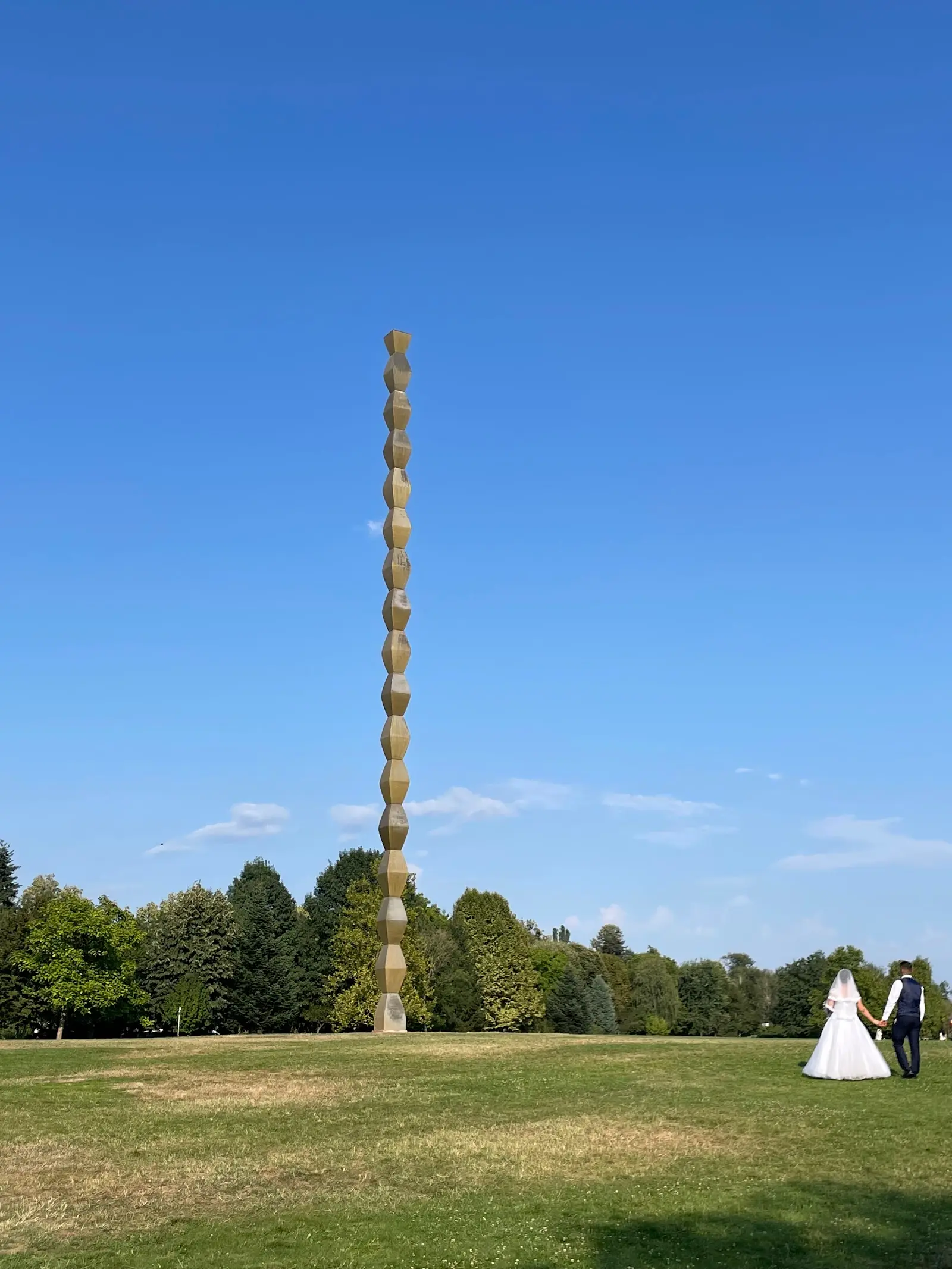
Târgu Jiu is the only city in Romania with an open-air museum in its very centre, signed by one of the twentieth century's most important sculptors. Brâncuși did not leave a single statue here; he left a whole route, walked on foot, from a stone table to a column that seems never to end. And around the city, Gorj county opens towards monasteries carved into rock, deep gorges and roads that climb into the mountains.
Why Târgu Jiu
The city on the Jiu is, above all, the city of the Constantin Brâncuși Monumental Ensemble, a group of works created in 1937–1938 as a tribute to the heroes who fell in the First World War. The sculptor, already famous in Paris, agreed to work for the town a few kilometres from his native village.
What makes the ensemble exceptional is not only the quality of each piece, but the fact that it reads as a single route, along Calea Eroilor, the Avenue of Heroes: the Table of Silence in the park on the bank of the Jiu, the Gate of the Kiss at the end of the alley, and then, across the city, the Endless Column, one of the key sculptures of modernism.
- It is a one or two day destination, compact enough to cover on foot.
- This is not a showcase town. It is a living provincial city of parks, a market and terraces, where modern art stands in the open, among people walking home.
- For the background of the commission, the materials and the thinking behind the route, read Brâncuși in Târgu Jiu.
Calea Eroilor, step by step
The best way to understand Târgu Jiu is to walk the axis Brâncuși designed, from the river towards the city. It is not a collection of sights but a single sentence written in stone.
- The Table of Silence sits in the Central Park, close to the Jiu: a stone disc surrounded by twelve round stools shaped like hourglasses. It is the starting point, the place where the monument speaks of gathering and of absence.
- The Alley of Chairs continues from the table, with rows of stone stools marking the way like the milestones of a procession.
- The Gate of the Kiss closes the alley: a massive travertine portal whose pillars carry the motif of the kiss, stylised down to its essence. You walk through it, not past it.
- Beyond the gate the axis crosses the city and reaches, a few minutes by car or a long walk away, the Endless Column in its own park, the purest form Brâncuși found for the idea of rising without end.
Walk the route in order, in one direction, ideally in the morning or towards evening, when low light brings out the texture of the stone and the rhythm of the column's modules.
The city beyond Brâncuși
The centre of Târgu Jiu is best seen on foot, around the Central Park and the pedestrian streets nearby.
- The Holy Voivodes Cathedral is the city's main religious building and a landmark on the skyline of the centre.
- The Church of the Holy Apostles Peter and Paul is one of the old churches of the town, with the modest, warm character of timber and masonry architecture in the Oltenia foothills.
- The Gorj County Museum Alexandru Ștefulescu gathers the history, archaeology and ethnography of the region. It is where the context of Brâncuși, the Gorj village and its woodcraft, becomes legible.
- The Central Park, with wide alleys and old trees, is part of the experience rather than its backdrop.
Târgu Jiu has always been a town of passage, between lowland Oltenia and the mountains, and that gave it a mixed character: low houses and inner courtyards beside mid-century blocks, a vegetable market a few streets from a travertine portal famous across the world. The food is the Oltenian cooking of the foothills, built on pork, beans, sheep cheese and plums, and the local plum brandy enjoys a respect it fully deserves.
A detailed list, with a recommended order and the stops worth making in the county, is in What to see in Târgu Jiu and Gorj.
Hobița, the sculptor's village
West of the city, towards Peștișani, lies Hobița, where Brâncuși was born. The Constantin Brâncuși Memorial House is a timber peasant homestead with a porch, carved posts and calm proportions, exactly the kind of architecture in which his later forms were first learned.
The visit makes most sense straight after Calea Eroilor: see the monument first, then the place it came from. The link between a carved porch post and the modules of the Column needs no further explanation.
Gorj county around it
The county is in fact the other half of the journey, and distances are short.
- Tismana Monastery, one of the oldest in Wallachia, is carved into the rock above a waterfall. The setting, with water falling below the walls and forest closing the valley, makes it one of the most memorable visits south of the Carpathians.
- The Sohodol Gorges are a narrow limestone defile with vertical walls, entered directly by the road. A place for walking, for climbing and for shade in high summer.
- Higher up, Gorj becomes the gateway to the Parâng mountains and to Rânca, the high-altitude resort on the Transalpina road. If you want to continue towards the ridge, with trails, winter sport and alpine roads, that territory is documented in detail on munte.online.
Practical information
- When to go: spring and autumn are ideal for the city and the gorges, with good light and mild temperatures. Summer is best for combining city and mountains, because the high roads are open. In winter the city remains easy to visit and Rânca comes into season.
- How many days: one day for Calea Eroilor and the centre, two if you add Hobița and Tismana, three if you also want the gorges or a day in the mountains.
- Getting there: Târgu Jiu is well connected by road with Craiova, Râmnicu Vâlcea and Deva, with the Transalpina and the Jiu valley linking it northwards. There are rail connections, but a car opens up the whole county.
- Getting around: the centre and the entire Brâncuși route are walkable. For Hobița, Tismana, Sohodol and Rânca you need a car.
- Where to stay: the options, from the centre to the guesthouses towards Tismana and the mountain bases, are in Where to stay in Târgu Jiu and Gorj.
What a well-made visit looks like
- Morning: the Table of Silence, the alley of chairs, the Gate of the Kiss, with low light and an empty park.
- Midday: the centre, the county museum, lunch in town.
- Afternoon: the Endless Column, ideally towards sunset, when the modules catch shadow.
- Second day: Hobița in the morning, Tismana at midday, the Sohodol Gorges towards evening.
Târgu Jiu does not sell itself loudly, and it does not need to. It has a city crossed by a line drawn by Brâncuși, and a county that climbs from waterfalls and gorges straight into the mountains.
Plan your trip
Stays nearby
Stays in Romania
Experiences
Tours & activities
Guided tours, day trips and hand-picked experiences via GetYourGuide — free cancellation on most.
See all experiencesGetting to Romania
Flights, transfer & car
Fly into Romania
Compare fares to Bucharest Otopeni (OTP) and regional airports — Cluj, Sibiu, Iași, Timișoara.
Airport transfer
Private, fixed-price door-to-door transfer — driver waiting from the moment you land.
Rent a car — see the real Romania
A rental car is the key to Romania: the Transfăgărășan, the painted monasteries of Bucovina, mountain roads and the villages of Maramureș that no train reaches.
Find a car











