In the Footsteps of Brâncuși at Târgu Jiu
The Endless Column, the Table of Silence, the Gate of the Kiss — the monumental ensemble through which one of the world's greatest sculptors honoured the fallen of his homeland.
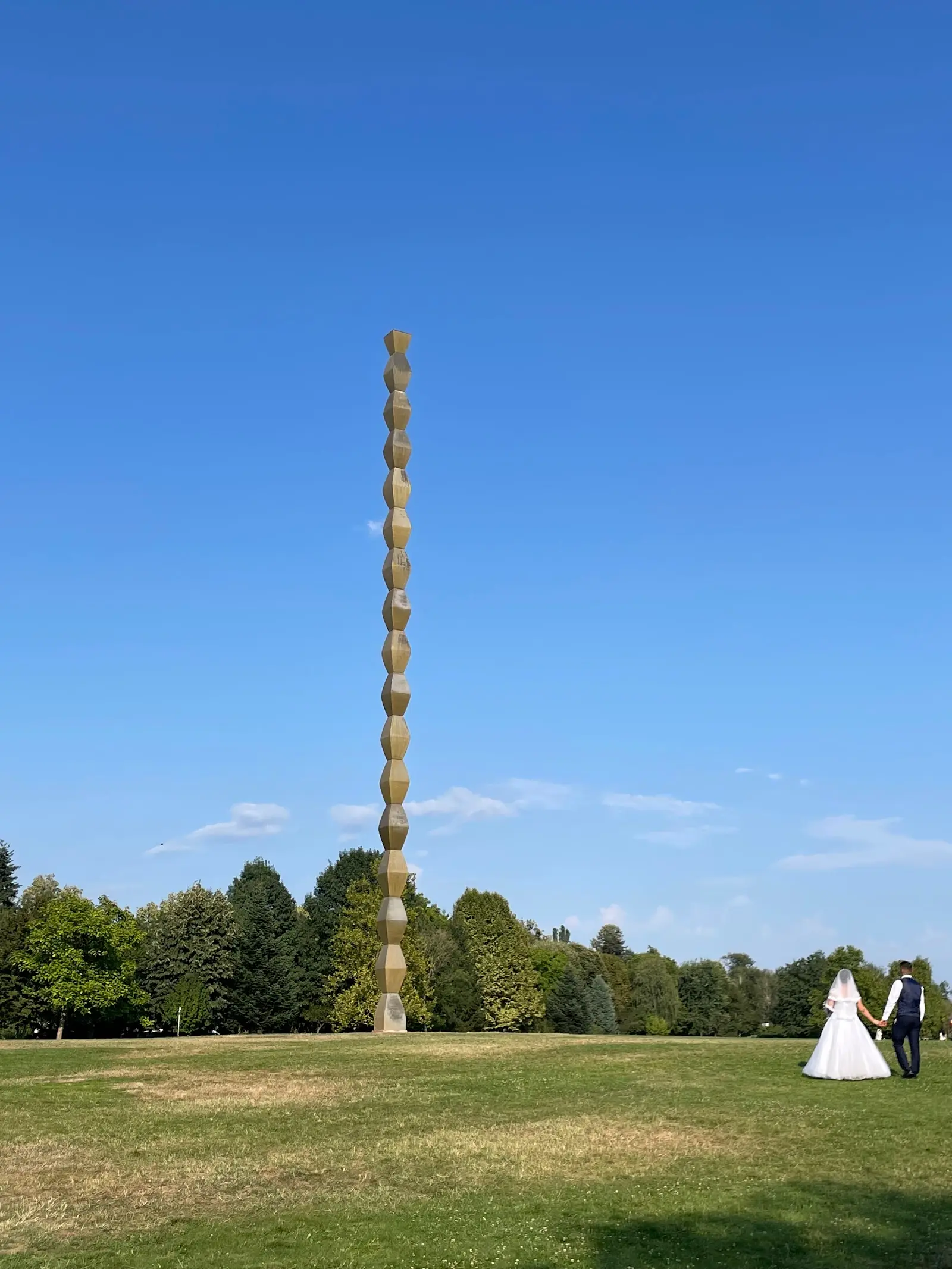
Constantin Brâncuși is regarded as one of the fathers of modern sculpture, an artist who reduced forms to their essence and changed the way the world sees sculpture. Born in Gorj, in the village of Hobița, Brâncuși left for Paris, where he became a central figure of the avant-garde. But at Târgu Jiu, in the town near his birthplace, he left his only monumental open-air ensemble — a tribute to the Romanian heroes fallen in the First World War.
One ensemble, a symbolic axis
The three main works are not scattered at random but placed along a symbolic axis running through the town, from the park beside the Jiu river to a church. Walking this axis, in the order the artist intended, turns the visit into an almost ritual experience, a passage from earth to sky.
The Table of Silence
The starting point, in the park by the river, is the Table of Silence — a round stone table surrounded by twelve hourglass-shaped seats. It is commonly interpreted as the soldiers' last meal before battle, but also the passing of time and communion. The simplicity of the forms conceals a meditative depth.
The Alley of Chairs and the Gate of the Kiss
From the table runs the Alley of Chairs, lined with stone seats, leading to the Gate of the Kiss. The gate, a massive travertine arch, is decorated with the stylised motif of the kiss — two halves merging, a recurring theme in Brâncuși's work. It is a gate of passage, of love and of life.
The Endless Column
The culmination, at the other end of the axis, is the Endless Column (the Column of the Infinite) — a tower of stacked rhombic metal modules that seems to rise towards the sky without ending. It is perhaps Brâncuși's most famous work and a remarkable technical achievement for its era. The column symbolises the infinite sacrifice of the heroes and the aspiration towards transcendence.
Heritage of universal value
The monumental ensemble at Târgu Jiu is recognised as a landmark work of modern art. It is considered a unique example of integrating abstract sculpture into an urban space with a commemorative function, and its value is recognised internationally.
How to visit
- On foot: walk the symbolic axis in order, from the Table of Silence, through the Gate of the Kiss, to the Endless Column. It is a pleasant stroll through the town.
- Combine with a visit to Hobița, the artist's native village, and the memorial house in the area.
- Nearby: the monasteries of Gorj and the sub-Carpathian region offer fine extensions of the route.
- Respect the place: the ensemble is both a work of art and a commemorative monument.
A language of essence
What makes Brâncuși's work so powerful is its reduction to essence. The sculptor said that simplicity is not a goal in art, but that one arrives at it despite oneself, in approaching the real meaning of things. At Târgu Jiu, this philosophy becomes a space to inhabit: you do not see figurative statues of heroes, but abstract forms — the table, the gate, the column — that carry a universal symbolic charge, understood beyond any language. It is modern art in its purest form, yet rooted in Romanian folk tradition, from the kiss motif to the rhythm of the column, which recalls the carved posts of peasant houses.
Why it matters today
The Târgu Jiu ensemble has been carefully restored in recent decades, and its value is increasingly recognised internationally. For a visitor, it offers a rare experience: the chance to touch, to walk around and to physically live with the works of one of the most important artists of the 20th century, in a public space, free of charge, in the open air. Few cities in the world have such a privilege.
To follow in Brâncuși's footsteps at Târgu Jiu is to understand how a world-class artist turned a nation's grief into forms of universal simplicity — a place where modern art and collective memory meet in the open air.
Plan your trip
Experiences
Tours & activities
Guided tours, day trips and hand-picked experiences via GetYourGuide — free cancellation on most.
See all experiencesGetting to Romania
Flights, transfer & car
Fly into Romania
Compare fares to Bucharest Otopeni (OTP) and regional airports — Cluj, Sibiu, Iași, Timișoara.
Airport transfer
Private, fixed-price door-to-door transfer — driver waiting from the moment you land.
Rent a car — see the real Romania
A rental car is the key to Romania: the Transfăgărășan, the painted monasteries of Bucovina, mountain roads and the villages of Maramureș that no train reaches.
Find a car