
What to see in Târgu Jiu and Gorj
From the Table of Silence and the Gate of the Kiss to the Endless Column, Brâncuși's ensemble is visited as a single route. Plus the city's museums and churches, Hobița, Tismana Monastery, the Sohodol Gorges and the road to the mountains.
Few Romanian cities can be visited as a single work of art. In Târgu Jiu the most important sights are not scattered: they form a route Brâncuși designed from one end to the other, and the rest of Gorj county gathers around it, with monasteries, gorges and timber villages.
The Constantin Brâncuși Monumental Ensemble
Created in 1937–1938 as a tribute to the heroes of the First World War, the ensemble is the main reason to come to Târgu Jiu. The key to the visit: these are not three separate sights but one route, set on an axis that crosses the city along Calea Eroilor, the Avenue of Heroes.
Walk it in order, from the river towards the town. For the story of the commission and the materials, see Brâncuși in Târgu Jiu.
The Table of Silence
The Table of Silence opens the route, in the Central Park near the bank of the Jiu. A massive stone disc surrounded by twelve round stools resembling hourglasses set one upon another.
- It is the quietest point of the ensemble and the hardest to photograph well. Try shooting from table level rather than from above.
- Early morning gives you the park almost to yourself.
The Alley of Chairs
Between the table and the gate, the alley is marked by rows of stone stools grouped in threes. This is no mere decoration: it sets the rhythm of the walk and turns it into a slow procession.
The Gate of the Kiss
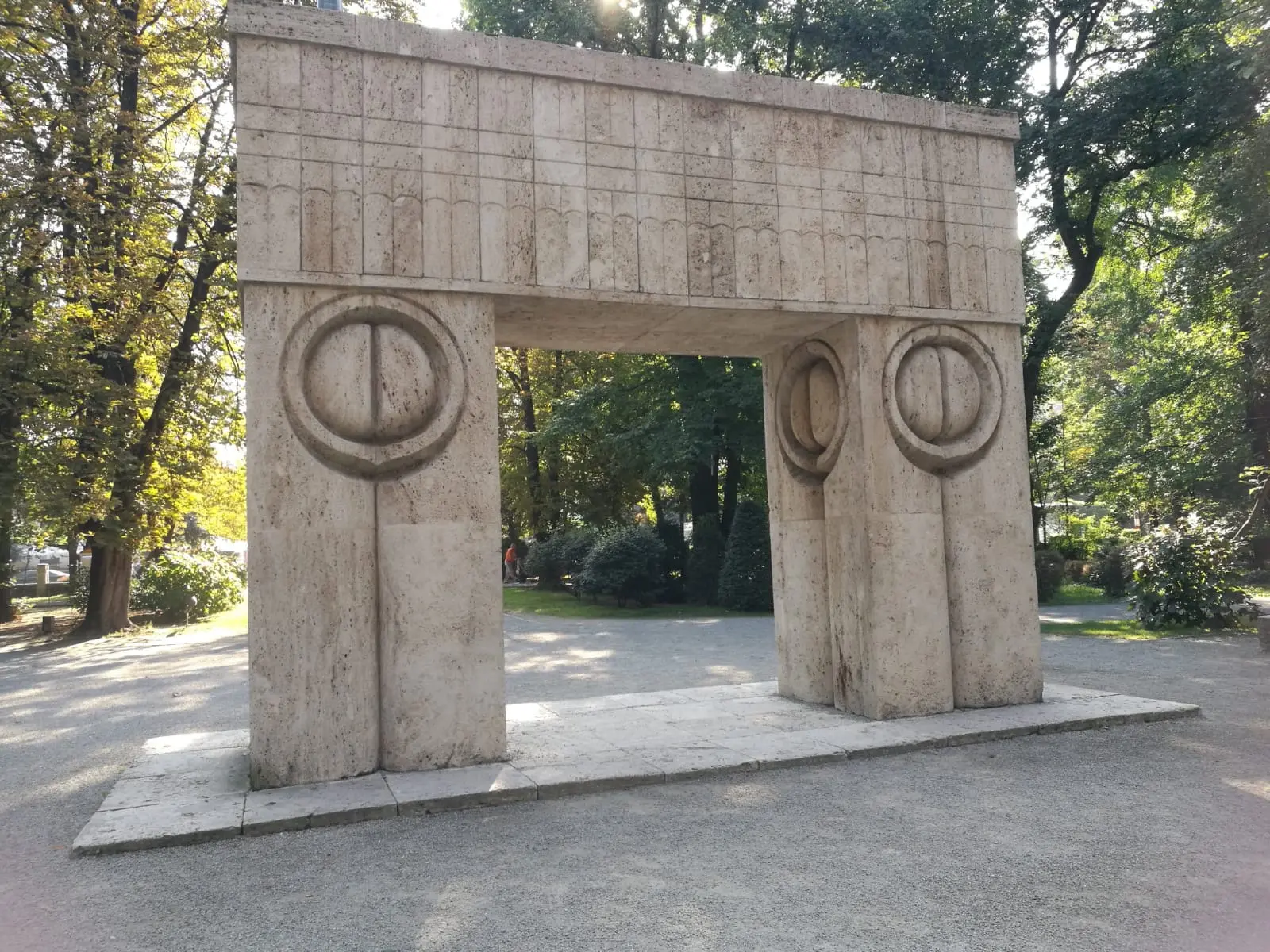
The Gate of the Kiss closes the alley at the entrance to the park: a massive travertine portal whose pillars reduce the motif of the kiss to two halves meeting.
- Walk through it, not past it. The gate was made to be crossed.
- Look at the detail on the pillars up close, then step back for the full volume.
The Endless Column
Beyond the gate the axis crosses the city and reaches the Endless Column, in the park that carries its name. A rhomboid module repeated vertically, cut at both ends to suggest a continuation beyond what is visible: one of the key sculptures of modernism.
- Come towards sunset, when low light brings every module into relief.
- It is a few minutes by car from the centre, or a long walk along the monument's axis, which is also the right way to approach it.
The city centre
After the Brâncuși route, the centre is an easy, unhurried walk.
- The Holy Voivodes Cathedral is the city's main religious building and a landmark on the skyline of the centre.
- The Church of the Holy Apostles Peter and Paul, one of the old churches of Târgu Jiu, has the modest, warm character of foothill architecture.
- The Gorj County Museum Alexandru Ștefulescu covers the archaeology, history and ethnography of the region. Visit it before Hobița: once you have seen the carved Gorj woodwork in the ethnographic collections, the sculptor's house reads differently.
- The Central Park is part of the monument, not just its setting. It deserves a full loop, with a pause on a bench facing the Jiu.
Hobița and the memorial house
West of the city, towards Peștișani, Hobița is the village where Brâncuși was born. The Constantin Brâncuși Memorial House is a timber homestead with a porch, carved posts and calm proportions.
- Visit it after Calea Eroilor. That order turns the visit from curiosity into explanation: the porch post and the module of the Column recognise one another.
- The village itself is worth a few minutes on foot, for the kind of timber architecture still standing in the area.
Tismana Monastery
Tismana Monastery is one of the oldest in Wallachia and probably the most spectacularly sited in Gorj: carved into the rock above a waterfall, in a valley closed by forest.
- The water falling below the walls does most of the work. You hear it before you see it.
- Allow time for the drive as well: the Tismana valley is among the finest in the county.
The Sohodol Gorges
The Sohodol Gorges are a narrow limestone defile with vertical walls, entered directly by the road running along the water.
- Perfect for a walk on the floor of the gorge, with guaranteed shade in high summer.
- A well-known climbing area, with routes on the limestone walls.
- Stop several times: the gorge changes completely at every bend.
Towards the mountains: Parâng and Rânca
Gorj is the gateway to the Parâng mountains and to Rânca, the high-altitude resort on the Transalpina road. From Târgu Jiu, half a day takes you out of the city straight into alpine scenery, with wide views across the ridges.
It is a natural extension of the visit if you have a car and at least one spare day. In summer you climb for the views and the ridge walks, in winter for snow and the slopes at Rânca. Check the state of the alpine roads before setting off: they are seasonal and close with snowfall.
Gorj in timber and stone
Between the big sights, the county deserves looking at for its own sake. Gorj is a succession of sub-Carpathian hills, plum orchards and long villages stretched along the valleys, with timber gates and porches.
- Timber architecture is the thread running through the region: carved posts, open porches, long roofs. It is the context Brâncuși came out of, and it is still visible in the villages between Târgu Jiu, Peștișani and Tismana.
- The landscape changes fast with altitude. In a single day you pass from fields and orchards to limestone gorges and, higher up, to alpine pasture.
- The side roads repay the detour. The Tismana and Sohodol valleys are beautiful in themselves, not merely the approach to a sight.
- Autumn is its season. The orchards and beech forests give the region the best colours of the year.
How to put it together
- One day: the Table of Silence in the morning, the alley and the Gate of the Kiss, the centre and the museum at midday, the Endless Column towards sunset.
- Two days: add Hobița in the morning and Tismana in the afternoon.
- Three days: add the Sohodol Gorges and a trip up to Rânca.
The full context of the city, with transport and seasons, is in the complete guide to Târgu Jiu, and the lodging areas, from the centre to the mountain guesthouses, in Where to stay in Târgu Jiu and Gorj.
Tips for the visit
- Light matters more than usual here. Brâncuși's stone lives on shadow: morning and evening are the good hours.
- Follow the axis, do not hop between sights. The ensemble is designed as a sequence, and the order is what gives it meaning.
- A car opens the county. The city is walkable, but Hobița, Tismana, Sohodol and Rânca need wheels.
- Allow time for the roads. Distances are short, but the hill roads ask for patience, especially towards the mountains.
Plan your trip
Stays nearby
Stays in Romania
Experiences
Tours & activities
Guided tours, day trips and hand-picked experiences via GetYourGuide — free cancellation on most.
See all experiencesGetting to Romania
Flights, transfer & car
Fly into Romania
Compare fares to Bucharest Otopeni (OTP) and regional airports — Cluj, Sibiu, Iași, Timișoara.
Airport transfer
Private, fixed-price door-to-door transfer — driver waiting from the moment you land.
Rent a car — see the real Romania
A rental car is the key to Romania: the Transfăgărășan, the painted monasteries of Bucovina, mountain roads and the villages of Maramureș that no train reaches.
Find a car











