
Complete guide to Sovata
The spa town in Mureș county, on the edge of the Székely Land, built around Lacul Ursu — the largest heliothermal lake in Europe. The phenomenon explained simply, the other salt lakes, the Praid salt mine, the pottery of Corund, and everything to know before you go.
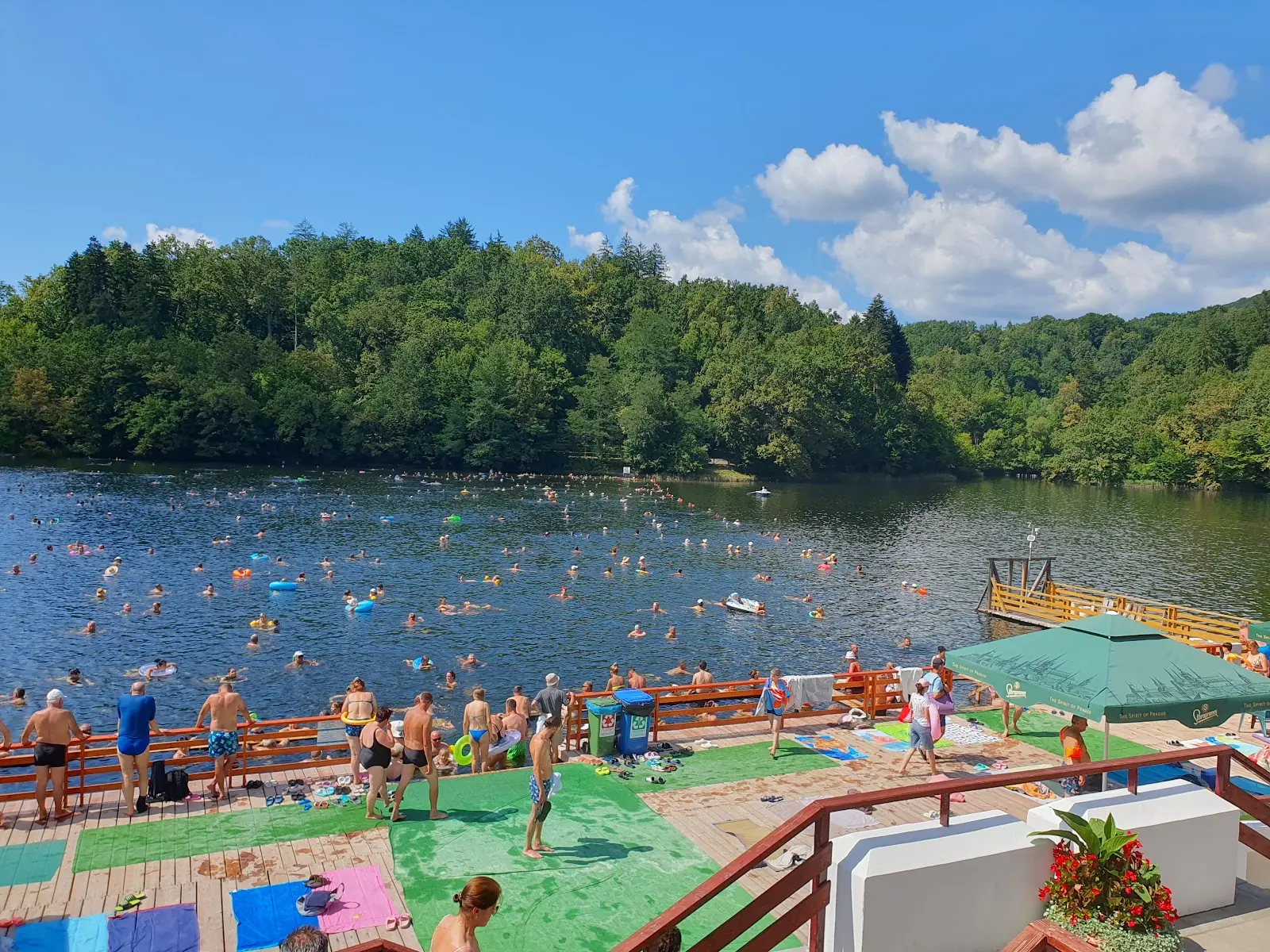
Sovata is one of the few resorts in Romania where the main attraction is not a building but a physical phenomenon. Lacul Ursu keeps its heat trapped in layers of salt water, and the town settled around it like an old-fashioned spa resort, with shaded paths, old villas and a slow rhythm. Everything else — a vast salt mine, smaller salt lakes, villages of potters — begins a short drive away.
Why Sovata is worth it
Sovata is a spa town in Mureș county, set on the edge of the Székely Land, where the hills of central Transylvania begin to climb towards the mountains in the east. Its reputation rests on one thing, but a thing that is rare across the whole continent: Lacul Ursu, the largest heliothermal lake in Europe.
It helps to know from the start what kind of place this is. Sovata is not a museum-town to tick off in two hours, with a main square and three churches. It is a resort in the old, interwar sense of the word: you come for a few days, you take treatment or simply walk the paths between the lakes, and in the evening not much happens — which is precisely the point.
Anyone who wants more is in luck: nearby sit one of the largest salt mines in Europe and the centre of Székely pottery, so Sovata also works very well as a base for exploring.
The heliothermal phenomenon, explained simply
In most lakes the warmest water is at the surface, because that is where the sun falls. At Lacul Ursu the opposite happens, and the reason is salt.
The lake formed through the collapse of a salt massif, so its water is a heavy brine. On top of that brine sits a thin layer of fresh water, brought by rain and springs, and the two barely mix: fresh water is far lighter and floats above like a transparent lid. Light passes through it, turns into heat in the salty layers below — and from there it has no way out.
The result is a heliothermal lake: the water at middle depth is far warmer than the water at the surface, a contrast your skin registers within seconds. The phenomenon is fragile by definition. Any strong mixing of the layers weakens it, and rebuilding the stratification takes time.
Which is why bathing in Lacul Ursu is seasonal and regulated, precisely in order to protect that layering. Do not assume the lake is open whenever you arrive and do not improvise — ask in advance, at the resort administration and at the treatment bases, about the period and the conditions under which you may enter the water.
The other lakes and the heart of the resort
Ursu is not alone. The resort also holds Lacul Negru, smaller and darker in colour because of its mud, along with other salt lakes scattered among beech and fir woods. Together they form a small saline system, with paths and alleys linking them — the most pleasant walk in town, best taken without a map and without hurry.
The organised side, with treatment bases, pools and procedures, is the cluster at Băile Sovata. This is where you see most clearly why the town exists: salt water, mud, a mild climate and more than a century of balneal tradition. The classic indications are rheumatic and gynaecological, and procedures are carried out under medical supervision — if you are coming for treatment, book early and speak to the base's balneology doctor.
Sovata is, in fact, a permanent fixture on the list of spa and balneal resorts in Romania — one of the few where the natural resource is genuinely unique rather than merely good.
The surroundings, briefly
A short drive east lies Praid — one of the largest salt mines in Europe, fitted out both for visiting and for treating respiratory conditions, with an enormous underground space reached by organised transport. Above it, at the surface, stands the Salt Mountain, a formation where salt breaks through to daylight, with gorges, salty springs and shapes carved by rain.
Nearby too is Corund, the centre of Székely pottery — whole villages of potters, with workshops and roadside stalls. The traditional motifs, blue and green on a white ground, are recognised across Transylvania.
All the sights, with context and a sensible order of visiting, are covered in the separate guide: what to see in Sovata and around.
When to go
- Summer — the classic resort season and the only time when bathing in the salt lakes is on the table at all. It is also the busiest.
- Autumn — the beech woods around turn colour, the air is clear, and balneal treatment works just as well. The best balance of quiet and weather.
- Winter — a calm resort, snow, salt mines and indoor pools. A surprisingly good option for a treatment stay.
- Spring — changeable, but uncrowded; good for walking and for Praid.
Getting there and getting around
Sovata sits on the road crossing the region from the Târnava Mică valley towards Praid and on into Harghita, so it is easy to reach by car from Târgu Mureș, Sighișoara, Brașov or Miercurea Ciuc. The nearest airport is Târgu Mureș, with Cluj and Sibiu as reasonable alternatives.
Inside the resort you manage on foot: the lakes, the alleys and the treatment bases are grouped together. For the surroundings — Praid, Corund, the Székely villages — a car is all but essential, because public transport covers the beautiful routes poorly. The roads are hill roads, winding rather than hard; in winter, fit good winter tyres.
Food, language and good manners
The cooking is Transylvanian with a Székely accent: sour soups, cabbage with meat, smoked meats, cheeses, pies and cakes baked over embers. Fruit pálinka tends to appear at the end of a meal almost automatically.
In the area you will hear both Hungarian and Romanian, and in the villages towards Praid and Corund Hungarian is the majority language. English turns up in hotels and guesthouses. A greeting in the local tongue is warmly received, and political arguments about identity are best sidestepped gracefully.
One last point of common sense: salt water is not a swimming pool. Do not wade in at random, do not dive, rinse off afterwards, and if you are on a treatment plan follow the medical advice. The lakes here are rare natural resources, not water-park attractions.
Where to sleep
The area beside Lacul Ursu is the most convenient, the town centre the most practical, and the guesthouses on the road towards Praid and Corund the quietest and cheapest. All the options, area by area, are in the dedicated guide: where to stay in Sovata.
Plan your trip
Stays nearby
Stays in Romania
Experiences
Tours & activities
Guided tours, day trips and hand-picked experiences via GetYourGuide — free cancellation on most.
See all experiencesGetting to Romania
Flights, transfer & car
Fly into Romania
Compare fares to Bucharest Otopeni (OTP) and regional airports — Cluj, Sibiu, Iași, Timișoara.
Airport transfer
Private, fixed-price door-to-door transfer — driver waiting from the moment you land.
Rent a car — see the real Romania
A rental car is the key to Romania: the Transfăgărășan, the painted monasteries of Bucovina, mountain roads and the villages of Maramureș that no train reaches.
Find a car











