Spa Romania: Thermal Resorts, Mineral Waters and Salt Mines
Few countries in Europe hold as many mineral springs, thermal waters, therapeutic muds and salt mines as Romania. From Băile Felix to Techirghiol and the Turda salt mine, here is the map of a spa tradition centuries in the making.
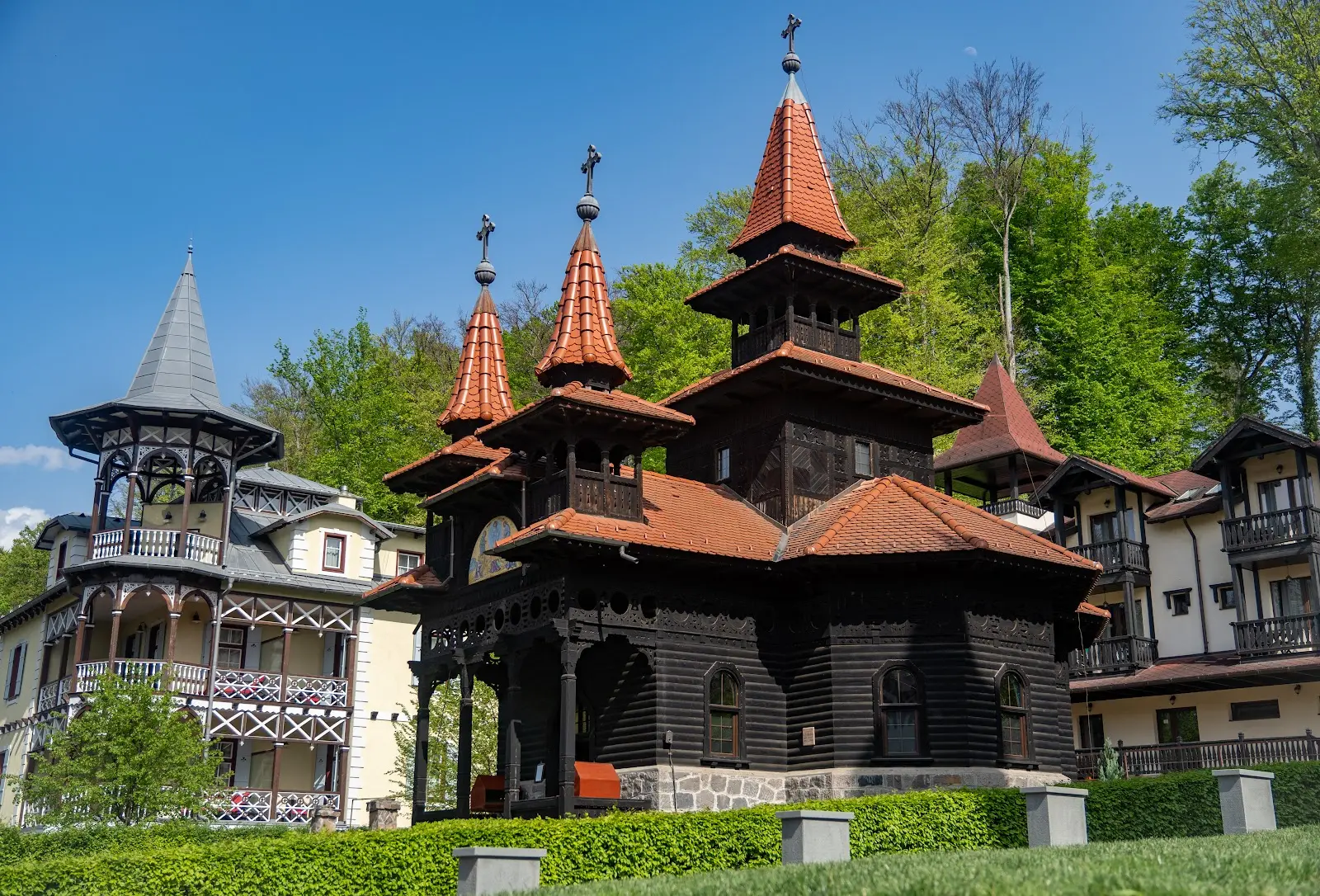
Romania is, quietly, one of Europe's great spa nations. Beneath its hills and mountains run thousands of mineral springs, thermal waters surface almost scalding, and salt lakes and mines have played a therapeutic role for generations. It is a heritage few travelers associate with the country, though it ranks among the richest on the continent.
Why Romania
The country is estimated to hold roughly a third of Europe's mineral and thermal springs, a density rarely matched anywhere. The reason lies in the complex geology of the Carpathians and its dormant volcanic zones: thermal waters, carbonated springs, sulphurous sources, sapropelic muds and immense salt deposits.
Unlike many modern wellness destinations, Romania has a genuine medical spa tradition, institutionalized since the 19th century. This is not merely about relaxation but about balneology as a recognized discipline, with procedures, physicians and structured treatments. Many resorts still operate as recovery centers, not simply as spas.
The landmark resorts
- Băile Felix and 1 Mai — near Oradea, the largest thermal complex in Romania. Its geothermal waters, rich in trace elements, flow year-round, and at 1 Mai lies a reserve for the thermal water lily Nymphaea lotus thermalis, a botanical rarity.
- Băile Herculane — one of the oldest spa towns in the world, with sulphurous waters used since Roman times, when it was called Ad Aquas Herculi Sacras. Today it preserves a faded Habsburg grandeur, imperial buildings awaiting restoration, and an unmistakable atmosphere in the Cerna gorge.
- Sovata — famous for Lake Ursu (Bear Lake), the largest heliothermal lake in Europe. Layers of fresh and salt water sit so that the depths trap the sun's heat, and the water can reach surprising temperatures in summer.
- Băile Tușnad — the smallest spa town in the country, tucked between mountains in the Székely Land, with mineral springs and mofettes (natural gas emanations) used for cardiovascular conditions.
- Covasna — nicknamed the resort of 1,000 mineral springs, a reference point for cardiology thanks to its carbonated waters and mofettes.
- Vatra Dornei — in Bukovina, at the foot of the mountains, it combines carbonated mineral waters with high-altitude air and peat mud in a splendid alpine setting.
- Techirghiol — on the seashore, celebrated for the black sapropelic mud of its lake, formed from organic deposits at the bottom of a hypersaline water, used extensively for rheumatic conditions.
- Slănic-Prahova and Slănic-Moldova — two distinct resorts tied to salt: the first with its salt mine and spectacular salt lakes, the second, in Moldova, with mineral springs renowned since the 19th century.
Salt-mine therapy
Beyond the waters, the Romanian underground offers a treatment all its own: speleotherapy in the old salt mines. The air deep inside them, low in allergens and rich in salt aerosols, is sought for respiratory health.
- Salina Turda — now one of Europe's most spectacular underground attractions, with vast galleries, a subterranean lake and modern facilities, yet medieval in origin.
- Salina Praid — one of the largest in Europe, with an extensive therapeutic sector deep below ground, visited above all for respiratory conditions.
- Salina Slănic — in Prahova, with imposing galleries and a stable microclimate, traditionally used for respiratory cures.
The constant microclimate, with balanced humidity and temperature, makes these mines sought out by people with asthma, bronchitis or allergies, as well as by visitors who simply descend for the unreal scenery.
Modern wellness
The spa tradition today coexists with contemporary wellness. Therme București, on the edge of the capital, is one of the largest thermal and leisure complexes in Europe: pools fed by geothermal water drawn from deep below, palm trees under glass domes, saunas and relaxation zones, open all year.
It is proof that Romanian balneology has not stayed a chapter of history but is reinventing itself for a new public seeking both recovery and indulgence.
What it helps and how to go
Romania's spa cures traditionally address a broad range of conditions: rheumatic and musculoskeletal, cardiovascular, respiratory, dermatological and recovery-related. Each resort has its own profile, depending on the type of water, mud or microclimate.
- Choose the resort by profile: Techirghiol and Sovata for mud and rheumatism, Covasna and Tușnad for the heart, the salt mines for the airways.
- Many resorts offer both medically supervised programs and wellness packages without a prescription.
- Season matters: thermal waters work year-round, but heliothermal lakes and mud are best used in summer.
- For specific conditions, speak with a doctor first — this guide describes a tradition and is not medical advice.
From the Roman ruins at Herculane to the glass domes at Therme, spa Romania is a journey through time and geology alike.
Plan your trip
Stays nearby
Stays in Romania
Experiences
Tours & activities
Guided tours, day trips and hand-picked experiences via GetYourGuide — free cancellation on most.
See all experiencesGetting to Romania
Flights, transfer & car
Fly into Romania
Compare fares to Bucharest Otopeni (OTP) and regional airports — Cluj, Sibiu, Iași, Timișoara.
Airport transfer
Private, fixed-price door-to-door transfer — driver waiting from the moment you land.
Rent a car — see the real Romania
A rental car is the key to Romania: the Transfăgărășan, the painted monasteries of Bucovina, mountain roads and the villages of Maramureș that no train reaches.
Find a car