
What to see in Sovata and around
Lacul Ursu and the salt lakes in the resort, the treatment bases of Sovata-Băi, the Praid salt mine and the Salt Mountain, the potters of Corund. The sights in the order that makes sense, with plans for one, two or three days.
Sovata has one sight that made it famous and a handful of others that fill your days. The good news is that everything is close: the lakes are in town, and the salt mine and the potters' villages take half a day. The less good news is that the short list is deceptive — this place asks for time, not sprinting.
Lacul Ursu, the phenomenon
Lacul Ursu is the reason Sovata exists on the tourist map of Europe. It formed through the collapse of a salt massif, it has the shape of a bear skin laid out flat — hence the name — and it is the largest heliothermal lake in Europe.
The phenomenon is worth understanding before you reach it. The water is a heavy brine, covered by a thin layer of fresh water brought by rain and springs. The two barely mix, light passes through the fresh water and turns into heat lower down, in the salty layers, from where it has no way out. That is how the water at middle depth ends up far warmer than the water at the surface.
To be clear, without hedging: bathing is seasonal and regulated, because any strong mixing of the layers weakens the phenomenon. Check in advance, with the resort administration and the treatment bases, when and under what conditions you may enter the water. Out of season the lake remains a fine walk along its arranged shore — and, honestly, it is as interesting to look at as it is to understand.
Lacul Negru and the other salt lakes
A few minutes' walk away lies Lacul Negru, smaller and darker in colour because of the mud on its bed. It has none of Ursu's fame, but it has quiet and the air of a forest pool, with firs coming down to the water.
The resort holds other salt lakes too, some of them very small, linked by alleys and paths among beech and fir. The walk from one lake to the next is in fact Sovata's best attraction — a couple of hours, no map needed, and suddenly you understand why the town looks the way it does.
Băile Sovata, the part that treats
The cluster at Băile Sovata is the working heart of the resort: treatment bases, pools, procedures with salt water and mud. The classic indications are rheumatic and gynaecological, and everything done here goes through consultation and medical supervision.
Even if you are not coming for treatment, it is worth a look: you can read the layers of history of a spa town very clearly — old villas, pavilions, recent buildings, all gathered around the same resource.
The Praid salt mine, the most spectacular sight around
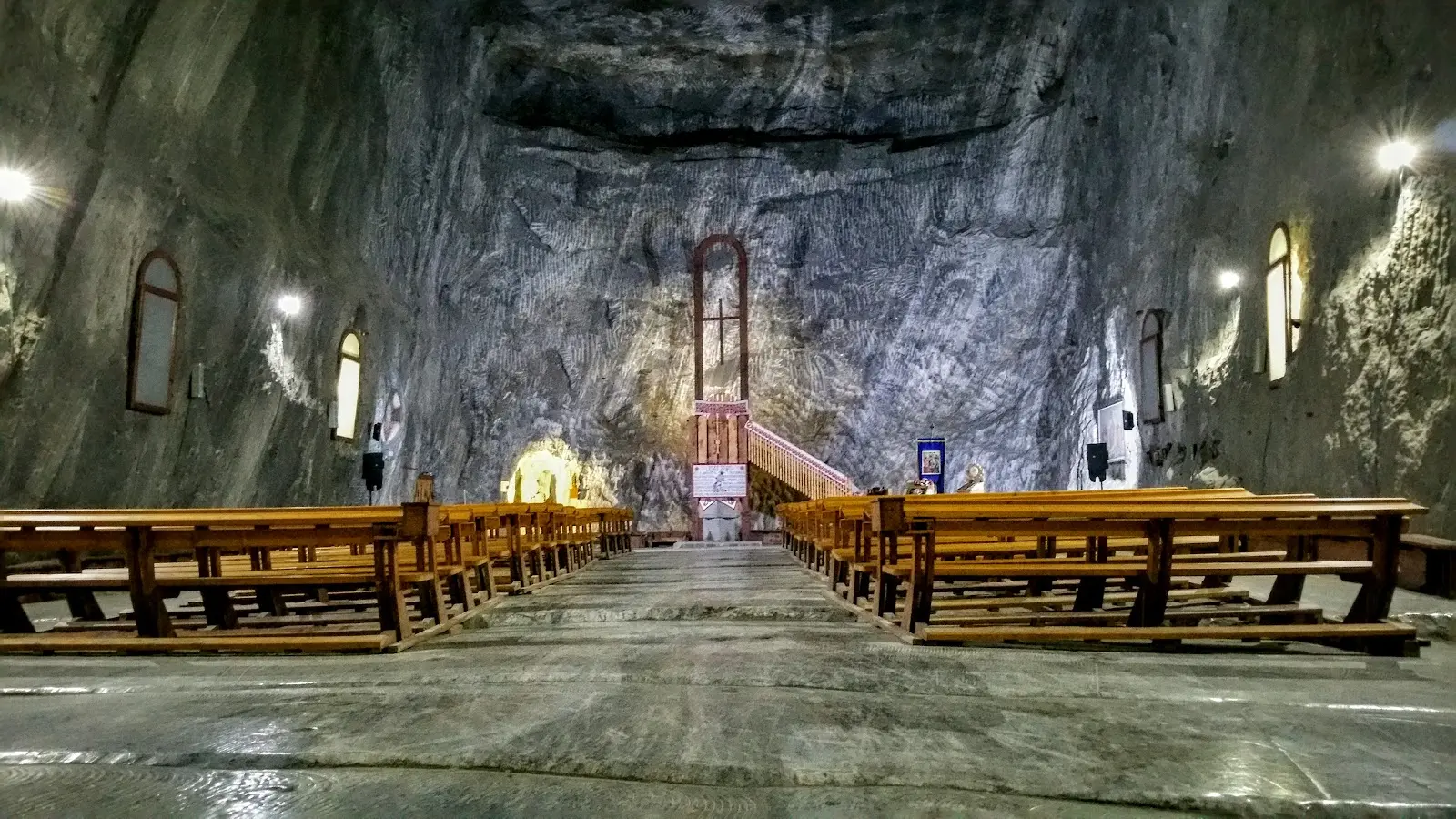
A short drive east, Salina Praid is one of the largest salt mines in Europe and probably the most impressive underground visit in Transylvania. The arranged space is enormous, you descend by organised transport, and the air down there is the main reason many people come: the mine is used for treating respiratory conditions, especially in children, and it is full of people settling in for hours with chairs, blankets and books.
A few practical, evergreen points:
- Bring warmer clothes. The underground is cool all year, whatever the weather above.
- This is not a twenty-minute visit. If you are going for the therapeutic effect, plan several hours.
- Check the schedule and the access arrangements before setting off. Underground transport and hours shift with the season.
- For children it is one of the safest rainy-day options in the whole area.
Praid naturally features in our guide to Romania's salt mines, alongside the country's other visitable salt workings.
The Salt Mountain, at the surface
Above the mine, where salt literally breaks through to daylight, stands the Salt Mountain. It is an unusual landscape for Romania: whitish walls, shapes carved by rain, salty springs and a small canyon cut into the salt by the water running over it.
You visit it along arranged paths, in a few dozen minutes, and it pairs perfectly with the mine: first the underground, then the surface, so you grasp how large the salt massif beneath your feet really is. Wear shoes with real grip, because wet salt is slippery.
Corund and Székely pottery
Also close by, Corund is the centre of Székely pottery — a village where potting is not nostalgia but an occupation: workshops, kilns, roadside stalls stretching for kilometres. The traditional motifs, blue and green on a white ground, are recognised across Transylvania.
Our advice: step into a workshop rather than stopping at the first stall. The difference between a piece made and painted on the spot and a mass-produced souvenir is obvious the moment you have seen both. For the full context, we have a guide to Romania's traditional crafts.
Ready-made itineraries
- One day — morning at Lacul Ursu and Lacul Negru, along the paths between the lakes; afternoon at the Praid salt mine.
- Two days — day 1 in the resort (the lakes, Băile Sovata, a walk in the woods); day 2 at Praid: the mine in the morning, the Salt Mountain at midday, Corund towards evening.
- Three days — add the Székely villages around, one of the region's arranged bathing spots and an unhurried drive over the hills towards Harghita with no particular objective.
What not to expect from Sovata
Sovata has no medieval citadel and no historic centre with a little square and terraces on every side. It has no nightlife. It has no large museums. Its attraction is natural, and the atmosphere is that of a treatment resort — quiet, green, slightly old-fashioned in places.
If you want architecture as well, plan a stop in Sighișoara or Târgu Mureș on the way. If you want exactly what Sovata offers — salt water, forest, salt-mine air and a slow rhythm — then it is one of the best choices in Transylvania.
For the full picture of the area, read our complete guide to Sovata, and for accommodation, where to stay in Sovata.
Plan your trip
Stays nearby
Stays in Romania
Experiences
Tours & activities
Guided tours, day trips and hand-picked experiences via GetYourGuide — free cancellation on most.
See all experiencesGetting to Romania
Flights, transfer & car
Fly into Romania
Compare fares to Bucharest Otopeni (OTP) and regional airports — Cluj, Sibiu, Iași, Timișoara.
Airport transfer
Private, fixed-price door-to-door transfer — driver waiting from the moment you land.
Rent a car — see the real Romania
A rental car is the key to Romania: the Transfăgărășan, the painted monasteries of Bucovina, mountain roads and the villages of Maramureș that no train reaches.
Find a car











