
Complete guide to Slănic Prahova
A small Prahova town with one huge attraction: the salt mine, holding one of Europe's largest underground mine chambers, plus the Salt Museum, Baia Baciului Lake and the Bride's Grotto. The day trip, explained honestly.
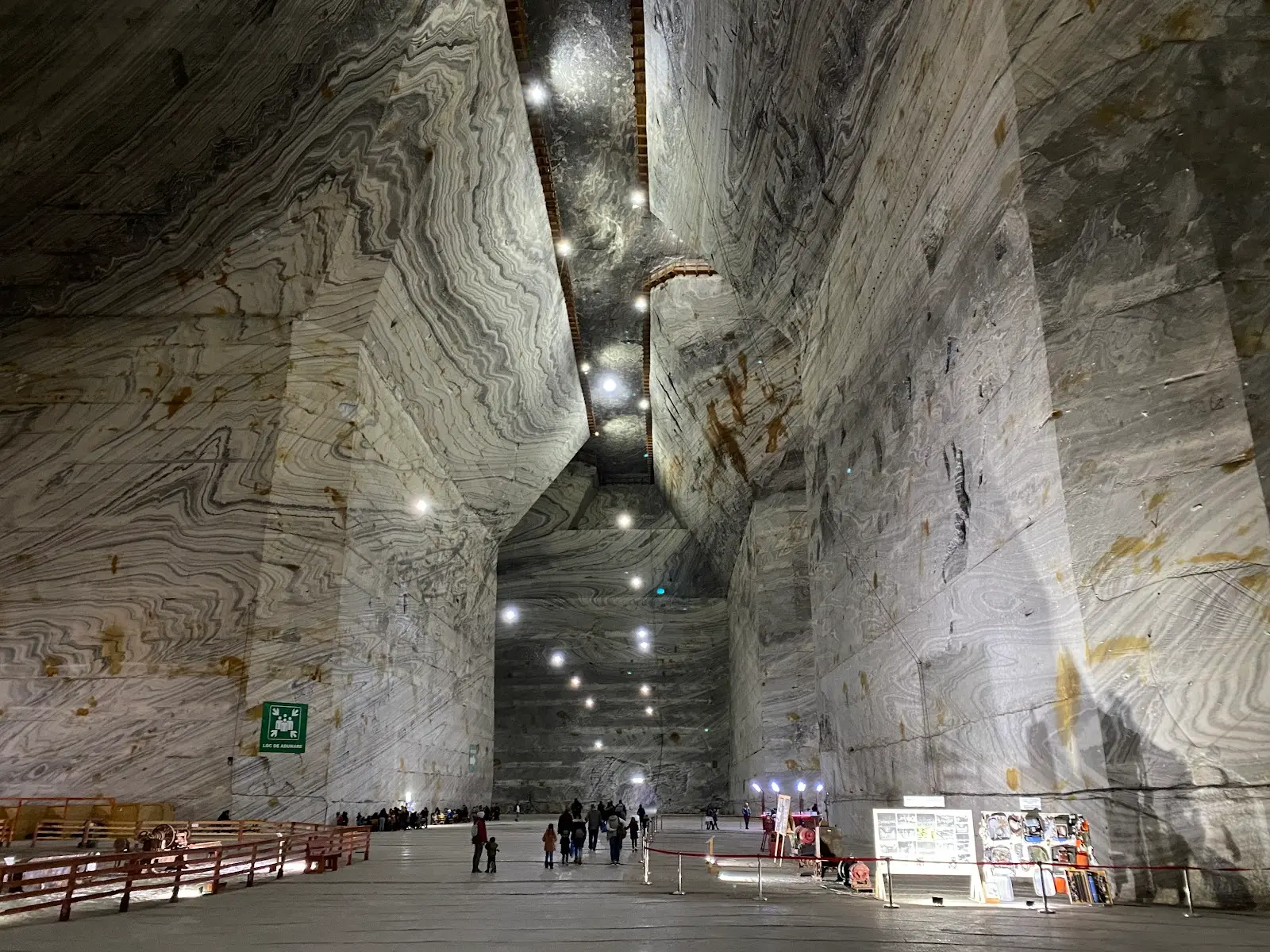
Slănic Prahova is a small town with one genuine attraction — but that one is among the most spectacular in Romania. Beneath the town lie mine chambers on a scale that is impossible to guess from the surface, and a few minutes' walk away there are salt lakes and an odd geological curiosity. It is a classic day trip from Bucharest or from the Prahova Valley — and that is about it, which for one day is exactly enough.
Why come to Slănic Prahova
Let's be direct: you don't come to Slănic for the town. You come for what is underground. Slănic is a small place in Prahova county that grew up around salt mining, and the legacy of that industry is the only serious reason to make the drive:
- Slănic Salt Mine, with one of the largest underground mine chambers in Europe, laid out for visitors.
- The Salt Museum, which explains why and how the digging happened here.
- Baia Baciului Lake and the Bride's Grotto, on the surface, minutes from the centre.
The town itself is modest — a few streets, shops, seasonal terraces. If you arrive expecting a historic centre or a spa resort with a promenade, you will be disappointed. If you come for the mine, you leave impressed. Worth saying plainly, so you plan the day properly.
Slănic Salt Mine — the attraction that justifies the trip
Slănic Salt Mine is, quite simply, unlike anything you have seen. Salt extraction left behind enormous underground halls with streaked white-grey walls and ceilings so high that the people below look like miniatures. One of these chambers is considered among the largest underground mining spaces in Europe, and the effect on a visitor is closer to a cathedral than to a mine.
The space is set up for visiting: walkways, play areas for children, sculptures carved into the salt, places to sit. The descent is organised, using the transport the mine administration provides.
The second reason people come down here is the air. The saline atmosphere, with humidity and temperature almost constant year-round, is used in the treatment of respiratory conditions, and many visitors spend a few hours simply breathing and walking.
Two practical, evergreen notes:
- Dress warm. It is consistently cool down there, no matter how hot the surface is in summer. A thin jacket won't carry you through a few hours.
- Check opening arrangements before you drive out. Hours and access conditions change with the season and with work inside the mine.
The Salt Museum
Back on the surface, the Salt Museum fills in the context. It is a small museum, but a useful one: it covers the geology of the area, extraction techniques, tools, maps of the old workings, and the life of the community that formed around the mine.
The visit is short. If you have children full of questions after the descent, this is where they get answers.
On the surface: Baia Baciului and the Bride's Grotto
A few minutes from the centre lies Baia Baciului Lake, a salt lake formed where old salt workings collapsed. The water is strongly saline, and in summer the area works as an open-air bathing spot with simple facilities.
Right next to it is the Bride's Grotto, one of the local curiosities: a cavity opened in the salt massif, again the result of an old working caving in. It isn't a cave in the classic sense and doesn't take long to see, but it is the kind of stop that makes sense if you are already there.
Getting there and what to combine it with
Slănic sits north of Ploiești, on a secondary road climbing into the Subcarpathian hills. From Bucharest it is an easy morning's drive; from the Prahova Valley the route goes through Ploiești or along the hill roads between the two areas.
Because the mine takes a few hours and the rest of the town very little, it works best combined:
- with a stop in Câmpina, half an hour away, for its museums and memorial houses;
- or continuing on to Sinaia, if you want to finish the day in the Prahova Valley.
If you like the format and want to see the other mines open to visitors, they are all gathered in our guide to Romania's salt mines — each has a different atmosphere.
When to go
The mine works the same all year — the underground temperature and humidity ignore the seasons. That makes Slănic one of the few Romanian trips that works equally well in January and in August.
The differences are on the surface:
- In summer you can pair the mine with a swim in Baia Baciului Lake, but weekends are busy. Come in the morning.
- Spring and autumn are the quietest and best for photography, with the surrounding hills in colour.
- In winter the underground attraction is untouched, and the road is usually trouble-free.
Weekends and school holidays bring the most groups, coaches included. If you can choose, go on a weekday.
What not to expect
- It isn't a resort. Accommodation and restaurant options are limited; most visitors come and leave the same day.
- It isn't a full weekend destination, unless you are following a treatment or pairing it with the Prahova Valley.
- It isn't a town for strolling. The beauty here is underground, not on the streets.
With the right expectations, Slănic Prahova is one of the best day trips in southern Romania: little driving, a lot of impact.
Plan your trip
Stays nearby
Stays in Romania
Experiences
Tours & activities
Guided tours, day trips and hand-picked experiences via GetYourGuide — free cancellation on most.
See all experiencesGetting to Romania
Flights, transfer & car
Fly into Romania
Compare fares to Bucharest Otopeni (OTP) and regional airports — Cluj, Sibiu, Iași, Timișoara.
Airport transfer
Private, fixed-price door-to-door transfer — driver waiting from the moment you land.
Rent a car — see the real Romania
A rental car is the key to Romania: the Transfăgărășan, the painted monasteries of Bucovina, mountain roads and the villages of Maramureș that no train reaches.
Find a car











