
Complete guide to Sinaia
The Pearl of the Carpathians, two hours by train from Bucharest: Peleș Castle and Pelișor, Sinaia Monastery, the Casino in the park and the Bucegi plateau twenty minutes away by cable car — plus how to get there, when to go and a one or two-day plan.
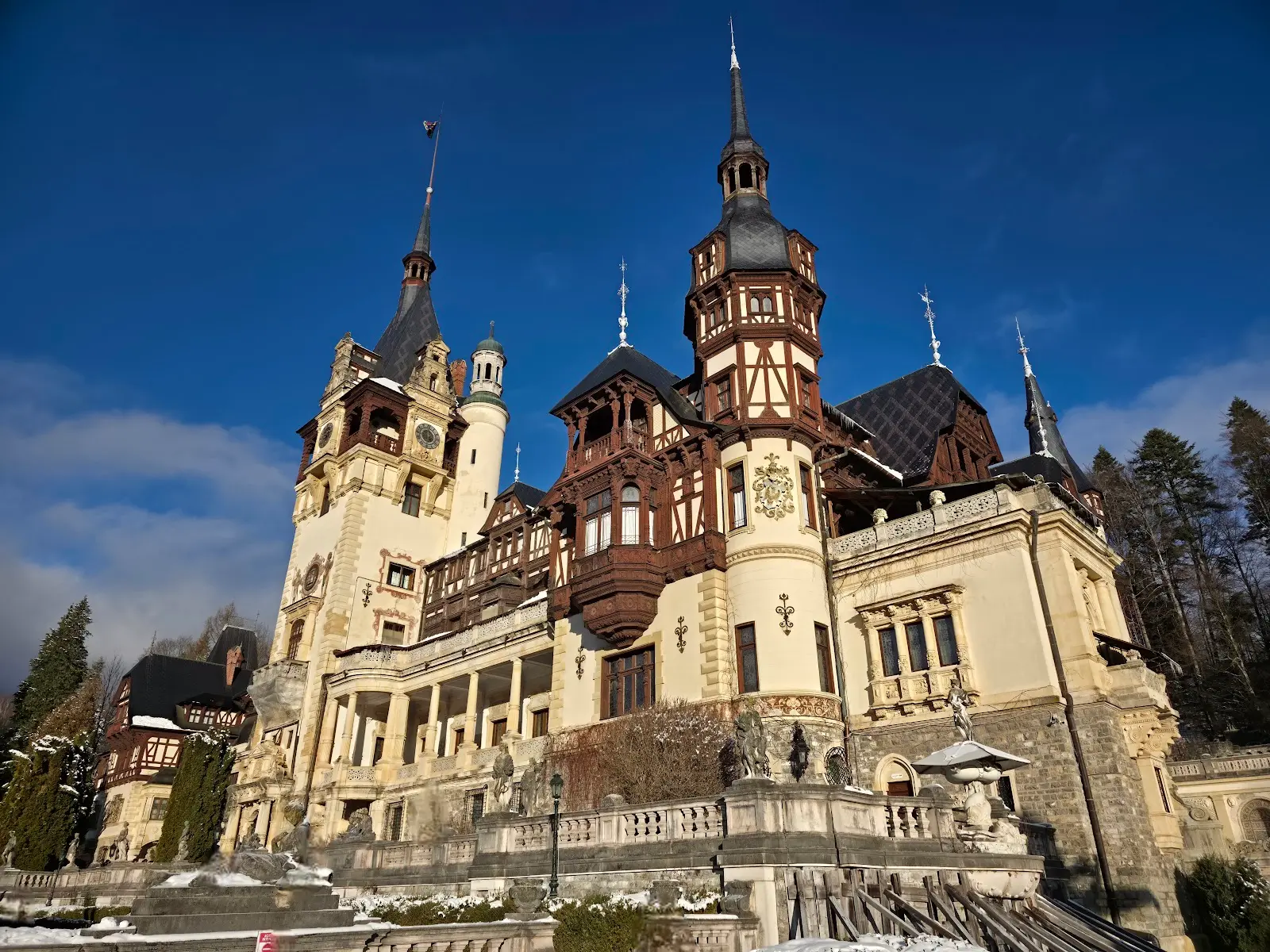
Sinaia is the easiest answer to "I want the mountains, but not a long drive". You board a train in Bucharest and, roughly two hours later, step out at the foot of the Bucegi range, in a town where a royal castle, an old monastery and a Belle Époque casino sit minutes apart. And right above the rooftops, the mountain simply begins.
Where you actually are
Sinaia stretches along the Prahova Valley, at the foot of the Bucegi Mountains, on a slope that climbs steeply from the railway station towards the forest. Nicknamed the Pearl of the Carpathians, the resort grew around its monastery and later became the summer residence of the Romanian royal family — and it shows: nineteenth-century villas, a park with broad avenues, and architecture far grander than a mountain town of this size would normally have.
The most useful way to picture Sinaia is as a town on two levels:
- The lower level — the station, the main boulevard, the park, the Casino, the restaurants and most of the accommodation.
- The upper level — Sinaia Monastery, Peleș Castle, the cable car station, the ski slopes and, beyond them, the alpine plateau.
On a map the two are only a few hundred metres apart, but the difference in altitude is real. Don't underestimate the gradient: every road to the main sights goes uphill.
Peleș Castle, the reason most people come
Peleș Castle is, deservedly, the star of the town. Built as the summer residence of King Carol I, it is a Neo-Renaissance masterpiece: sharp towers, carved wood, stained glass, an armoury and a sequence of interiors that travel through half of Europe stylistically, from German Gothic to Moorish. This is not a restored medieval fortress but a building conceived from scratch as the manifesto of a young monarchy — and that intent shows in every detail.
A short walk away, Pelișor is the other side of the same story: smaller, more intimate, Art Nouveau in spirit, designed for the crown prince's family. Many visitors skip it for lack of time, which is a mistake — for some, it is the more moving half of the visit.
Important: opening times, closing days and the available tour circuits at Peleș change through the year. Check the current schedule before you travel, and expect queues on peak weekends. Visits are guided, run in timed circuits, and places are limited.
Sinaia Monastery and the Casino
Sinaia Monastery is where everything started — the town takes its name from it. The complex holds two churches and a quiet courtyard, and because it sits on the road up to Peleș, it is an almost automatic stop. Remember that it is a working monastery rather than just a sight: dress modestly and keep the noise down.
In the central park stands the Casino, a Belle Époque building from the years when Sinaia wanted to be a small Carpathian Monte Carlo. Today it works as an events and exhibition venue, but even seen from outside, together with the park and the surrounding villas, it tells you everything about the resort's golden age.
The mountain side: cable car, Cota 1400 and the plateau
This is where Sinaia proves its real worth. The cable car climbs in two stages: first to Cota 1400, the hub of slopes and chalets, then on to Cota 2000, which delivers you straight into the alpine zone of the Bucegi. The landscape changes completely in twenty minutes: from conifer forest to bare ridge, with the whole Prahova Valley below you.
From up there run the classic routes to Babele, the Sphinx and, for the fit and well-equipped, Mount Omu. These are genuine mountain walks, not strolls: they require boots, water, layers and a serious look at the forecast, because weather on the plateau turns fast. For detailed routes, timings and ridge conditions, our dedicated mountain portal, munte.online, is the place to look.
In winter the same infrastructure becomes a ski area: pistes at Cota 1400 and above, with one of the longer seasons in the Carpathians thanks to the altitude.
Waterfalls and easy walks
If you want forest rather than ridge, Sinaia has gentler options. Urlătoarea Waterfall is the best known — reached by a short, popular trail from the Bușteni side, ideal for half a day. Around the town there are also marked paths through the woods above Peleș, good for an hour or two of undemanding walking with proper mountain air.
Getting there and getting around
- By train — the recommended option. The Prahova Valley line links Bucharest to Sinaia directly, and the station is in town, minutes from the centre. On weekends it spares you the DN1 traffic, which can be grim.
- By car — DN1 is the main road. Scenic, but busy on Friday evenings and Sunday afternoons. Parking near Peleș fills early.
- On foot, in town — most central sights are walkable, but the climb to Peleș is relentless. If you'd rather not, there is local transport and there are taxis.
- The cable car — the fastest way from town to mountain. Check the timetable and the wind: strong gusts can shut it down.
When to come: summer versus winter
Summer (June to September) is plateau season: long days, open trails and mild temperatures in a town that sits high anyway. It is also when Peleș sees the most coach groups.
Winter (December to March) is ski season and resort-atmosphere season — the town is beautiful under snow and Cota 1400 becomes its centre of gravity. In exchange, the waterfall trails and the plateau stop being casual outings.
May and October are the most underrated: fewer people, better rates, spectacular forest in autumn. The trade-off is unsettled weather and the chance that high routes are still, or already, under snow.
Food
Sinaia cooks in two registers: classic mountain fare — sour soups, smoked meats, tochitură, bulz, pies — and a smarter line of restaurants in restored villas, reinterpreting Romanian dishes. Up at Cota 1400 and on the slopes, food is simple and functional. In the centre, a booking is no luxury on busy weekends, especially for dinner.
A one or two-day plan
One day: Peleș and Pelișor in the morning, early, ahead of the groups; a stop at Sinaia Monastery on the way back down; lunch in the centre; an afternoon through the park and past the Casino; then the cable car up to Cota 1400 for sunset.
Two days: day one as above, without rushing. Day two belongs to the mountain — cable car up early, then either a plateau route towards Babele and the Sphinx, or the gentle version: Urlătoarea Waterfall and a slow afternoon.
Practical basics
- This is a mountain town: even in August, evenings are cold. Bring a jacket.
- City shoes do not work here. Minimum: trainers with real grip; for the plateau, boots.
- A little cash is useful for parking, small terraces and entrance fees.
- Weekends and public holidays change the experience entirely. If you can come midweek, come midweek.
- Phone signal drops out in places on the plateau — download the map offline.
In short
- Come for: Peleș and Pelișor, the Bucegi plateau twenty minutes away by cable car, and the air of a royal resort.
- Getting there: direct train from Bucharest, about two hours.
- Book ahead: weekend accommodation and dinner in the centre.
- Check first: the current Peleș Castle schedule, the cable car timetable and the ridge forecast.
- Don't skip: the cable car ride, even if you aren't hiking.
- Read next: What to see in Sinaia and Where to stay in Sinaia.
Plan your trip
Stays nearby
Stays in Romania
Experiences
Tours & activities
Guided tours, day trips and hand-picked experiences via GetYourGuide — free cancellation on most.
See all experiencesGetting to Romania
Flights, transfer & car
Fly into Romania
Compare fares to Bucharest Otopeni (OTP) and regional airports — Cluj, Sibiu, Iași, Timișoara.
Airport transfer
Private, fixed-price door-to-door transfer — driver waiting from the moment you land.
Rent a car — see the real Romania
A rental car is the key to Romania: the Transfăgărășan, the painted monasteries of Bucovina, mountain roads and the villages of Maramureș that no train reaches.
Find a car












