
What to see in Sinaia: attractions & experiences
Peleș Castle and Pelișor, Sinaia Monastery, the Casino in the park, the cable car to Cota 2000 and the Bucegi plateau with Babele and the Sphinx, plus the Urlătoarea and 7 Izvoare waterfalls — the sights worth your time, with themed shortlists.
Few towns in Romania manage to put a royal castle, a seventeenth-century monastery, a Belle Époque casino and an alpine plateau within minutes of each other. Sinaia does — which is why you can come for the architecture, for the hiking, or for both without choosing. Here are the sights and experiences worth your time, from the town centre to above the clouds.
Peleș Castle
Peleș Castle is what brings most visitors up the Prahova Valley. Built as the summer residence of King Carol I, it is a Neo-Renaissance masterpiece in which every room was conceived as a statement: carved wood down to the last centimetre, stained glass, a remarkable armoury, a hall of honour panelled in walnut, and a sequence of interiors that travels through Europe's styles.
Visits are guided, run in circuits, and places are limited. Opening times, closing days and the available circuits change through the year — check the current schedule before you build your day around it. Go as early as you can: in season, waits after midday can be long.
- The exterior and the terraces deserve an extra half hour, even if you don't go inside.
- The walk up from the road passes a lane of souvenir stalls; allow time for that too.
Pelișor Castle
A short walk away, Pelișor is the other side of the same royal story: smaller, lighter, Art Nouveau in spirit, built for the crown prince's family. Where Peleș impresses, Pelișor feels lived in — the rooms are on a human scale and carry a personal note the big castle lacks. It is the sight most often skipped by rushed visitors and, for many, the better half of the day.
Sinaia Monastery
Sinaia Monastery is where the whole town began — Sinaia takes its name from it. The complex holds two churches and a quiet courtyard, with painting and religious objects that reward a slow look. Because it sits on the road between the centre and Peleș, it gets visited almost automatically.
Bear in mind it is a working monastery: dress modestly, keep your voice down, and don't photograph interiors without permission.
The Casino and the central park
Sinaia Casino is the building that best explains the resort's ambition in the early twentieth century, when Sinaia wanted to be a Carpathian Monte Carlo. Today it serves as an events and exhibition venue, but that Belle Époque silhouette in the middle of the park remains one of the most photographed sights in town.
The park around it deserves a walk of its own: broad avenues, nineteenth-century villas, benches with a mountain view. It is the ideal pause between two sights.
The cable car, Cota 1400 and Cota 2000
The best experience in Sinaia isn't a building, it's an ascent. The cable car leaves town and climbs in two stages: first to Cota 1400, the hub of chalets and ski slopes, then to Cota 2000, where you step straight into the alpine zone of the Bucegi.
The change of landscape is abrupt in the best way: in twenty minutes you go from conifer forest to bare ridge, with the whole Prahova Valley below. It is worth doing even if you have no intention of hiking a single step — take a jacket, because it is always a few degrees colder up there, and windy.
Check the cable car timetable and the forecast: strong wind can shut it down.
The Bucegi plateau: Babele and the Sphinx
From Cota 2000 run the trails to the best-known rock formations in the Carpathians. Babele is a cluster of rocks sculpted by wind and frost that has become the emblem of the plateau, and a short distance away stands the Bucegi Sphinx, the stone profile that, from the right angle in the right light, really does look like a human face.
For the fit and well-equipped, the plateau continues towards Mount Omu, the highest point of the massif — a long, serious outing to reserve for a full day and settled weather.
- These are mountain routes, not strolls: boots, water, layers, offline map.
- Weather on the plateau turns within minutes. For routes, timings and ridge conditions, our mountain portal munte.online is the right source.
- The last cable car down has a fixed time — note it before you set off.
Urlătoarea Waterfall
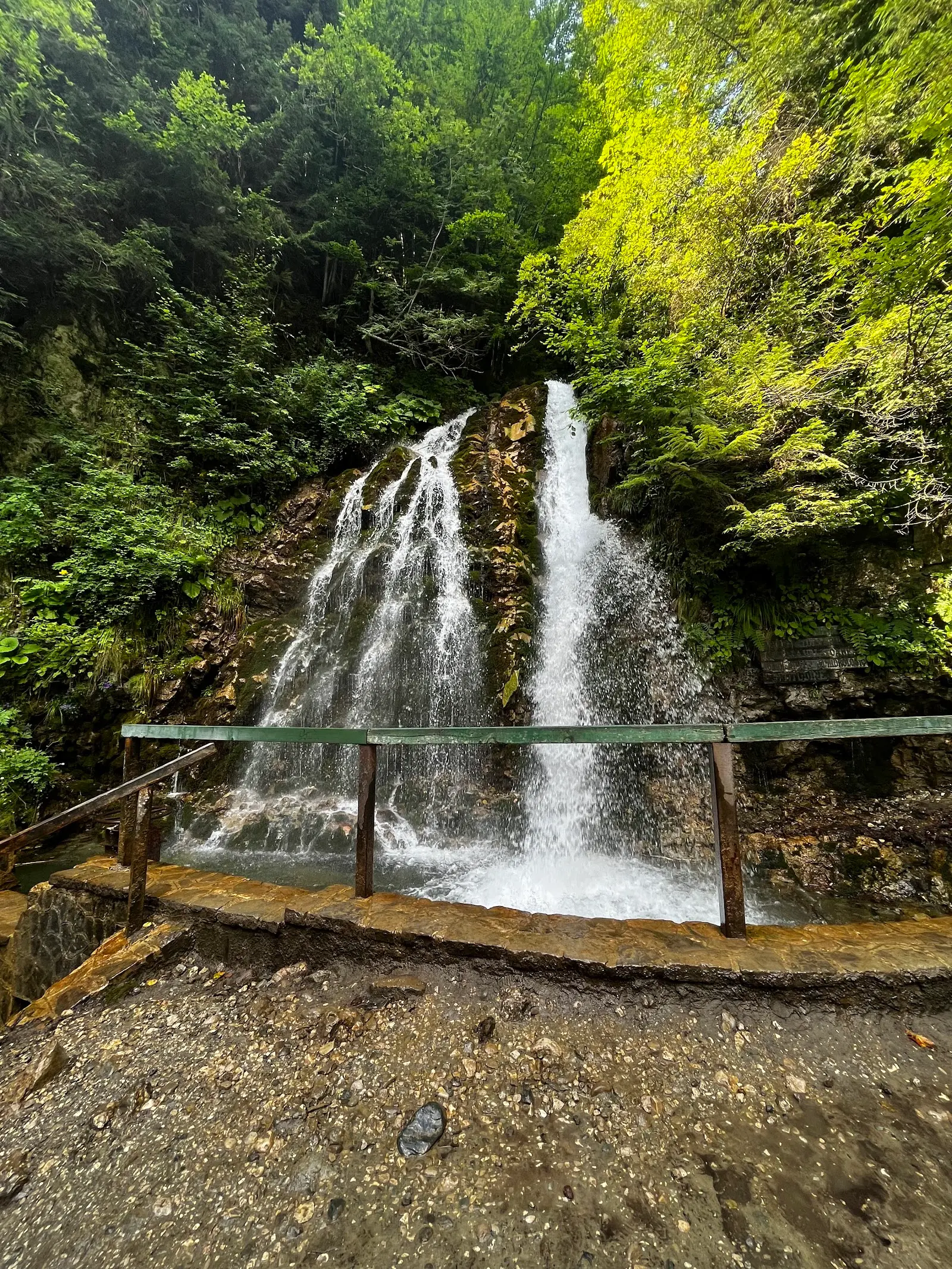
Urlătoarea Waterfall is the area's best-known waterfall and the easiest to tick off: a short, well-trodden forest trail from the Bușteni side, on gentle gradients. Perfect for half a day, for families, and for days when you don't want altitude. It looks most spectacular in spring and after rain.
7 Izvoare Waterfall
7 Izvoare Waterfall is the quieter, less crowded alternative, set among forest and the springs that feed the area. Getting there takes longer and the path is less developed than at Urlătoarea, so it suits anyone who wants fewer people and is willing to walk for it.
Skiing and winter experiences
In winter, Sinaia stops being a museum town and becomes a ski area. The pistes at Cota 1400 and above benefit from altitude, and therefore from a longer season than many other Carpathian resorts, with the cable car linking them straight to the town. If you don't ski, winter still offers something summer can't — the park, the Casino and Peleș under snow.
Small experiences that make the trip
- A walk along Carol I boulevard, past early twentieth-century villas, with a stop at a patisserie.
- Sunset from Cota 1400, with the lit-up town below.
- A proper mountain meal — sour soups, smoked meats, bulz — after a day of walking.
- The forest above Peleș, on the marked paths, for an hour of effortless quiet.
What to pick, depending on how you travel
With kids
- The cable car to Cota 1400 — the ride is the attraction.
- Urlătoarea Waterfall, short and gentle.
- The central park and the Casino, with frequent breaks.
- Pelișor, shorter and less tiring than Peleș.
If you only have one day
- Peleș Castle first thing in the morning.
- Pelișor straight after.
- Sinaia Monastery on the way back down.
- The park and the Casino for the afternoon.
- The cable car to Cota 1400 to finish.
For hikers
- Cota 2000 and the plateau towards Babele and the Sphinx.
- Mount Omu, for a full day and good weather.
- 7 Izvoare Waterfall, for the quiet.
- The forest paths above town, as a recovery day.
For context, planning and logistics, read the Complete guide to Sinaia, and for choosing where to sleep, Where to stay in Sinaia.
Plan your trip
Stays nearby
Stays in Romania
Experiences
Tours & activities
Guided tours, day trips and hand-picked experiences via GetYourGuide — free cancellation on most.
See all experiencesGetting to Romania
Flights, transfer & car
Fly into Romania
Compare fares to Bucharest Otopeni (OTP) and regional airports — Cluj, Sibiu, Iași, Timișoara.
Airport transfer
Private, fixed-price door-to-door transfer — driver waiting from the moment you land.
Rent a car — see the real Romania
A rental car is the key to Romania: the Transfăgărășan, the painted monasteries of Bucovina, mountain roads and the villages of Maramureș that no train reaches.
Find a car












