
Complete guide to Mediaș
One of Transylvania's seven Saxon towns, on the Târnava Mare: a fortified enclosure with guild towers, the leaning tower of Saint Margaret's, and the best-preserved fortified churches around it, including UNESCO-listed Valea Viilor.
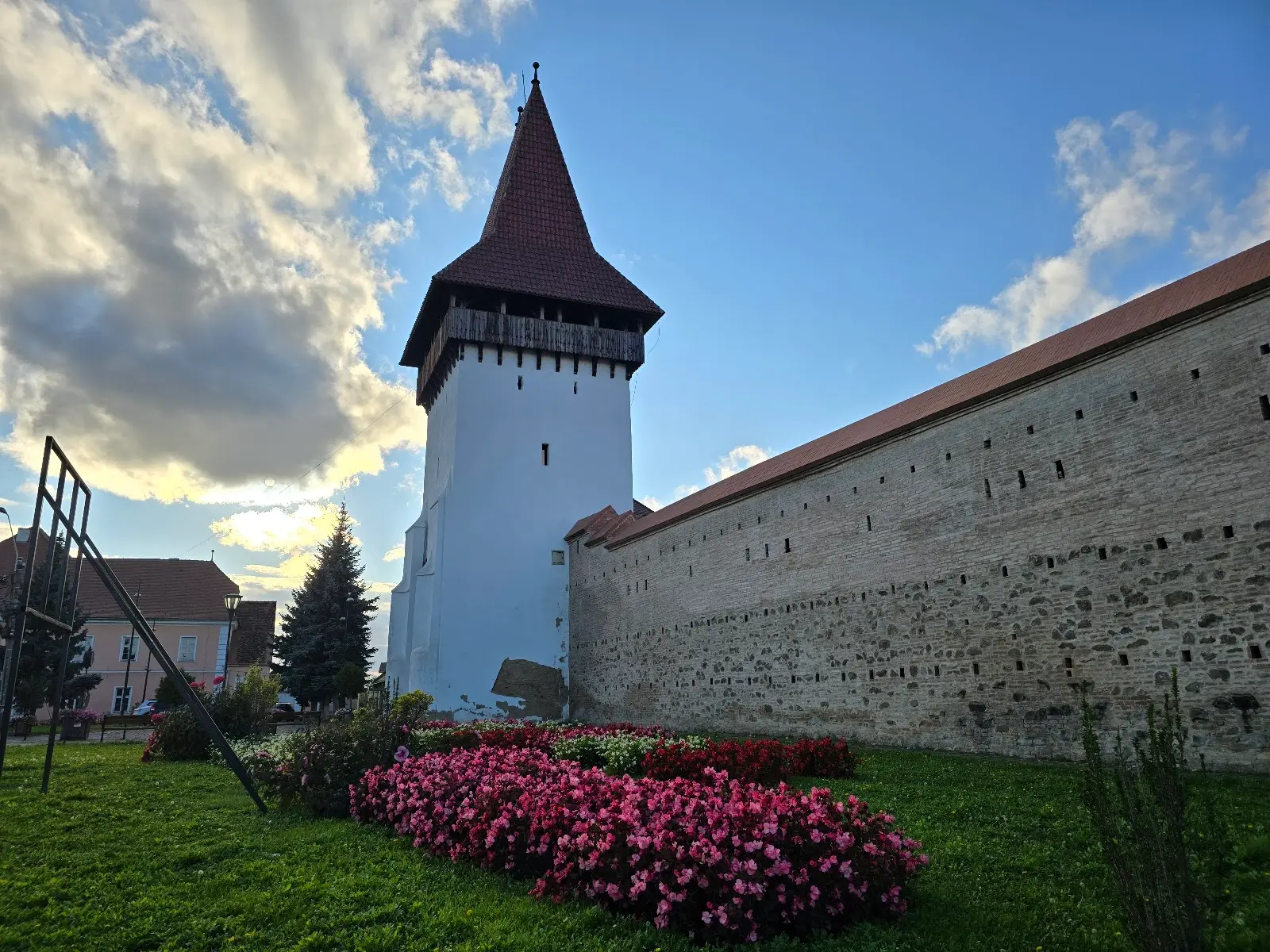
Mediaș is the town most people drive straight through on the road between Sibiu and Sighișoara, without stopping for even an hour. That is a mistake: behind the houses in the centre stands one of the most complete urban fortified enclosures in Transylvania, and the visibly leaning tower beside the evangelical church has become the town's signature. Half an hour out in every direction, meanwhile, begins the real heart of fortified-church country.
Where Mediaș is, and why it deserves a stop
Mediaș sits on the Târnava Mare river in central Transylvania, almost exactly halfway between Sibiu and Sighișoara. It was one of the seven Saxon towns that gave the province its German name — Siebenbürgen, "seven citadels" — and it still keeps the medieval layout of a craftsmen's town: a broad central square, a fortified church complex in the middle, and a ring of walls with towers named after the guilds that defended them.
What sets it apart from Sibiu and Sighișoara is scale and mood. Mediaș is not a citadel polished for tourism; it is a town going about its ordinary life among its monuments — children on bikes in the square, modest terraces in the shade of the walls, people walking home through a medieval gate with their shopping. After two days in the crowds of Sighișoara, Mediaș comes as a relief.
In practical terms that translates into three advantages: nobody queues ahead of you at the monuments, rooms cost less than in the neighbouring destinations, and there is enough parking to use the town as a launchpad for drives through the Târnava villages. Mediaș is, in other words, the town you sleep in to visit an entire region properly.
What makes up the old town
The historic centre is small and walkable, and an unhurried half day covers it.
- The fortified complex in the middle of town — Cetatea Mediaș is not a hilltop castle but an enclosure built around the church, with walls, gates and defensive towers. Walking its perimeter, outside and in, is the best introduction to the town.
- The church at its core — Saint Margaret's Evangelical Church is the centrepiece, a Gothic hall church around which the whole fortification gathered.
- The leaning tower — the Trumpeters' Tower is the church's bell tower, famous for a tilt you can see with the naked eye. It is the image on every photograph of the town.
- The guild towers — the Stonemasons' Tower is the easiest to pick out among the towers that carried the names of the craftsmen responsible for defending them.
- The town's collections — the Mediaș Municipal Museum puts the whole story in context: Saxon settlement, the guilds, centuries of town life.
If you want the full list, in visiting order and with what not to miss inside, it is all laid out in the guide to what to see in Mediaș.
Fortified-church country
The real reason to sleep in Mediaș rather than just pass through is what lies around it. The villages of the Târnava valleys preserve some of the best-kept Saxon fortified churches in Transylvania, and three of them are a very short drive away:
- Valea Viilor — inscribed on the UNESCO World Heritage list, with a compact enclosure and a massive tower. If you only see one, see this one.
- Moșna — one of the most imposing village churches in the area, its towers and walls still standing.
- Axente Sever — an enclosure with an inner courtyard and store rooms built against the walls, exactly the sort of detail that explains what these fortifications were for.
For the wider context — why they were built, how they worked, and which are the finest across Transylvania — see the dedicated guide to the Saxon fortified churches.
Getting there
- By car is the best option, because the surrounding villages cannot be visited seriously any other way. The main road between Sibiu and Sighișoara runs through town, and both are a short drive.
- By train Mediaș sits on the main line linking Brașov and Sighișoara with Sibiu, Alba Iulia and onward to Cluj and Timișoara. The station is a few minutes' walk from the centre.
- By air the closest options are the airports at Sibiu and Târgu Mureș, both a short drive away.
Getting around
The town itself is walkable — the centre is compact and flat. For the Saxon villages you need a car: the roads are mostly paved, though the last stretch to some churches can be rougher.
One habit worth knowing: many village fortified churches are not permanently open. The key is held by a local custodian and visits happen on request — ask at the first house in the churchyard, at the shop in the village centre, or at the town hall. It is a ritual that is part of the experience, and the reason to set out in the morning rather than at dinner time.
How much time to allow
- Half a day — the historic centre only: the enclosure, the church, the towers, the museum.
- A full day — the centre in the morning, two fortified churches in the afternoon.
- Two to three days — Mediaș as a base, with village drives plus a day each in Sibiu and Sighișoara.
When to come
Late spring and early autumn are the best windows: soft light, green or golden hills, civilised temperatures. Summer is pleasant, but it is also when Sighișoara and Sibiu are packed — all the more reason to sleep in Mediaș. Winter gives the region an austere beauty, but village visits get harder: less daylight, rougher roads, custodians harder to track down.
Mediaș as a base between Sibiu and Sighișoara
This is the town's great practical advantage. You stay somewhere small, quiet and inexpensive, yet two of Transylvania's most visited destinations are under an hour away: the medieval citadel of Sighișoara and the baroque heart of Sibiu. Do each as a day trip and come back in the evening to a town where nobody is standing on your toes.
For neighbourhoods, areas and the villages worth searching for a room, see the guide to where to stay in Mediaș.
Food, coffee and breaks
The dining scene is that of a small provincial town: a handful of restaurants around the centre, patisseries and cafés near the square, plus seasonal terraces. The local cooking combines Transylvanian staples — sour soups, roasts, pies — with Saxon and Hungarian influences, and portions are generous.
Two practical notes:
- lunch is easy to find in town, dinner in the villages much harder — if you are staying at a village guesthouse, ask your host whether they cook in the evening;
- keep water and a snack in the car when you head out to the fortified churches; between villages there is not always an open shop.
Know before you go
- Set out early on village days; late afternoon lowers your chances of finding the custodian with the key.
- Carry cash — card payment is not guaranteed in small villages, and donations towards church upkeep are left in cash.
- Comfortable shoes — the cobbles in the centre and the churchyards of the fortified enclosures are unkind to smart footwear.
- Mind the services — these evangelical churches are still in use; avoid visiting during Sunday morning worship.
- Book ahead in summer, especially for a guesthouse in a Saxon village: the number of rooms is small.
A two-day itinerary
Day 1 — the town. Morning in the central square and inside the fortified enclosure, then the church and the leaning tower. Afternoon at the municipal museum and a slow walk past the guild towers, with a coffee break in the centre.
Day 2 — the villages. Set out early for Valea Viilor, continue to Moșna, finish at Axente Sever. In between: hill roads, orchards, vineyards and villages of Saxon houses lined up along the street. Back in Mediaș for the evening.
With a third day, choose between Sibiu and Sighișoara — both work comfortably as a day trip from Mediaș.
Plan your trip
Stays nearby
Stays in Romania
Experiences
Tours & activities
Guided tours, day trips and hand-picked experiences via GetYourGuide — free cancellation on most.
See all experiencesGetting to Romania
Flights, transfer & car
Fly into Romania
Compare fares to Bucharest Otopeni (OTP) and regional airports — Cluj, Sibiu, Iași, Timișoara.
Airport transfer
Private, fixed-price door-to-door transfer — driver waiting from the moment you land.
Rent a car — see the real Romania
A rental car is the key to Romania: the Transfăgărășan, the painted monasteries of Bucovina, mountain roads and the villages of Maramureș that no train reaches.
Find a car











