
What to see in Mediaș and the fortified churches
Saint Margaret's Evangelical Church and its leaning tower, the fortified enclosure and guild towers, the town museum, and the three fortified churches around Mediaș: Valea Viilor, Moșna and Axente Sever.
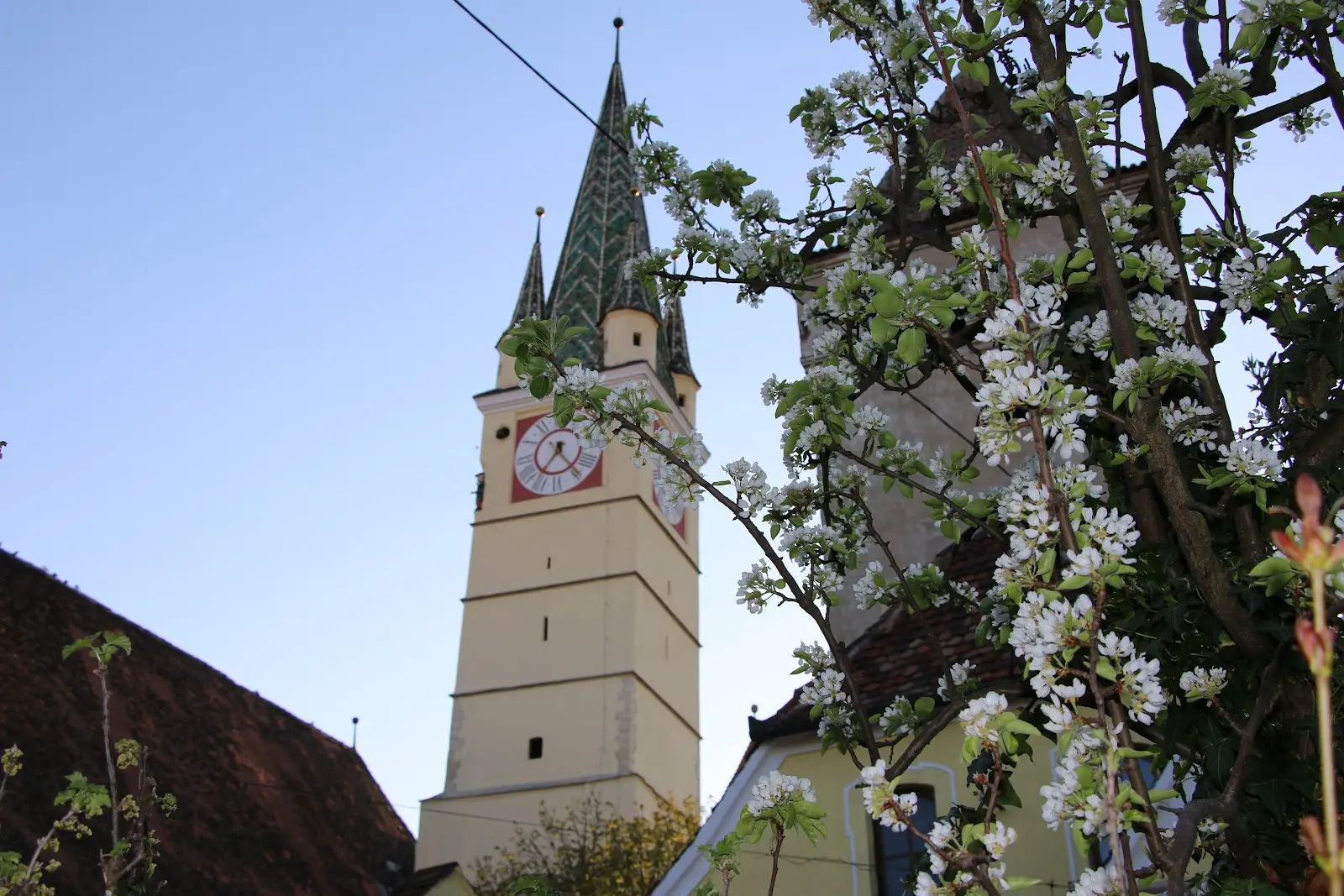
Mediaș has a small centre that is unusually dense: an almost complete fortified enclosure, a leaning tower that catches your eye from any angle, and, a few kilometres out, some of the best-preserved Saxon fortified churches in Transylvania. The list below runs in the order it deserves to be walked — the town first, then the villages.
Saint Margaret's Evangelical Church
The starting point is Saint Margaret's Evangelical Church, the Gothic hall church at the centre of town around which the entire fortification was built. It is severe from outside and surprisingly ample within, with high vaults and that sober, unornamented air particular to Saxon evangelical churches.
Worth your attention:
- the interior space — hall-church proportions, no transept, piers that lead the eye straight to the altar;
- the stonework — portals, vault keystones and funerary slabs set into the walls;
- its relationship to the enclosure — notice how the church does not stand free in a square but inside a defended courtyard.
Give it half an hour at least, longer if you catch a quiet moment.
The Trumpeters' Tower — the leaning tower of Mediaș
Attached to the church rises the Trumpeters' Tower, the town's defining landmark. Its tilt needs no explanation and no spirit level: the tower leans clearly off vertical, and the effect is all the more striking because it is a massive thing of stone and brick, not some fragile spire.
The name comes from its medieval function — signals for the town were sounded from the top. The best photographic angle is not from the square but from inside the enclosure, where you get the tower and the line of the walls in one frame.
Cetatea Mediaș — the fortified enclosure
Many visitors look for a hilltop castle and fail to find one. Cetatea Mediaș is not that: it is an urban fortification built around the church, with walls, gates and defensive towers that turned the town centre into a refuge under attack.
It reads best on foot, in two laps:
- outside, along the walls, to grasp the true size of the enclosure;
- inside, in the church courtyard, where the towers, the gate and the buttresses come into view.
Allow an hour for the full circuit with photo stops.
The Stonemasons' Tower and the guild towers
As in every Saxon town, each stretch of wall was the responsibility of a guild, and the towers kept the craftsmen's names. The Stonemasons' Tower is the easiest to identify and the most photogenic of them — a massive, plainly shaped structure that looks exactly like what it was built for.
Look for the other surviving towers around the perimeter too: together they show a defensive system conceived as a whole, not a collection of isolated buildings. The logic was simple and effective — each trade maintained its stretch of wall, stored its weapons in its own tower and answered for it when needed. Seen in a row from the street that follows the enclosure, the towers are effectively the org chart of a medieval town.
The central square and the streets around it
Between monuments, Mediaș rewards walking with no particular target. The main square is broad, lined with burgher houses in warm painted colours, with vaults, carriage gates and inner courtyards glimpsed in passing. The streets leading off it keep the town's old scale: two-storey buildings, workshops at ground level, old wrought-iron signs.
This is the walk that gives you the measure of the place: twenty minutes takes you around the old centre, and every corner offers another angle on the leaning tower. If you have only one photograph to take in Mediaș, look for it here, in morning light or the hour before sunset.
The Mediaș Municipal Museum
Before or after your walk along the walls, the Mediaș Municipal Museum is where the pieces connect: the Saxon settlement of Transylvania, the guild system, everyday town life, the objects left behind by old households and workshops. It is a small-town museum with no spectacular pretensions, and precisely what you need to make sense of what you see outside.
Our advice is to go in before walking the walls, especially if this is your first encounter with Saxon Transylvania: half an hour of context completely changes how you read the towers, the gates and the village store rooms. With children in tow, the museum also works well as a shaded break between two outings.
Valea Viilor — the UNESCO fortified church
A very short drive from town lies the single most important sight in the surroundings: the fortified church of Valea Viilor, inscribed on the UNESCO World Heritage list as part of the villages with fortified churches in Transylvania.
Why it stands out:
- compactness — a tight enclosure around the church, no wasted space, a complete miniature defensive system;
- the massive tower — visible from the village entrance, dominant above the low houses;
- its state of preservation — among the best in the region.
If you have time for only one fortified church around Mediaș, make it this one. The village is small and walkable in a few minutes, and the drive there through vineyard hills is part of the pleasure.
Moșna
The fortified church of Moșna is the opposite of delicate picturesque: an imposing, almost outsized structure for the village it serves, with walls and towers that make plain how serious the threat behind them was.
The village itself rewards a short walk: Saxon houses lined up along the street, with wide gates and long courtyards behind — the classic layout of settlements in the Târnava valleys.
Axente Sever
The fortified church of Axente Sever explains the practical purpose of these complexes better than any other. Its enclosure has an inner courtyard and store rooms built against the walls — the spaces where the community kept its provisions and sheltered during a siege. That detail turns a "handsome church" into what it really was: a fortified warehouse and a collective refuge.
Putting it together as a route
- Half a day, town only: the church and the leaning tower, the fortified enclosure, the guild towers, the municipal museum.
- A full day: the town in the morning, Valea Viilor and Moșna in the afternoon.
- Two days: the town on day one; Valea Viilor, Moșna and Axente Sever on day two, with short hill drives in between.
One thing to remember about the Saxon villages: the churches are not necessarily open all day. The key is held by a local custodian and visits usually happen on request — set out in the morning rather than late afternoon, and ask at the first house by the churchyard gate or in the village centre. The wider context, covering the whole network of Saxon fortified churches across Transylvania, is covered separately.
For full planning — transport, seasons, how much time to allow — see the complete guide to Mediaș, and for the areas and villages to search for a room, the guide to where to stay in Mediaș.
Plan your trip
Stays nearby
Stays in Romania
Experiences
Tours & activities
Guided tours, day trips and hand-picked experiences via GetYourGuide — free cancellation on most.
See all experiencesGetting to Romania
Flights, transfer & car
Fly into Romania
Compare fares to Bucharest Otopeni (OTP) and regional airports — Cluj, Sibiu, Iași, Timișoara.
Airport transfer
Private, fixed-price door-to-door transfer — driver waiting from the moment you land.
Rent a car — see the real Romania
A rental car is the key to Romania: the Transfăgărășan, the painted monasteries of Bucovina, mountain roads and the villages of Maramureș that no train reaches.
Find a car











