The Complete Guide to Sibiu
Transylvania's Saxon jewel, with medieval squares, rooftops that seem to watch you, and one of Romania's finest food scenes. A complete guide to the city that was European Capital of Culture.
Few Romanian cities stay with you the way Sibiu does. Set at the foot of the Carpathians, with rooftops that seem to watch you through a thousand slender attic windows and cobbled squares raised by Saxon settlers eight centuries ago, it is perhaps the best-preserved and best-run historic city in the country. Here you travel slowly, with long coffee breaks and views that beg to be photographed.
Why Sibiu
Sibiu – Hermannstadt in its Saxon name – was founded by German settlers in the 12th century and became the political and economic heart of Transylvania's Saxons. The wealth of the medieval guilds left behind a compact, elegant and extraordinarily well-preserved old town.
In 2007 the city was European Capital of Culture, a turning point that reshaped its fortunes: façades were restored, squares repaved, and Sibiu became one of Romania's most visited urban destinations.
- The famous "eyes of Sibiu" – the narrow, almond-shaped dormer windows on the old-town rooftops – give the houses a strangely alive look, as if the city were watching you back.
- It is a city built for walking: distances are short and the centre is largely pedestrian.
- Year after year it appears on lists of the most beautiful and most liveable cities in Central Europe.
The Old Town
The heart of Sibiu is a chain of linked squares, easily covered in a single long stroll.
- Piața Mare (the Large Square) is the monumental centre of the city, framed by baroque palaces and the former mansions of the Saxon patriciate. In summer it fills with terraces; in winter it hosts one of the country's loveliest Christmas markets.
- Piața Mică (the Small Square), more intimate, with arcades and merchants' houses, shelters cafés and workshops.
- The Bridge of Lies (Podul Minciunilor) links the two squares – the first cast-iron bridge in Romania, wrapped in legends about lovers and merchants who told falsehoods on it.
- The Council Tower (Turnul Sfatului) separates the Large Square from the Small Square; you can climb it for one of the finest panoramas over the rooftops and the distant mountains.
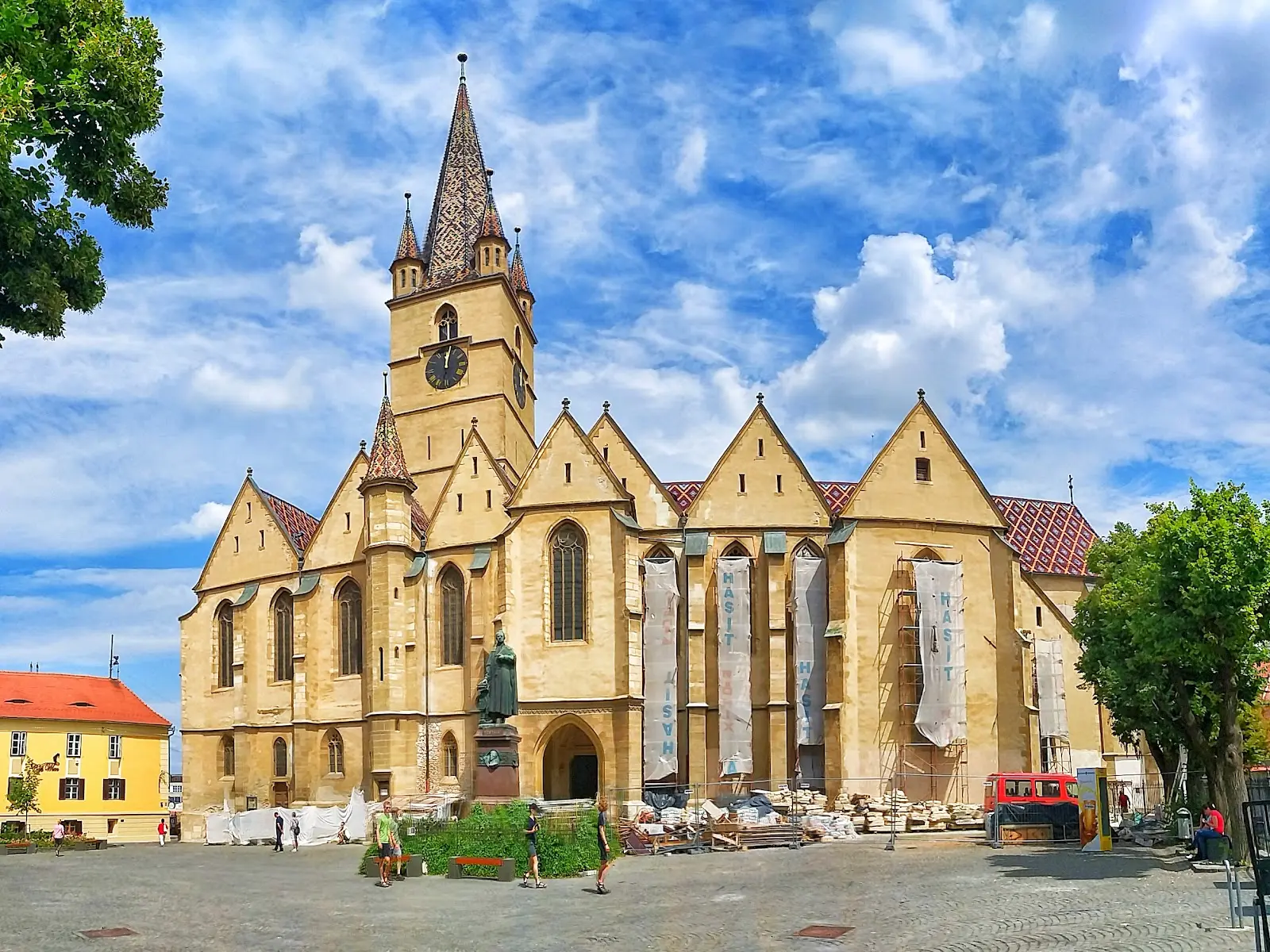
- The Evangelical Cathedral, with its tall Gothic tower visible from afar, dominates the skyline and hosts organ recitals.
- The Passage of Stairs (Pasajul Scărilor), a medieval descent through stone walls and arches, connects the upper town to the lower town and is one of the most photogenic corners of the whole centre.
The Museums
Sibiu has a density of museums rare for a city its size, and two of them are of European importance.
- The Brukenthal Museum, opened to the public at the end of the 18th century, is one of the oldest public museums in Europe. Its collection of European paintings, gathered by Baron Samuel von Brukenthal, is remarkable and remains the city's leading cultural attraction.
- The ASTRA Museum, on the edge of the city near the Dumbrava forest, is a vast open-air village museum. Dozens of farmsteads, mills, wooden churches and rural workshops have been relocated here from across the country, along paths you wander for a few hours between woods and ponds.
Food and Drink
Sibiu is rightly considered one of Romania's best dining cities. Saxon cooking, the produce of the surrounding Mărginime villages and a wave of young chefs have turned the city into a culinary destination in its own right.
- The covered market in the centre is where you buy sheep's-milk cheeses from Mărginimea Sibiului, smoked meats, honey and seasonal vegetables.
- Look for dishes of Saxon and Transylvanian inspiration: sour soups, slow stews, savoury pies and desserts with a German accent.
- The cafés around the Small Square and its side streets are perfect for a long pause; the specialty-coffee scene is among the best in the country.
Around Sibiu
One of the city's great advantages is how quickly it delivers you into nature and the surrounding villages.
- Mărginimea Sibiului is a string of shepherding villages at the foot of the mountains – Rășinari, Sibiel, Gura Râului and others – renowned for cheeses, painted churches and a still-living traditional way of life. Sibiel is home to a nationally known museum of glass-painted icons.
- Cisnădie and Cisnădioara, south of the city, preserve fortified Saxon churches – the one at Cisnădioara, perched on a hill, is among the oldest in Transylvania.
- Sibiu is also the gateway to the Transfăgărășan, the famous alpine road that climbs over the ridges of the Făgăraș Mountains – usually open only in the summer months.
Practical Information
- When to go: late spring and summer for terraces, hikes and the Transfăgărășan; December for the Christmas market. Autumn brings glorious colour to the Mărginime.
- How many days: two days are enough for the old town and museums; three or four if you want to explore the Mărginime and drive the Transfăgărășan.
- Getting there: Sibiu has an international airport with flights to several European cities. It is well connected by road and rail to Brașov, Cluj-Napoca and the rest of the country.
- Tip: the centre is best seen on foot – leave the car and lose yourself among the squares, stairways and rooftops with eyes.
Sibiu is in no hurry, and neither should you be. It is the city that teaches you to look up again.
Plan your trip
Experiences
Tours & activities
Guided tours, day trips and hand-picked experiences via GetYourGuide — free cancellation on most.
See all experiencesGetting to Romania
Flights, transfer & car
Fly into Romania
Compare fares to Bucharest Otopeni (OTP) and regional airports — Cluj, Sibiu, Iași, Timișoara.
Airport transfer
Private, fixed-price door-to-door transfer — driver waiting from the moment you land.
Rent a car — see the real Romania
A rental car is the key to Romania: the Transfăgărășan, the painted monasteries of Bucovina, mountain roads and the villages of Maramureș that no train reaches.
Find a car