
Complete guide to Buzău
Mud volcanoes, fire coming out of the ground, churches carved into cliffs and one of Romania's best wine regions — everything you need to know about Buzău and Buzău Land.
Plenty of travellers drive past Buzău without stopping, on their way to Moldavia or the Black Sea coast. The mistake becomes obvious less than an hour from the centre, where the ground bubbles in craters of grey mud and, on a hillside above Lopătari, flames come straight out of the rock. The city is the logical base for all of it.
Getting your bearings: the city and the land
Buzău is a lowland city, set where the roads between Wallachia, Moldavia and Dobrogea meet — a position that made it a market town and a crossing point for centuries. To the north the land rises quickly: first vine-covered hills, then the Subcarpathians, then the Carpathian Bend.
That whole upland area in the north of the county forms Buzău Land (Ținutul Buzăului), recognised as a UNESCO Global Geopark. In practice you are dealing with two destinations that share one name. The city is for architecture, food, accommodation and logistics. The land is for landscape: mud volcanoes, natural flames, churches carved into rock, hill villages. With a single day, the city is a pleasant stop; with two, head for the hills.
For the mountain trails of the Carpathian Bend, which pick up where the Buzău hills end, our dedicated mountain portal munte.online goes into more depth.
Why it is worth the trip
Buzău is one of the few destinations in Romania whose main argument is not a monument but geology. Mud volcanoes, gas burning at the surface and amber all occur here within a small radius, and the landscape they produce looks like nowhere else in the country.
Two more things turn the area from a curiosity into a proper weekend: a quiet rock-cut heritage of tiny churches hewn into cliffs, and one of Romania's best wine regions sitting right at the foot of the hills. And because visitor numbers are far lower than in Transylvania or on the Prahova Valley, you have a real chance of seeing the mud volcanoes without a crowd.
Geology that does not look Romanian
The mud volcanoes at Pâclele Mici are the star of the region. Gas from deep underground pushes water and clay to the surface, building small cones that bubble continuously. The salty soil keeps vegetation away, so the result is a grey, cracked, lunar plateau — one of the most photogenic landscapes in Romania, especially in low light early in the morning or before sunset.
At Lopătari, the Living Fire is the other face of the same phenomenon: instead of pushing mud, the gas reaches the surface and burns naturally among the stones. The flame shows best at dusk or after dark, when the dark hillside sets it off.
In Colți, the Amber Museum explains another local rarity: Colți amber, mined from the surrounding hills and prized for its dark tones. It is a short stop, but it ties the geological story together.
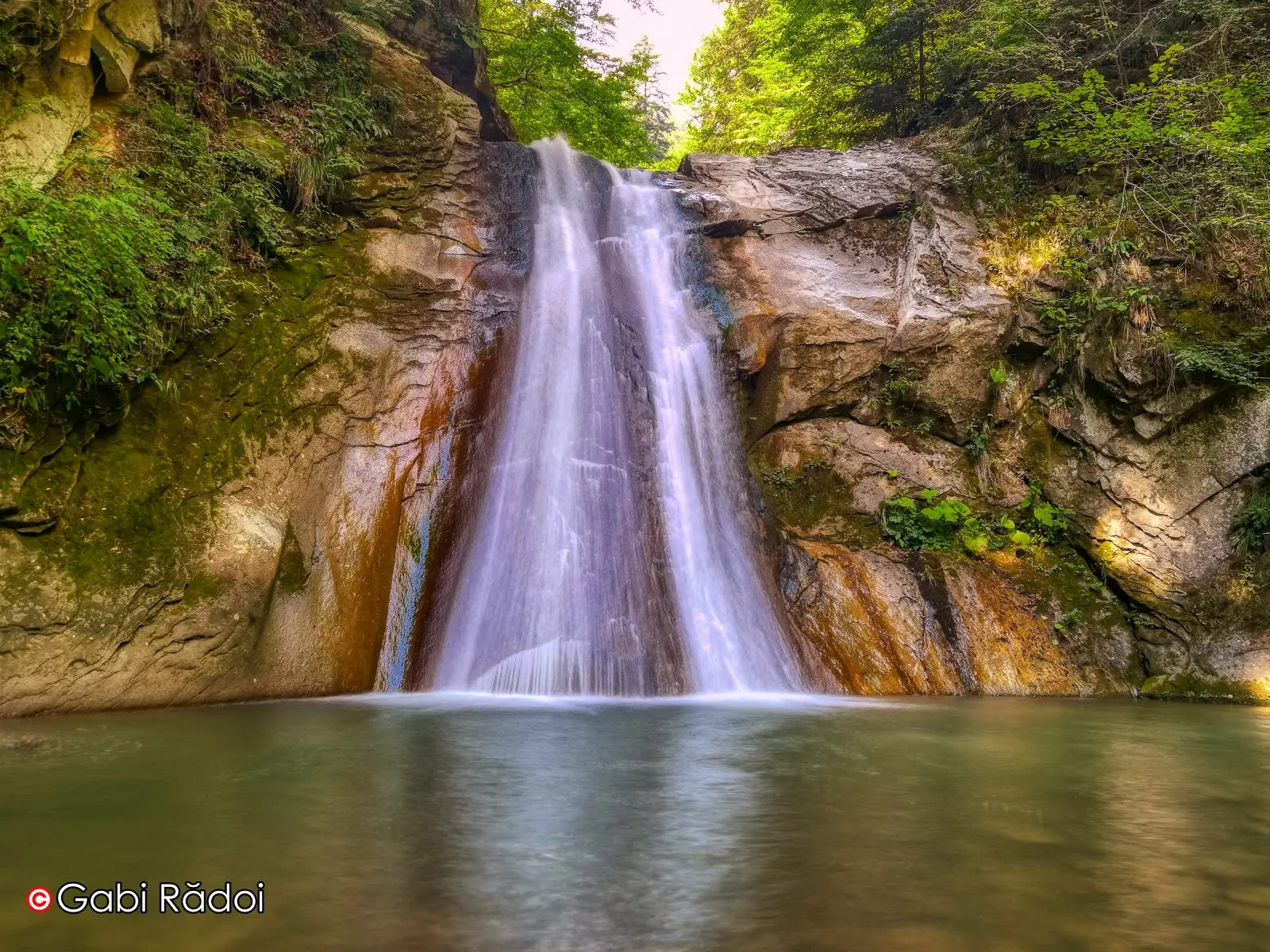
And if you want water in the picture, Pruncea Waterfall, known locally as the Niagara of Buzău, is a broad curtain of water right beside the road — far more accessible than the nickname suggests.
Stone worked by human hands
The Aluniș rock complex is where the region shows its historical side: small churches and cells carved directly into the cliff, used by monastic communities and preserved in the sandstone landscape. You walk up on foot, and the atmosphere is nothing like a masonry church.
A few kilometres away, the Măgura sculpture camp continues the same idea with modern means: a park of limestone sculptures scattered through grass and trees, left to weather in the open air. The walk is slow and quiet, and for children it works like a maze.
For a sight-by-sight breakdown, see our guide to what to see in Buzău.
The city: architecture and green space
Central Buzău deserves a couple of hours on foot. The main landmark is the Communal Palace, the building that sets the city's architectural tone and still gives you the best photograph downtown. Nearby, the Ascension of the Lord Cathedral is the city's religious reference point.
For fresh air, Buzău has a rare asset: Crâng Park, a large urban woodland with mature avenues, perfect for an aimless hour once you come back off the hill roads.
Wine and food
South-west of the city begins Dealu Mare, one of Romania's best wine areas. The vineyards run along sunny terraces at the foot of the Subcarpathians, and many estates take visitors for tastings and tours: Domeniile Tohani, Crama Ceptura, Crama Pietroasa and Domeniile Săhăteni are among the names you will hear most often.
One practical note: cellar visits are almost always arranged in advance, especially outside the warm season, and it is wise to have a driver who is not tasting.
At the table, this is meat and cheese country. Pleșcoi sausages, the dried and heavily spiced babic, hill cheeses, savoury pies and acacia honey are the things worth seeking out, either in the city or directly in the villages.
Getting there and getting around
Buzău sits on the road and rail axis linking Bucharest with Moldavia, so arriving is easy: frequent trains on the main line and a direct national road from the capital, Brăila or Focșani.
For the uplands, though, a car is effectively essential. The sights are scattered across dozens of kilometres of hill roads, and public transport does not usefully connect them. The final stretches to some sights are unpaved: you do not need a four-wheel drive, but a low-clearance car will give you trouble. In the city, by contrast, everything is within walking distance.
When to go
The best windows are April to June and September to October: good light, bearable temperatures, dry hill roads. Autumn adds the bonus of harvest time in the vineyards.
Summer is hot and dusty in the lowlands, and the volcano plateau has no shade at all, so go early or late. In winter the upland roads can be difficult after snowfall, but the Living Fire burns year-round and looks spectacular in the dark. One thing to remember: avoid the mud volcanoes right after rain, when the clay turns slippery and impossible to get off your shoes.
A one or two day plan
Day 1 — the geological uplands. Morning at the mud volcanoes of Pâclele Mici, then climb towards Aluniș and Măgura. Afternoon in Colți at the amber museum, and the evening at the Living Fire above Lopătari, when the flame reads best.
Day 2 — city and wine. An early walk through central Buzău, the Communal Palace and the cathedral, then an hour in Crâng Park. In the afternoon drop down to Dealu Mare for one or two cellars, booked in advance.
If you only have a day, choose: either the uplands, or the city plus one winery. Trying to do everything in a single day ends with you spending it in the car.
Practical basics
- Where to sleep: in the city or in guesthouses up in the hills — the area-by-area comparison is in our guide on where to stay in Buzău.
- Cash and fuel: ATMs and petrol stations are reliable in the city and larger towns; in the villages, carry cash.
- Signal: phone coverage is patchy in the upland valleys. Download the map offline.
- Kit: washable footwear, water, a hat. The volcano plateau is completely exposed.
- Respect the geopark: do not climb on active cones, do not throw anything into the craters, and stay on marked paths.
In short
- Buzău is the gateway to Buzău Land, a UNESCO Global Geopark.
- Signature sights: the mud volcanoes of Pâclele Mici, the Living Fire at Lopătari, Colți amber, the Aluniș rock complex and the Măgura sculpture camp.
- In the city: the Communal Palace, the cathedral and Crâng Park.
- Wine: Dealu Mare, with Tohani, Ceptura, Pietroasa and Săhăteni.
- Allow two days minimum, and your own car for the uplands.
- Best timing: late spring or autumn, in dry weather.
Plan your trip
Stays nearby
Stays in Romania
Experiences
Tours & activities
Guided tours, day trips and hand-picked experiences via GetYourGuide — free cancellation on most.
See all experiencesGetting to Romania
Flights, transfer & car
Fly into Romania
Compare fares to Bucharest Otopeni (OTP) and regional airports — Cluj, Sibiu, Iași, Timișoara.
Airport transfer
Private, fixed-price door-to-door transfer — driver waiting from the moment you land.
Rent a car — see the real Romania
A rental car is the key to Romania: the Transfăgărășan, the painted monasteries of Bucovina, mountain roads and the villages of Maramureș that no train reaches.
Find a car











