
What to see in Buzău: attractions & experiences
From the lunar plateau of the mud volcanoes to the flame above Lopătari, from the rock churches of Aluniș to the cellars of Dealu Mare — the sights of Buzău, one by one.
Buzău works on two levels: a compact city centre you can cover in a few hours, and an upland region where the sights are scattered across dozens of kilometres. The best things here are not buildings but phenomena — mud that boils, gas that burns, rock carved out by monks. Below, each one and what makes it worth the drive.
The mud volcanoes of Pâclele Mici
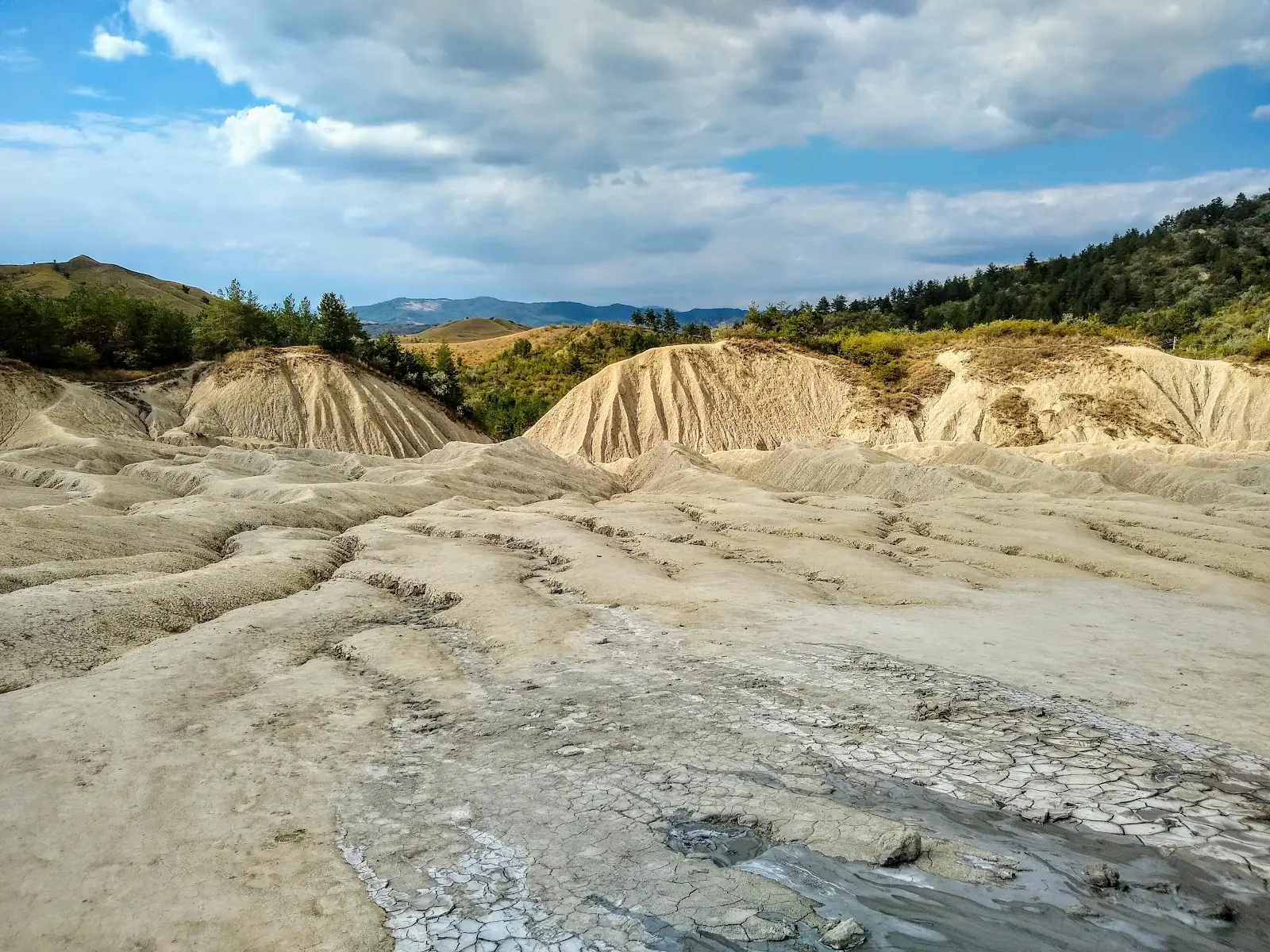
If you see one thing in the county, make it this. The mud volcanoes are a plateau where gas from deep underground pushes water and clay to the surface, building small cones that bubble day and night. Salt in the soil keeps vegetation away, and the result is a grey, cracked, lunar landscape, utterly unlike anywhere else in Romania.
This is a place to walk slowly. The cones change constantly: some dry out, others appear a few metres away. Low light early in the morning or before sunset picks out the cracks and gives the best photographs.
- Note: the plateau has no shade. In a heatwave, go at the very start or end of the day.
- Avoid visiting after rain — the clay turns slippery and sticks to everything.
- Stay on marked paths and do not climb on active cones.
The Living Fire at Lopătari
The Living Fire is the other face of the same geology: here the gas does not push mud but reaches the surface and burns naturally, among the stones of a hillside. The flame is not large, but it is constant, and the fact that it comes out of the ground with no apparatus at all is what makes it memorable.
Come after dark or at dusk, when the contrast with the slope sets it off; in full daylight it reads far more faintly. The drive up through the hill villages is a good part of the experience.
Colți amber
The village of Colți has a story few people associate with Romania: Colți amber, mined from the surrounding hills and prized for its dark tones, from honey to almost black. The Amber Museum gathers pieces, tools and the geological context that explains why it occurs precisely here.
It is a short stop, but do not skip it: having seen mud boil and gas burn, the museum is the piece that ties every phenomenon back to the same underground story.
The Aluniș rock complex
The Aluniș rock complex is the region's historical side: small churches and cells carved directly into the cliff, used by monastic communities and preserved in the area's soft sandstone. The spaces are small and low, with walls that still carry tool marks.
You reach them on foot, up a short climb that is steep in places. The atmosphere is nothing like a masonry church, and the view across the valley from the entrance is a bonus.
The Măgura sculpture camp
A few kilometres from Aluniș, the Măgura sculpture camp continues the theme of worked stone by modern means: an open park of limestone sculptures scattered through grass and trees, deliberately left to weather outdoors.
There is no set route — you wander and discover. For children it works like a maze, and for photography it is the most forgiving subject in the area, because it looks good in almost any light.
Pruncea Waterfall, the Niagara of Buzău
Pruncea Waterfall is wide and low, closer to a curtain of water than a dramatic drop — hence the local nickname. Its great advantage is access: it sits right beside the road, with no hike, so it slots easily into a busy day.
Flow varies a lot with the season, so spring and spells of wet weather will show it at its best.
The Communal Palace and the city centre
In town, the landmark is the Communal Palace, the building that sets Buzău's architectural tone and still gives you the best photograph downtown. Around it the centre is compact and walkable, with early twentieth-century facades, terraces and a quiet civic life free of the tourist pressure you feel in other Romanian cities.
The Ascension of the Lord Cathedral
The Ascension of the Lord Cathedral is the city's religious reference point and a natural stop on a walk through the centre. Inside, dress modestly and keep quiet, particularly during services.
Crâng Park
Crâng Park is Buzău's green asset: a large urban woodland with mature avenues and good shade, exactly what you want after a day on dusty hill roads. It works equally well for a morning run and for an aimless hour in the evening.
The wine road: Dealu Mare
South-west of the city begins Dealu Mare, one of Romania's best wine areas, on the sunny terraces at the foot of the Subcarpathians. Many estates take visitors for tours and tastings, and the differences between them are real: some are classic and rooted in local tradition, others are modern projects built around the visitor experience.
- Domeniile Tohani and Crama Ceptura — usually where a first day on the wine road starts.
- Crama Pietroasa — one of the region's best-known references.
- Domeniile Săhăteni and Lacerta Winery — cellars with well-organised visits.
- Licorna Winehouse, Vitis Metamorfosis, Crama Budureasca and Crama Rotenberg — for a second day, or a second trip.
Visits are almost always arranged in advance, and a driver who is not tasting is not optional.
The hill villages and the drive between sights
One thing that appears on no list of attractions: the drive itself. Between Pâclele, Aluniș, Colți and Lopătari you pass through villages strung along hillsides, with long farmsteads, hay meadows and small churches, and panoramas over the valleys open up out of nowhere at every wider bend.
Treat the transfers as part of the visit rather than wasted time. Measure distances in time rather than kilometres: on narrow hill roads, 30 kilometres can mean an hour. And stop when you see a good spot — there is no crowd here to hurry you along.
If you only have one day
- Morning: the mud volcanoes of Pâclele Mici.
- Midday: Aluniș and Măgura.
- Evening: the Living Fire at Lopătari.
With children
- The Măgura sculpture camp — open space to run in.
- Crâng Park — shade, paths, a break.
- The mud volcanoes — spectacular, but hold hands near the cones.
For photography
- The volcano plateau, in low light.
- The Living Fire, after dark.
- Aluniș, for the texture of the rock and the valley view.
For a day without hiking
- The city centre and the Communal Palace.
- Pruncea Waterfall, right beside the road.
- One Dealu Mare winery, booked ahead.
The general guide to the area, with logistics and day plans, is our complete guide to Buzău; for accommodation areas, see where to stay in Buzău.
Plan your trip
Stays nearby
Stays in Romania
Experiences
Tours & activities
Guided tours, day trips and hand-picked experiences via GetYourGuide — free cancellation on most.
See all experiencesGetting to Romania
Flights, transfer & car
Fly into Romania
Compare fares to Bucharest Otopeni (OTP) and regional airports — Cluj, Sibiu, Iași, Timișoara.
Airport transfer
Private, fixed-price door-to-door transfer — driver waiting from the moment you land.
Rent a car — see the real Romania
A rental car is the key to Romania: the Transfăgărășan, the painted monasteries of Bucovina, mountain roads and the villages of Maramureș that no train reaches.
Find a car











