
Complete guide to Brăila
An old Danube port, cosmopolitan in the 19th century, with the only radial-concentric street plan in Romania. A complete guide to Brăila: the fan-shaped streets, the merchant communities' churches, the riverfront and Grădina Mare, the Maria Filotti Theatre and the little delta of Insula Mică a Brăilei.
Brăila looks like nowhere else in Romania, and the reason is clearest from above: the streets run out of the centre in a fan, like ripples from a stone dropped into the Danube. It is the legacy of a cosmopolitan port that, in the 19th century, spoke Greek, Armenian, Yiddish and Russian as naturally as Romanian. The city is quieter now, but its plan and its churches still tell that story.
Why Brăila
For a century Brăila was one of south-eastern Europe's great grain ports. Wheat from the Bărăgan plain came down to the Danube here and left by sea, and in its wake came merchants, shipowners and bankers from across the Levantine world. The city you see today — wide boulevards, eclectic facades, churches built for communities that have almost vanished — is the portrait of that prosperity.
- A radial-concentric street plan, unique in Romania, with fan-shaped streets and boulevards curving in semicircles
- Churches of the old communities: Greek, Armenian, Lipovan, and a former mosque turned into a church
- The riverfront and the Grădina Mare park, with an open view over the Danube and the wetlands beyond
- Insula Mică a Brăilei Nature Park, a delta-like wetland a few kilometres from the centre
- The city of Panait Istrati, the writer who carried Brăila into French literature
Brăila is not a front-to-back restored postcard town. It is a city with patina, where beauty and decay sit side by side on the same street — and that is exactly what gives it character.
The city as a fan
Brăila's most interesting attraction is not a building but the shape of the city itself. After the Ottomans withdrew and the fortifications that ringed the town were demolished, the city was laid out again from scratch: a centre by the Danube, with radial streets spreading out like the ribs of a fan, cut by concentric boulevards that trace, in successive semicircles, the line of the old walls.
The result is a plan you will not find anywhere else in Romania, and you feel it on foot: you walk down a street that opens toward the river, cross a curving boulevard and, if you look up, there is the water at the end of the view. For a city of Brăila's size, that is a rare piece of urban luxury.
In practice: you hardly need a map. Walk downhill and you reach the Danube. Walk uphill and you leave the centre. Walk in a circle and you come back where you started.
The cosmopolitan inheritance
Nowhere is the city's multi-ethnic past more legible than in its churches. Every merchant community built its own place of worship, and the buildings remain even where the community has faded.
- The Greek Church is the most eloquent monument of the Hellenic colony that controlled much of the grain trade — a monumental building with a solemnity unusual for a provincial town.
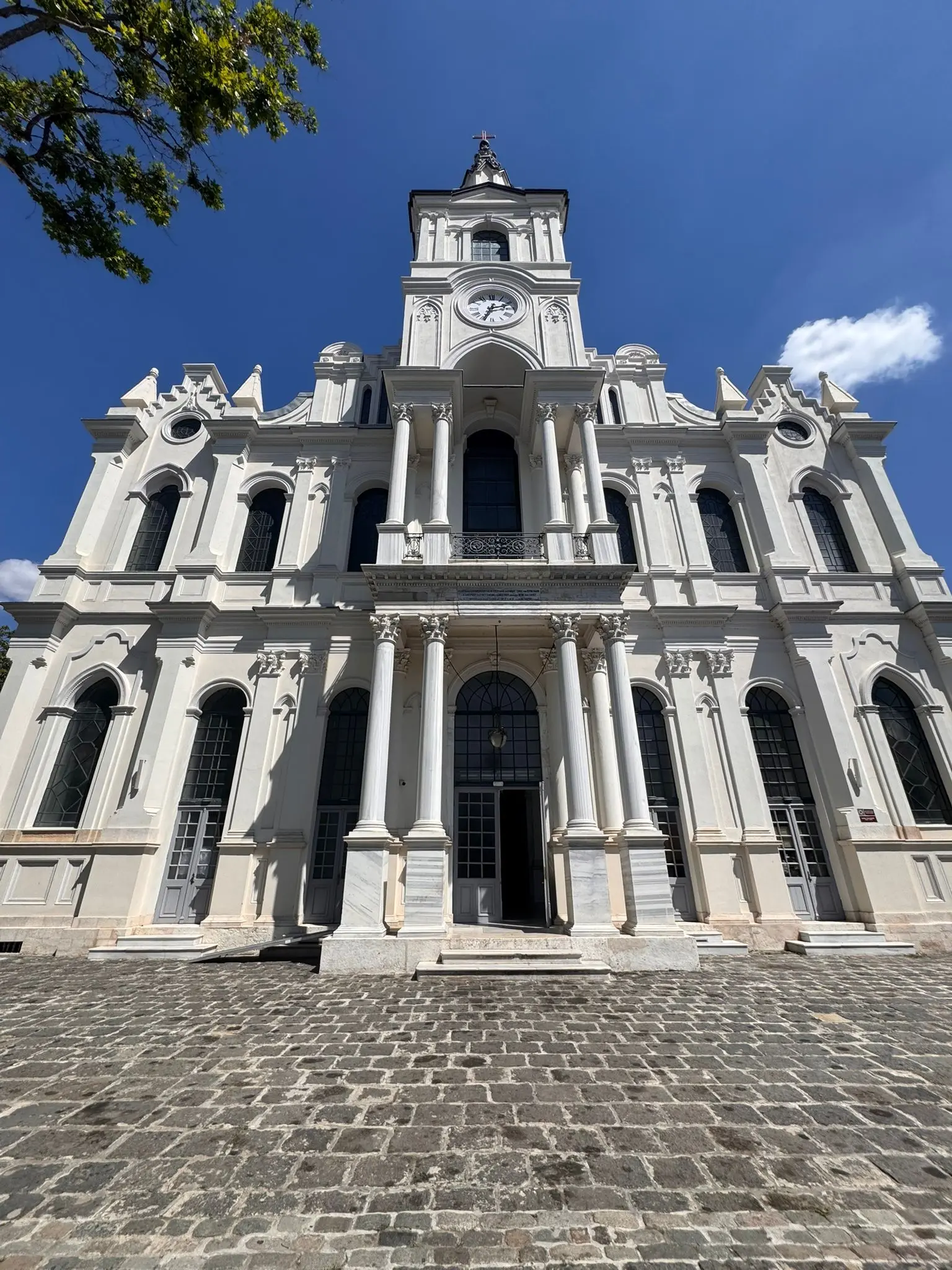
- The Church of the Holy Archangels Michael and Gabriel carries the city's strangest architectural story: a former Ottoman mosque converted into a Christian church after the Turks left. You can read it in the proportions and the structure, if you look closely.
Alongside them the city had and still has Armenian and Lipovan places of worship and synagogues — some active, some only facades. Together they map a Brăila where trade brought people, and people brought faiths.
The centre: theatre, museums and merchant houses
The heart of the city lies between the main square and the river, where the public buildings of the port's wealthy decades are concentrated.
Maria Filotti Theatre is the key landmark: a historic auditorium named after the great actress born in Brăila, and proof of how seriously cultural life was taken in a port town. It is worth seeing from outside for the facade, and from inside if you can catch a performance.
Casa Colecțiilor, the House of Collections, is for those who want the interiors: objects, furniture and collections that reconstruct the taste of the old local bourgeoisie, housed in a building that is itself part of the display.
Around them, walk the radial streets without hurrying. The eclectic facades, with their stucco, wrought-iron balconies and the initials of forgotten families, are the most honest part of the city.
The Danube, the riverfront and Grădina Mare
Brăila is a city that deserves its river. Grădina Mare, the Great Garden, is where the city meets the Danube: a historic park on the high terrace above the water, with old alleys, mature trees and a wide belvedere over the river and the wetlands opposite.
From here the view explains the local geography better than any map: the Danube does not run in one disciplined channel but splits into arms, islands and still water. At sunset, with low light on the river, this is the finest half hour of the day in Brăila.
Insula Mică a Brăilei
A few kilometres from town begins Insula Mică a Brăilei Nature Park, a protected wetland of islands, river arms, lakes and flood-plain willow forest. It is what survives of the former Balta Brăilei, a vast marsh system largely drained for agriculture.
Locals call it the little delta, and the comparison is fair: the same reed beds, the same willows, the same flocks of birds. For the real thing at full scale afterwards, the dedicated portal delta-dunarii.online covers the Danube Delta in detail.
The island is visited by boat with a local guide, and it is the best reason to add a day to a stay in Brăila.
Panait Istrati's city
Brăila has a writer who gave it a face in European literature: Panait Istrati, born here, the son of a washerwoman and a Greek smuggler, a dock labourer who became an author in French, discovered and championed by Romain Rolland.
His books are full of the port of Brăila, its innkeepers, its porters and the roads between the Danube and the Levant. Read a page of Istrati before you come and the city looks different: not just facades, but a world.
Brăila and Galați: two cities, one river
Brăila and Galați are twin cities, less than half an hour apart on the same Danube. They grew at the same time out of the same trade, and they complement each other: Brăila is the visibly older one, with its radial plan and merchant facades; Galați is the industrial port, with a long promenade and a very good modern art museum.
See them together. Details on the neighbour are in the complete guide to Galați.
When to go and how long to stay
Late spring and early autumn are ideal: the light is good for photography, the parks are at their best, and walking the centre is neither hot nor humid. Summer brings heavy Bărăgan heat — schedule museums for midday and the riverfront for the evening. Winter is windy and grey, but the churches and the theatre carry on.
For the city itself, a day and a half is enough. With two or three nights you can add Insula Mică a Brăilei and half a day in Galați. What to put on the list, attraction by attraction, is set out in what to see in Brăila, and the good areas to sleep in where to stay in Brăila.
Practical tips
- Walk the radials, not only the boulevards. The best facades are on the streets running down to the Danube.
- Look up. Many buildings are modest at shopfront level and spectacular on the upper floors.
- Arrange the Insula Mică boat in advance. This is not a trip you improvise on arrival.
- Check the theatre schedule. A performance in the historic hall transforms the evening.
- Do not rush. Brăila has no checklist, it has an atmosphere — and that takes time.
Plan your trip
Stays nearby
Stays in Romania
Experiences
Tours & activities
Guided tours, day trips and hand-picked experiences via GetYourGuide — free cancellation on most.
See all experiencesGetting to Romania
Flights, transfer & car
Fly into Romania
Compare fares to Bucharest Otopeni (OTP) and regional airports — Cluj, Sibiu, Iași, Timișoara.
Airport transfer
Private, fixed-price door-to-door transfer — driver waiting from the moment you land.
Rent a car — see the real Romania
A rental car is the key to Romania: the Transfăgărășan, the painted monasteries of Bucovina, mountain roads and the villages of Maramureș that no train reaches.
Find a car











