
Complete guide to Viscri
A Saxon village in Brașov county with a UNESCO fortified church and international fame born of King Charles III's involvement. A model of slow travel — few sights, a great deal of atmosphere.
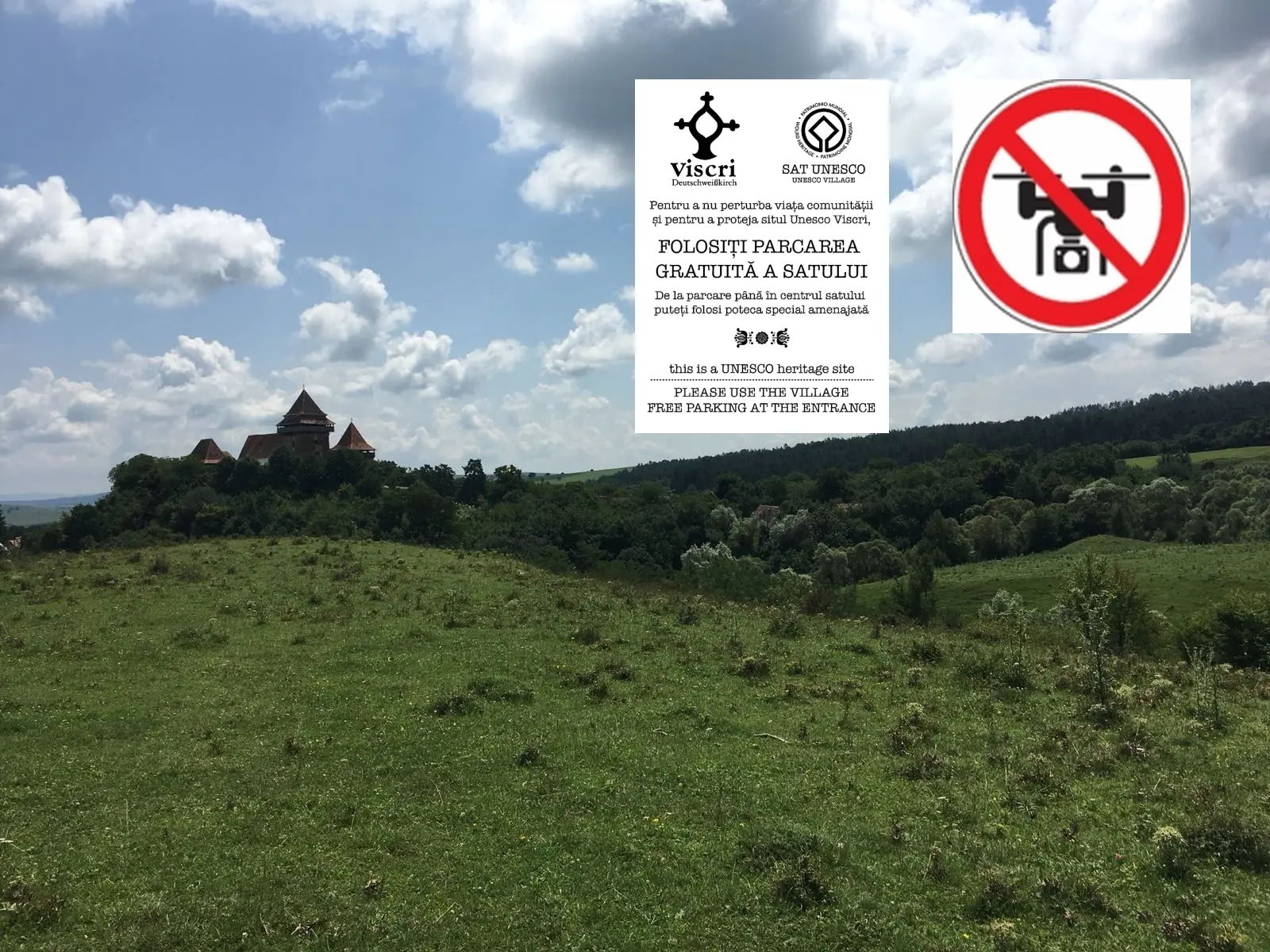
An unpaved road, houses whitewashed in blue and white, a cart passing without hurry and, at the end of the village, the tower of a fortified church. Viscri has become one of Romania's best-known villages, not because it has a great deal to tick off, but because something survived here that was lost elsewhere. This guide is honest about what you will and will not find.
Where Viscri is
Viscri is a village in Brașov county, at the end of a road that branches off the Brașov–Sighișoara route and runs deep into the hills. It is not a place you pass through: you go there on purpose. Once you arrive you understand why — the area is a mix of pasture, orchard and woodland with not a single new building in sight.
If you are exploring more widely, Viscri fits most naturally with the rest of the Brașov surroundings, which we gathered in our guide to Brașov and its surroundings.
The fortified church
The tower of the Viscri fortified church is the highest point in the village and the only sight in the classic sense. The church, white and heavy-walled, is ringed by walls and towers, and from the main tower you see the whole village: one long street, deep courtyards, the hills around.
It is inscribed on the UNESCO World Heritage list as part of the group of Transylvanian villages with fortified churches — like the other sites we collected in our article on UNESCO Romania. The historical context, meaning why a village fortified its church at all, is set out at length in the Saxon fortified churches.
Inside there is no opulence. There is simplicity: wooden pews, whitewashed walls, light coming in at an angle. The visit is short and better for it.
The connection with King Charles III
Viscri became internationally known thanks to the involvement of King Charles III, then Prince of Wales. He owns a traditional house in the village and has supported, through his foundations, the conservation of the local architecture and crafts: restoring houses with traditional materials and techniques, lime wash instead of modern paint, salvaged old tiles instead of sheet metal.
The effect shows. Viscri does not look like a village remade for tourists; it looks like a village that was kept from spoiling. The royal house can be visited in certain periods, on its own schedule — check the current status before travelling, as it is not permanently open.
The less-discussed part: the fame also brought coaches. On peak weekends the village takes in far more people than it should, and the very atmosphere you came for thins out. Go on a weekday if you can.
What to do in Viscri (and what is not there)
Be prepared: Viscri does not have many attractions. It has the church, the street and the hills. If you arrive with a checklist you will be done in two hours and disappointed. If you arrive for the atmosphere and the slow pace, a day passes without you noticing.
What is worth it:
- A walk along the main street, end to end, paying attention to the house colours and the Saxon gates.
- Climbing the church tower for the view from above.
- Workshops and local products — wool socks, slippers, cheeses, preserves. Buy directly in the village: the money stays with the people here.
- A walk on the hills, along the pasture tracks around the village. In spring the hay meadows here are extraordinary.
- A meal with a host family, with food cooked in the house.
A little history, so you understand what you see
Viscri was a Saxon village, founded by German-speaking settlers who built the church and fortified it against repeated raids. After 1990 almost the entire Saxon community emigrated to Germany, and the houses passed to Romanian and Roma families, who live in the village today.
That matters for the visit: what you see is not an open-air museum but an inhabited village, with smallholdings, animals and daily work. The yards are private and the people are not scenery. Ask before photographing anyone, and do not walk into courtyards uninvited — that is the difference between a visitor and a rude tourist.
More than anything, Viscri is a model of slow travel. You will find the same logic in the villages of Maramureș, with a different architectural style and a different community, but the same principle: the place reveals itself when you walk slowly.
Getting there
- By car, off the Brașov–Sighișoara road and along the side road into the village. The last stretch is modest, and inside the village the road stays unpaved — deliberately so, as part of conserving the place. Drive slowly.
- By public transport it is difficult. Connections are rare and unreliable; without a car, the best option is a transfer arranged by your accommodation.
Park where indicated and walk in. The village is small, and cars on the main street ruin exactly what you came to see.
When to go and how long to stay
- Spring and early summer — flowering hay meadows, greenery, long days. The best window.
- Autumn — colour, quiet, fewer visitors.
- Winter is beautiful but cold, with short days and reduced services in the village.
One day is the reasonable minimum. One night with a host family is the version that changes the visit entirely: in the morning, before the cars arrive, Viscri is exactly the village from the photographs.
Plan your trip
Stays nearby
Stays in Romania
Experiences
Tours & activities
Guided tours, day trips and hand-picked experiences via GetYourGuide — free cancellation on most.
See all experiencesGetting to Romania
Flights, transfer & car
Fly into Romania
Compare fares to Bucharest Otopeni (OTP) and regional airports — Cluj, Sibiu, Iași, Timișoara.
Airport transfer
Private, fixed-price door-to-door transfer — driver waiting from the moment you land.
Rent a car — see the real Romania
A rental car is the key to Romania: the Transfăgărășan, the painted monasteries of Bucovina, mountain roads and the villages of Maramureș that no train reaches.
Find a car











