
Complete guide to Turda
A town built on salt, half an hour from Cluj-Napoca: a medieval mine turned spectacular underground space, salt lakes for treatment and swimming, a limestone gorge at the edge of the Apuseni, and a history that starts with the Romans of Potaissa.
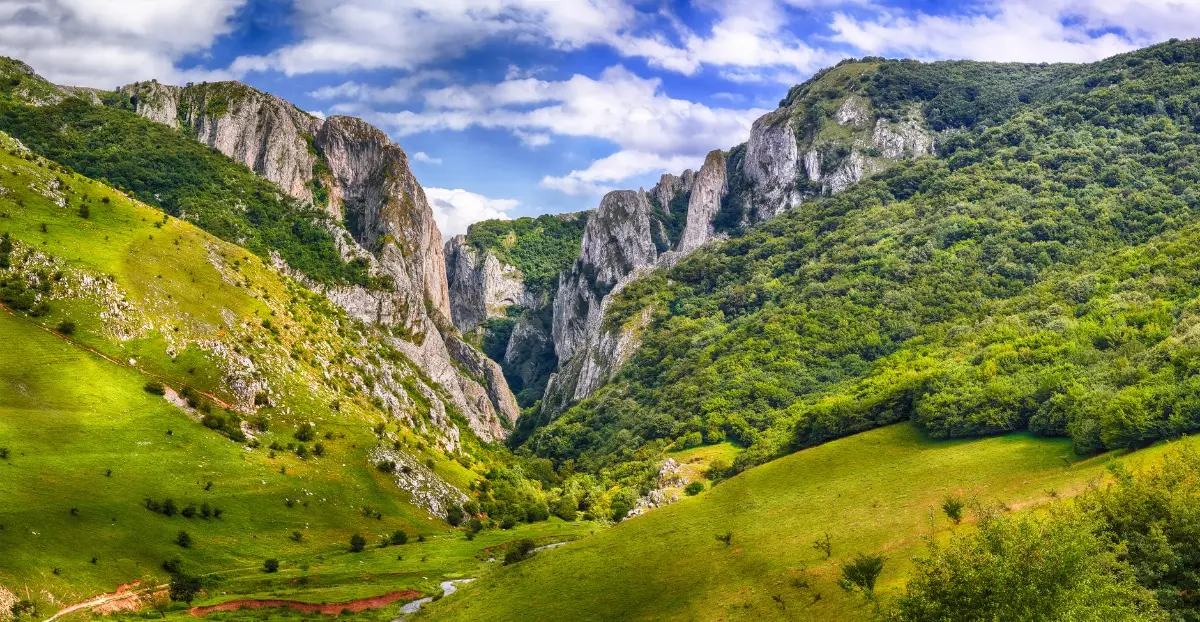
Turda does not make a fuss about itself, and that is precisely what makes it surprising. The town just south of Cluj-Napoca sits on top of one of Romania's most spectacular attractions, surrounded by a landscape of salt, limestone and mineral water that looks like nothing else in Transylvania. At its foundation lies Potaissa, a Roman fort and town — the story here begins almost two thousand years ago.
Why Turda
For many travellers, Turda means a couple of hours on the road between Cluj and Alba Iulia. The first visit corrects that: the town has enough layers to fill a comfortable weekend.
- A spectacular underground: the medieval salt mine, turned into a visitable space, is one of Romania's signature images.
- Salt water above ground: the lakes at Băile Sărate Turda are used for treatment and, in summer, as a beach, in a long-standing spa tradition.
- Nature a few kilometres away: Cheile Turzii, the Turda Gorge, cuts through the hills with limestone walls and a trail that follows the stream.
- Real history, not decoration: Potaissa, the Voivodal Palace, and one of Europe's earliest acts of religious tolerance, signed right here.
Potaissa, the town underneath
Turda was born Roman. A fort was built here and around it grew Potaissa, one of the significant settlements of Roman Dacia. The reason was simple, and it is still under the town: salt. The resource brought the army, then trade, then the town itself.
Traces of the fort can still be read on the high ground above the streets, and the finds from the site explain why the local museum deserves a stop before anything else. If you like understanding a place before photographing it, this is the starting point: everything else — the mine, the lakes, the town's medieval wealth — comes from the same salt.
After the Roman withdrawal, extraction continued under successive rulers, and in the Middle Ages Turda salt travelled the trade roads of Transylvania. The town you see today is the product of that continuity: not a settlement that reinvented itself several times over, but one that patiently did the same thing for two millennia.
Salina Turda, in brief
The medieval salt mine, transformed into an underground visiting space with a panoramic wheel and a lake you can row on, is the reason most visitors come. Its scale is hard to convey in words: galleries as tall as cathedrals, walls still marked by chisels, and a dry, salty air completely unlike the one at the surface.
Because it deserves unhurried treatment, we covered the descent and what you see below in detail in what to see in Turda. Here we look at the rest of the town — the part people in a hurry miss.
The salt baths and the spa tradition
On the edge of town, Băile Sărate Turda are a direct inheritance of salt mining: intensely salty lakes formed in the old workings, used for generations as a treatment base and, in summer, as a beach.
- For treatment: the salt water and mud have long been used for rheumatic conditions and recovery.
- For the beach: in summer, the lakes are the closest thing to the seaside for the whole of central Transylvania.
- For floating: the high salinity turns swimming into floating — a sensation children love.
It is an attraction barely promoted abroad, yet perfectly woven into the local rhythm: underground in the morning, in the water in the afternoon.
Turda Gorge and the edge of the Apuseni
A few kilometres from town, Cheile Turzii form one of Transylvania's finest nature reserves: a narrow defile with vertical limestone walls, crossed by a trail that follows the stream over footbridges and past small cascades.
It is not a hard hike, but it does ask for proper shoes and a little attention. The reward comes immediately: minutes after you enter the gorge, the town disappears from the landscape entirely.
Beyond the gorge, the Apuseni Mountains begin — limestone country with caves, gorges and villages scattered across the hills. Turda is effectively their north-eastern gateway, and anyone with a spare day spends it there.
The town on foot
Turda's centre is easy to walk and holds two stops worth your time.
- The History Museum in the Voivodal Palace occupies one of the town's most valuable old civic buildings. Its collections cover the road from Potaissa to medieval and modern Turda — exactly the thread you need to connect every other attraction.
- Parcul Central, the central park, is where the town breathes: shaded paths, benches, a slow pace. Ideal for a pause between the underground and the gorge.
One detail deserves to be far better known: in 1568, the Edict of Turda was proclaimed here, one of the earliest acts of religious tolerance in Europe. For a town this size, that is an enormous legacy — and an invitation to look differently at the streets you are walking.
Turda as a base
The map works in the town's favour. To the north, about half an hour away, is Cluj-Napoca, with an international airport and all the urban choice you might want in the evening. To the west the Apuseni begin, with caves, waterfalls and hill villages. To the south, the road drops towards Alba Iulia and central Transylvania.
In practice, you can build three completely different days out of Turda without changing accommodation: one underground and urban, one hiking in the gorge, one in the mountains at Huda lui Papară cave and Pișoaia waterfall. Few small Romanian towns offer that range within an hour's drive.
Practical information
- When to come: May to September gives you the best combination — an accessible gorge and lakes open for swimming. The salt mine can be visited year-round, and in summer it is the ideal escape from the heat, since the underground stays consistently cool.
- How many days: one day covers the essentials; two days give you the mine, the lakes, the gorge and the centre without rushing.
- Getting there: the nearest airport is Cluj-Napoca, around half an hour away. The town is easy to reach by road, and connections with Cluj are frequent.
- Getting around: the centre works on foot, but for the gorge, the lakes and the Apuseni a car gives you the freedom you need.
For the full list of sights in the order that actually makes sense, read what to see in Turda. And to choose where to sleep — the centre, near the mine, near the lakes, or Cluj as a base — see where to stay in Turda.
Turda rewards exactly those visitors who refuse to treat it as a stopover: a small town built on salt, with an underground of European stature and nature that starts at the end of the last street.
Plan your trip
Stays nearby
Stays in Romania
Experiences
Tours & activities
Guided tours, day trips and hand-picked experiences via GetYourGuide — free cancellation on most.
See all experiencesGetting to Romania
Flights, transfer & car
Fly into Romania
Compare fares to Bucharest Otopeni (OTP) and regional airports — Cluj, Sibiu, Iași, Timișoara.
Airport transfer
Private, fixed-price door-to-door transfer — driver waiting from the moment you land.
Rent a car — see the real Romania
A rental car is the key to Romania: the Transfăgărășan, the painted monasteries of Bucovina, mountain roads and the villages of Maramureș that no train reaches.
Find a car











