
Complete guide to Rimetea
White facades, green shutters and a limestone wall above the rooftops: a guide to the best-preserved village in Transylvania, Romania's first Europa Nostra laureate, with Piatra Secuiului, the ethnographic museum and the Vălișoara gorge.
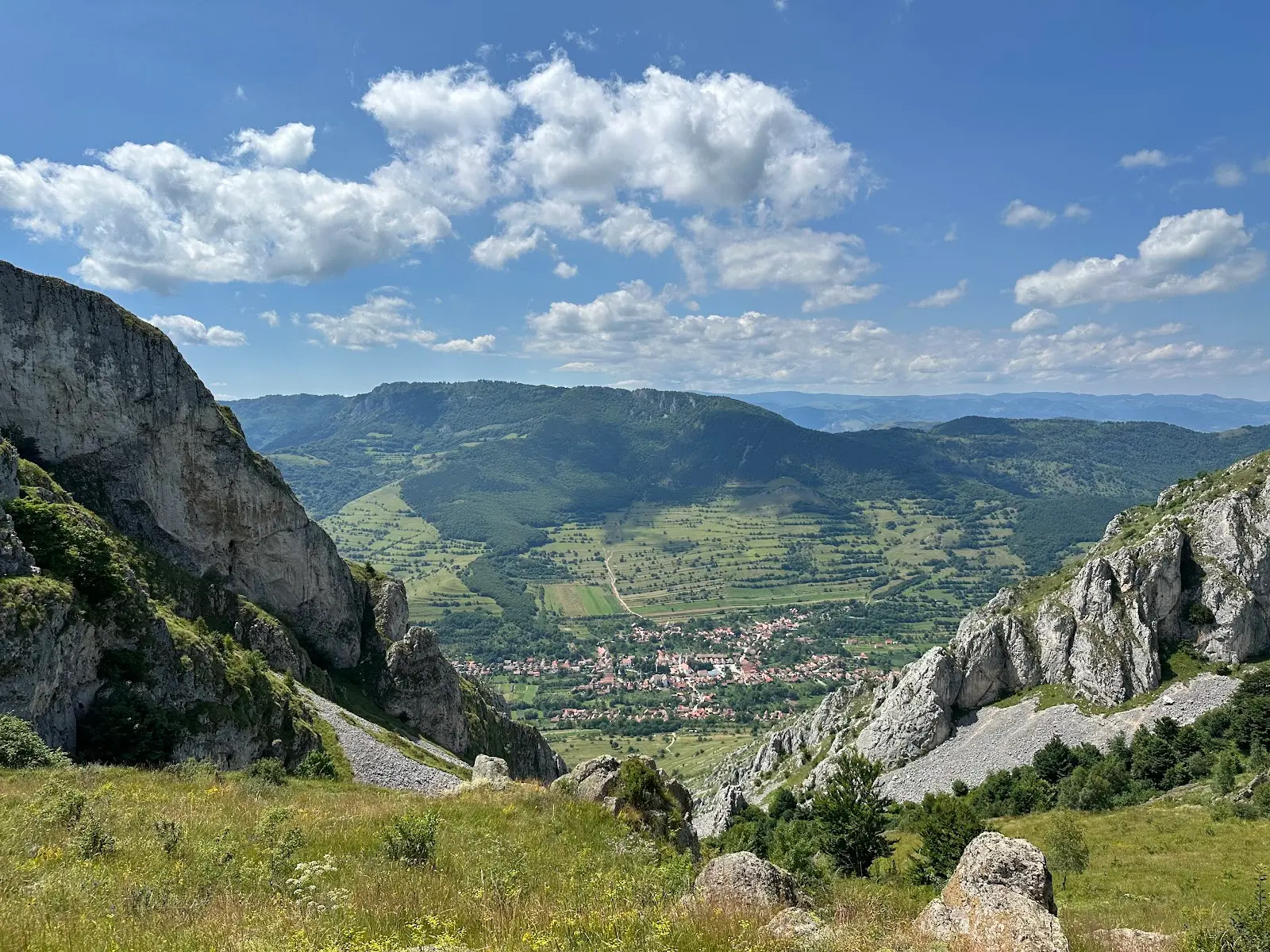
There are beautiful villages in Transylvania, and then there is Rimetea. White houses lined neatly along the street, green shutters at the windows, wooden gates — and above it all the limestone wall of Piatra Secuiului. This village in Alba county won Romania's first Europa Nostra award for heritage conservation, and you can see why from the first street.
Why come here
Rimetea — Torockó in Hungarian — sits at the foot of the Trascău Mountains, with a largely Hungarian population from the Szekler-Hungarian community settled here for centuries. Its history is bound up with mining and ironwork: iron was dug and worked here, and the money the craft brought in built the houses you see today.
What sets Rimetea apart from other picturesque villages is its discipline. The facades are white, the joinery green, the roofs share one pitch, and the houses stand gable-end to the street. This is not stage design: it is a local architectural code, upheld by the community and then protected through a restoration programme that earned the village the Europa Nostra award — the first granted in Romania for built-heritage conservation.
The result is the best-preserved vernacular village in Transylvania and, at the same time, an excellent base for hiking. For the wider region, from the Apuseni range to mountain village life, start with our guide to the Apuseni and the Land of the Moți.
The village, street by street
Rimetea is best seen on foot, without a plan. A few things to look for:
- the main street, with its row of white facades and green shutters — the village's most photographed image;
- the gates and joinery made locally, with profiles and colours repeating from house to house;
- the village churches, witnesses to confessional coexistence, among them the Unitarian church;
- the farmyards, with barns, stables and workshops, many restored using traditional materials.
If you want to know how that conservation actually works — lime, timber, wrought iron, local craftsmen — the thread continues in our guide to traditional crafts.
Piatra Secuiului
Piatra Secuiului, the Szekler Stone, is the mountain that gives the village both its skyline and its Hungarian name. A limestone wall rising sharply above the roofs, with a long summit ridge and views across the whole of the Trascău.
The climb goes up a marked path straight out of the village. It is not technical, but there are steep and exposed sections, and limestone turns slick in the damp — boots, water and an eye on the weather. From the top the village reads like a map, every roof in line.
The area is also a classic climbing ground, with routes on the limestone faces. If the mountain matters to you more than the village, the Trascău's routes and conditions are covered on munte.online.
The sun that rises twice
The local phenomenon everyone will tell you about: because Piatra Secuiului rises to the east of the village, at certain times of year the sun appears once above a saddle in the ridge, vanishes behind the crest, and then rises a second time a little later.
It is not a legend, it is geometry — but it is exactly the sort of detail that explains why this village has such a particular relationship with the mountain above it. Ask locals which weeks show it best.
The Ethnographic Museum
The Ethnographic Museum of Rimetea is the stop that connects the village to its story. Housed in a traditional dwelling, it shows the inside of a local household: painted furniture, textiles, pottery, tools, costume and, inevitably, traces of the mining and ironwork that made the place prosperous.
It is a small community museum, and that is precisely its worth: after an hour you understand why the houses look the way they do.
Cheile Vălișoarei
A few kilometres away, Cheile Vălișoarei cuts the limestone into a narrow gorge, with vertical walls and a road running through it. It is easily covered on foot, or by car if time is short, and it is one of the most accessible gorges in the Trascău.
For climbers these walls are a destination in their own right. For everyone else it is an hour's walk that shows you what the Trascău looks like from the inside.
What to eat
The cooking here is Transylvanian with a Hungarian accent, and the best meals are taken at your guesthouse rather than in a restaurant. Look for sour soups, goulash and long-simmered stews, cabbage with pork, langos, and kürtőskalács, the sweet chimney cake baked on a spit, at village events. Summer brings jars of jam and flower syrups; winter food is heavy and good, as in any mountain village. Tell your host in advance if you want dinner: it is cooked to order, not kept warm.
When to come
- May–June — hay meadows in flower, dry paths, a quiet village.
- July–August — the busiest, but also the liveliest, with local events.
- September–October — the best light for photography and the best conditions for climbing Piatra Secuiului.
- Winter — white on white, very beautiful, though the ridge path turns serious.
Getting there and where to stay
Rimetea is reached most easily from Turda, on the road towards Buru and then up the valley into the village; it is a short detour off the Cluj–Alba Iulia axis. If you are starting there, or want to combine the trip with the salt mine, use our Turda guide.
Accommodation is in the village itself, in restored traditional houses and small family guesthouses — one of the most agreeable places to sleep in Transylvania, because you stay inside the very heritage you came to see. Beds are few; in summer, book ahead.
In short
- Come to Rimetea for the village: white facades, green shutters, Romania's first Europa Nostra recognition.
- Add the Ethnographic Museum for context and Piatra Secuiului for the view.
- Cheile Vălișoarei completes the day, and the climbing is reason enough to stay longer.
- The stops, with a weekend plan, are in our article on what to see in Rimetea and the Trascău.
Plan your trip
Stays nearby
Stays in Romania
Experiences
Tours & activities
Guided tours, day trips and hand-picked experiences via GetYourGuide — free cancellation on most.
See all experiencesGetting to Romania
Flights, transfer & car
Fly into Romania
Compare fares to Bucharest Otopeni (OTP) and regional airports — Cluj, Sibiu, Iași, Timișoara.
Airport transfer
Private, fixed-price door-to-door transfer — driver waiting from the moment you land.
Rent a car — see the real Romania
A rental car is the key to Romania: the Transfăgărășan, the painted monasteries of Bucovina, mountain roads and the villages of Maramureș that no train reaches.
Find a car











