
What to see in Rimetea and the Trascău
The village of green shutters, the ethnographic museum, the Piatra Secuiului ridge and the Vălișoara gorge — the stops in Rimetea and the Trascău Mountains, tied into a weekend plan.
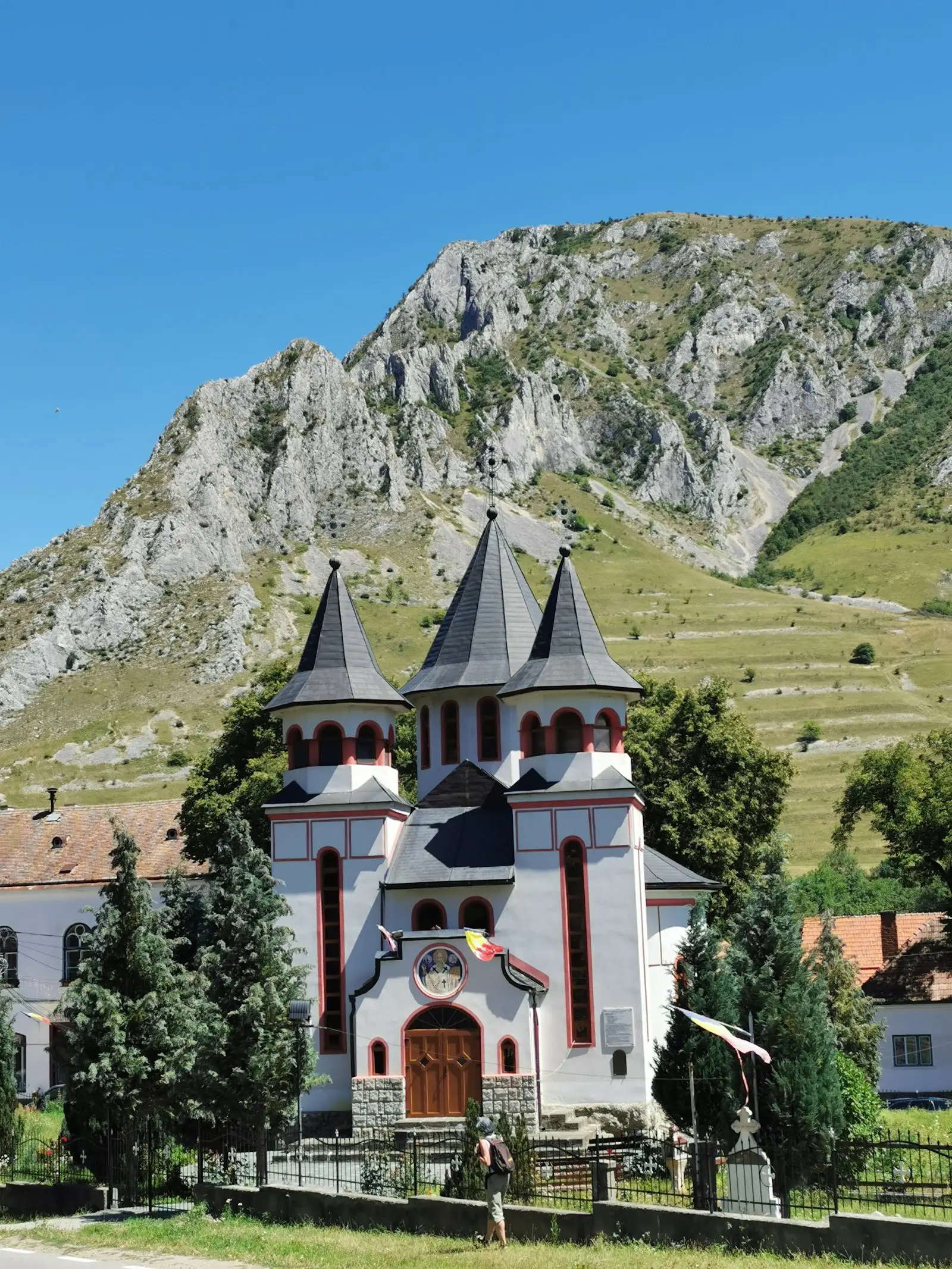
Rimetea takes a morning to see and holds you for a whole day. The village itself is the main attraction — white facades, green shutters, the same discipline from house to house — but around it, in the Trascău Mountains, there are gorges, ridges and a castle that fill out a weekend. Here are the stops worth making, in the order they link up.
1. The village, on foot
Start without an objective. Walk the main street, look at the gates, the joinery, the way every house stands gable-end to the road. This is the only village in Romania to have won the Europa Nostra award for built-heritage conservation, and it shows: nothing has been patched up with PVC windows and shiny sheet metal.
Look for the village churches, the Unitarian one among them, and the farmyards with their barns and workshops. The village is home to a largely Hungarian community, from among the Szekler-Hungarians settled here for centuries, and you will see its Hungarian name — Torockó — on signs beside the Romanian one.
A few details that reward a closer look:
- colour — lime white on the walls, green on shutters and joinery, the same shade from one end of the street to the other;
- orientation — houses stand gable-end to the road, so the facade you see is in fact the end of the house;
- ironwork — hinges, nails, fittings: the traces of the craft that brought money into the village;
- the central square, where the markets were held and where the community still gathers.
For the regional context — the Apuseni, mountain villages, the Land of the Moți — see our guide to the Apuseni and the Land of the Moți.
2. The Ethnographic Museum
The Ethnographic Museum of Rimetea belongs at the start of the day, not the end: it teaches you how to read the village. A traditional house holds painted furniture, textiles, pottery, tools and costume, plus the record of the mining and ironwork that brought money into the village and paid for those white houses outside.
It is small and very concrete. An hour is enough, and afterwards you walk the street differently. If you want the techniques behind it all, continue with our guide to traditional crafts.
3. Piatra Secuiului
Piatra Secuiului is the limestone wall that dominates the village and, for many, the reason to come. The marked path leaves the village and climbs to the ridge, with views across the Trascău and over the village laid out like a map.
What to know:
- it is not a technical route, but there are steep and exposed sections;
- limestone gets slippery in the damp — boots, not city trainers;
- weather changes fast on the ridge; check the forecast first;
- climbing here has serious sectors on the limestone faces — routes and conditions are covered on munte.online.
If you catch the right weeks, ask locals about the sun that rises twice, thanks to the saddle in the ridge.
4. Cheile Vălișoarei
Cheile Vălișoarei lies a few kilometres away and is easy going: a narrow gorge with vertical limestone walls and a road running through it. On foot it takes an hour, but it is also one of the few gorges you can see without hiking at all, which helps with small children or a tight schedule.
The walls are popular with climbers, and in summer it is a cool place to stop on the way back from the mountain. If you walk it, enter from the lower end and go up slowly: the walls close in gradually, and the narrowest stretch comes around the middle. No equipment needed — and no need to hurry either.
What to eat
Meals are taken at your guesthouse, and the cooking is Transylvanian with a Hungarian accent: sour soups, goulash, long-simmered stews, cabbage with pork, langos and, at village events, kürtőskalács, the sweet chimney cake baked on a spit. In summer there are home-made jams and flower syrups for sale.
Two things to remember: dinner is ordered in advance, because it is cooked to request, and a post-hike lunch is safer booked than hunted — the village has few tables, and at weekends they fill up.
5. Around, in the Trascău
If you stay two days:
- Trascău Castle at Colțești, in the neighbouring village — ruins on a crag, with one of the finest views in the area.
- Râmeț and Întregalde gorges, further south, for anyone who wants serious gorges and rare flowers.
- Turda, to the north, with its salt mine and old town — see our Turda guide.
- The surrounding villages, with similar architecture, less restored and without visitors.
All of these sit within half an hour's drive of Rimetea, which makes the village a better base than it first appears: you sleep inside the very heritage you came to see and head for the mountains in the morning, with no long transfers.
A weekend plan
Day 1. Morning: the ethnographic museum and the village on foot. Lunch at a local guesthouse. Afternoon: the climb up Piatra Secuiului, for the evening light on the ridge.
Day 2. Cheile Vălișoarei in the morning, Trascău Castle at Colțești around midday, then on towards Turda or Alba Iulia.
If you only have one day, sacrifice the gorge, not the village: Rimetea on foot, the museum and a partial climb up Piatra Secuiului as far as the first viewpoint fit comfortably between morning and sunset.
Practical tips
- Sleep in the village. The restored traditional houses are part of the experience; beds are few, so book ahead.
- Avoid the August peak if you want empty streets for photographs.
- Carry cash. In small villages, cards do not always work.
- Respect the village. People live in the houses you are photographing; ask before stepping into a yard.
- For the background — Europa Nostra, the Hungarian community, the mining, the double sunrise — read our complete guide to Rimetea.
Plan your trip
Stays nearby
Stays in Romania
Experiences
Tours & activities
Guided tours, day trips and hand-picked experiences via GetYourGuide — free cancellation on most.
See all experiencesGetting to Romania
Flights, transfer & car
Fly into Romania
Compare fares to Bucharest Otopeni (OTP) and regional airports — Cluj, Sibiu, Iași, Timișoara.
Airport transfer
Private, fixed-price door-to-door transfer — driver waiting from the moment you land.
Rent a car — see the real Romania
A rental car is the key to Romania: the Transfăgărășan, the painted monasteries of Bucovina, mountain roads and the villages of Maramureș that no train reaches.
Find a car











