
Complete guide to Putna
The village in northern Bukovina that lives around Stephen the Great's foundation and burial place. A measured guide to the monastery, its medieval embroideries, Daniil the Hermit's cell and the waterfall in the woods.
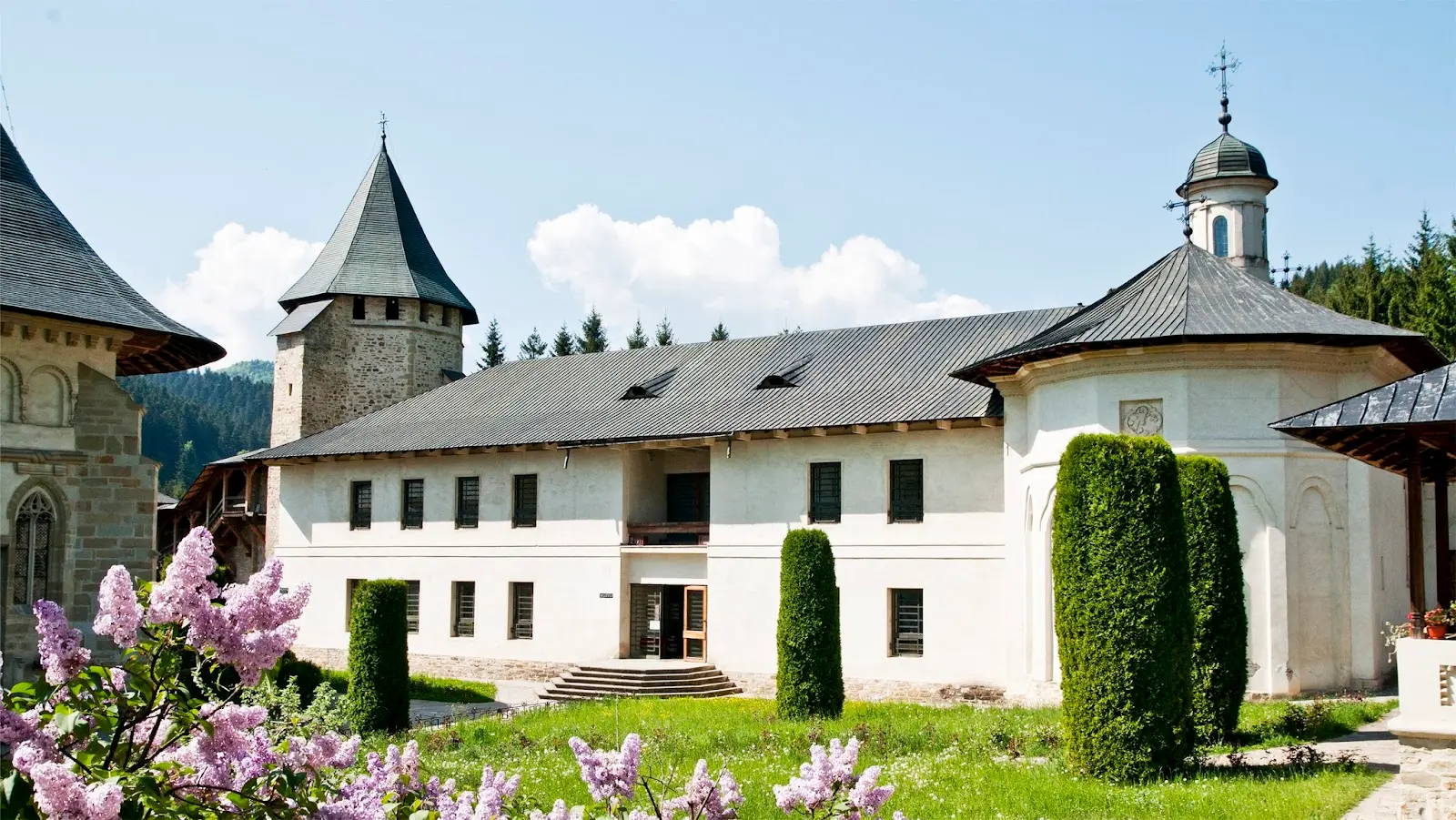
At Putna the road from the south runs out and the quiet begins. This village in northern Bukovina lives around a monastery that is not only a princely foundation but a burial place: beneath a marble slab inside the church lies Stephen the Great. Few places in Romania hold so much memory in a single square kilometre.
Why come here
Putna is a village in Suceava county, at the northern edge of Bukovina, where the hills close into beech and spruce forest and the Ukrainian border sits just beyond the ridge. Nobody passes through Putna by accident. People come on purpose, for the monastery.
Putna Monastery is the first great foundation of Stephen the Great and the place he chose as his family's necropolis. That is why it later came to be called „the Jerusalem of the Romanian nation” — a grand phrase, but one that describes exactly what visitors feel when they step inside and see the lamp burning at Stephen's tomb.
One thing is worth knowing in advance: Putna is not one of the churches with exterior frescoes. If you came for Voroneț blue and a Last Judgement painted on an outside wall, those are an hour away and gathered in our guide to the Bukovina monasteries. Putna is something else — a place of remembrance rather than a museum of painting. For the wider region, from villages and traditions to food, start with the Bukovina guide.
The church and Stephen's tomb
The main church, dedicated to the Dormition of the Mother of God, was raised in the last decades of the 15th century at Stephen's command. Fires, earthquakes and successive rebuildings changed its silhouette, but the Moldavian plan survives: narthex, burial chamber, nave and altar — and in the burial chamber, the princely tombs.
Stephen's slab is there, carved in marble and sheltered by a canopy. His wives and several direct descendants rest alongside him. People come, bow, touch the stone and fall silent. It is the kind of quiet that cannot be explained, only experienced.
Elsewhere in the walled precinct you will find:
- the treasury tower, the oldest surviving structure from Stephen's time, built to shelter the monastery's valuables;
- the Buga bell, given according to tradition by the prince himself and counted among the oldest in Moldavia;
- the monks' cells and the chapel, rebuilt in successive layers, and the monastery cemetery.
Putna also has a modern history that matters. In the 19th century it hosted the great celebration in honour of Stephen the Great, organised by young Romanians from the Austro-Hungarian Empire — among them the poet Mihai Eminescu and the writer Ioan Slavici. For that generation Putna was already a political symbol, not merely a church.
The monastery museum
The Putna monastery museum is the reason not to leave the moment the service ends. Its collection is among the most valuable in Romania: medieval embroideries worked in gold and silver thread, tomb covers, liturgical stoles, old manuscripts and early printed books, crosses, chalices and icons.
What impresses is not the quantity but the provenance — many pieces were donated by the founder and his family. You look at an embroidery and you are in fact looking at the court workshop of 15th-century Moldavia. If you have patience for display cases and captions, give it a full hour.
The cell of Daniil the Hermit
A few kilometres from the monastery, on the riverbank, stands the cell of Daniil the Hermit — a hermitage hand-cut into the rock, with tiny chambers: a chapel, a space for prayer, a sleeping niche hollowed out of stone.
Daniil was Stephen the Great's confessor, and tradition holds that the prince came here for counsel in hard hours, before battle. The place is minuscule and disarmingly plain — the opposite of a princely monastery's splendour — and that is precisely why it stays with you. Access is easy, right off the road, and the visit takes about as long as a walk.
Putna waterfall and the forest around
The Putna waterfall rewards anyone who wants a dose of nature too. Water drops over rock steps into a wooded gorge, and the approach is a footpath through beech trees. In late spring, with the snowmelt, it runs strongest; in summer it is a cool refuge; in autumn the forest does all the work.
It is not a spectacular Carpathian waterfall, but it matches the rhythm of the area perfectly: an hour of walking, cold water, silence.
When to come
- Late spring and summer — the easiest access, plenty of water at the falls, the village at its greenest.
- Summer feast days — the monastery fills up and the atmosphere is powerful, but the quiet disappears. If you want stillness, avoid the major festival dates.
- Autumn — the finest light in Bukovina and the fewest cars.
- Winter — harsh and very beautiful, with roads that demand care.
Getting there and where to stay
The nearest town is Rădăuți; coming from Suceava, the drive takes a good part of a morning, especially if you stop along the way. A car is by far the most practical option, because it lets you combine Putna with Sucevița and Marginea in the same day. If you are starting from Bukovina's main city, plan the route with our Suceava guide.
Accommodation is in the village and the surrounding communes — small family guesthouses with home cooking. There are not many beds, so in high season book ahead.
In short
- Come to Putna for the monastery, Stephen the Great's tomb and the museum — not for exterior frescoes.
- Allow at least half a day: the church, the museum, Daniil's cell.
- Add the waterfall if you want a walk, and Sucevița if you want wall painting.
- The full list of stops, with a two-day plan, is in our article on what to see at Putna and around.
Plan your trip
Stays nearby
Stays in Romania
Experiences
Tours & activities
Guided tours, day trips and hand-picked experiences via GetYourGuide — free cancellation on most.
See all experiencesGetting to Romania
Flights, transfer & car
Fly into Romania
Compare fares to Bucharest Otopeni (OTP) and regional airports — Cluj, Sibiu, Iași, Timișoara.
Airport transfer
Private, fixed-price door-to-door transfer — driver waiting from the moment you land.
Rent a car — see the real Romania
A rental car is the key to Romania: the Transfăgărășan, the painted monasteries of Bucovina, mountain roads and the villages of Maramureș that no train reaches.
Find a car











