
Complete guide to Praid
One of Europe's largest salt mines, a salt mountain protected as a geological reserve, and the centre of Székely ceramics at Corund. Note: the mine was affected by flooding in 2025 and access may be limited — check the status before you travel.
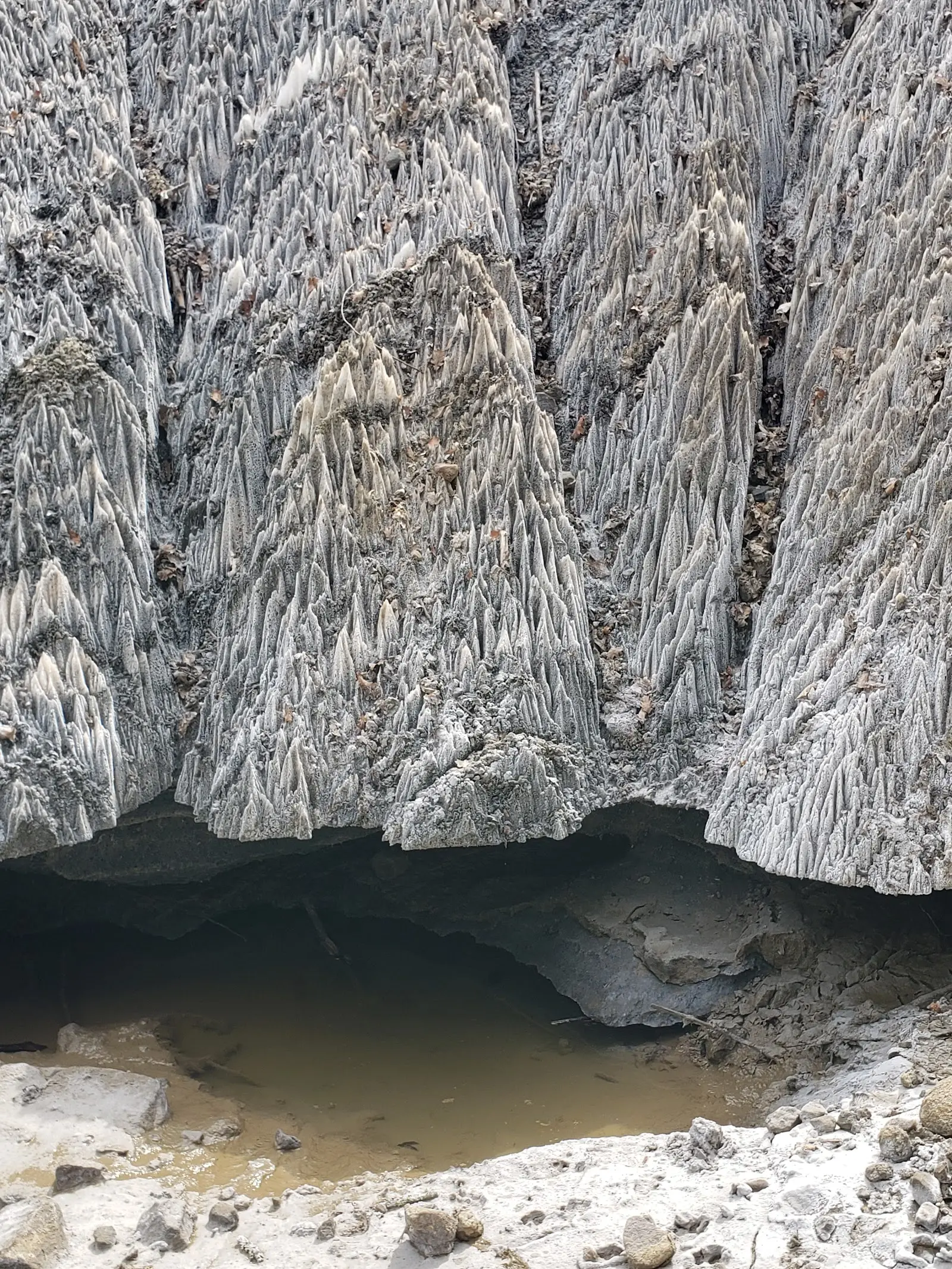
At Praid, the ground is salt. Beneath it lies one of the largest salt mines in Europe; above it rises a grey-white mountain in which rain carves miniature canyons; and a few kilometres away the potters' wheels of Corund are still turning. This guide gathers what is worth seeing — and one important warning about access to the mine.
Where Praid is
Praid is a commune in Harghita county, in the Székely Land, on the valley of the Târnava Mică among wooded hills. This is a largely Hungarian-speaking area, with a cuisine, an architecture and a calendar of festivals of its own.
Its position suits a short circuit: Sovata, with its heliothermal lake, is nearby, and Odorheiu Secuiesc is the closest town with full services. Praid, Sovata and Corund link naturally into one weekend.
Praid salt mine — read this before you travel
The salt mine is the main reason people come. It is one of the largest in Europe, with galleries arranged for visits and, more importantly, for the treatment of respiratory conditions in the underground microclimate: air of constant humidity, stable temperature and salt aerosols. For generations, families with asthmatic children have made the journey to Praid specifically for this.
Important warning: the mine was affected by flooding in 2025, and access may be restricted. Visits may be limited or closed, depending on the works and on the operator's decisions. Do not set out assuming you will be able to go underground — check the current status with the operator or your accommodation before you leave. If you are planning a stay for treatment, all the more so: confirm in writing before booking.
On how Romania's salt mines work for both tourism and treatment, and what the alternatives are, we wrote in the salt mines of Romania — useful above all if you need to change destination.
The Salt Mountain and the geological reserve
Even without underground access, Praid has something you do not see in many places: the Salt Mountain, a salt massif that reaches the surface and is protected as a geological reserve.
The Praid salt reserve looks different from what you expect — not postcard-bright white but grey, furrowed, shaped by rain into small canyons, ridges and lenses of polished salt. In places there are salt springs and halophile vegetation, meaning plants that grow only on salty ground.
You visit on foot, along the marked paths. Simple common-sense rules: do not break pieces off the formations, do not leave the path (salt is friable and the ground can give way) and avoid visiting straight after heavy rain.
Corund and Székely ceramics
A few kilometres from Praid lies Corund, the centre of Székely ceramics — probably the best-known potters' village in Romania. Along the Corund valley run workshops, houses with pottery hung on the fences, and a permanent pottery market that greets you at the edge of the village.
The important advice: go into the workshops, do not stop at the first roadside stalls. The stalls carry everything, including goods brought in from elsewhere. The workshops have the potter at the wheel, the glaze on the table and the kiln in the yard. The difference in quality and price is real, and the conversation with the craftsman is half the experience.
What is made at Corund: glazed pots and mugs with traditional motifs, decorative plates, jugs, black pottery and, more recently, modern decorative pieces. On the crafts still practised in Romania, and how to recognise genuine work, we wrote in traditional crafts.
What to eat in the area
The Székely Land has a cuisine of its own, with clear Hungarian accents and serious portions. What you will almost certainly find at guesthouses and at the places to eat in Praid, Corund or Sovata:
- Sour soups and broths finished with sour cream, served as a substantial first course.
- Cabbage dishes and stews seasoned with paprika.
- Kürtőskalács, the Székely chimney cake baked on a spit, usually at markets and roadside stands.
- Home-made pies and sweets at the local accommodation.
Many guesthouses cook to order rather than from a menu — say in advance if you need something meat-free.
Getting there
- By car is the recommended option: the area is visited at several points (the mine, the Salt Mountain, Corund, Sovata) which are close together but not walkable.
- By public transport there are buses linking Praid with Odorheiu Secuiesc, Târgu Mureș and Sovata, but the timetable heavily constrains the day. Check in advance.
When to go and how long to allow
- Spring and autumn are the best: hill country, green, without crowds.
- Summer is peak season, with many visitors at Corund and Sovata.
- Winter makes sense if the underground is the main purpose — but that is exactly where the current uncertainty lies.
One day covers the Salt Mountain and Corund at a relaxed pace. Two or three days make sense if visiting the mine is possible and you want to combine it with Sovata. Respiratory treatment usually means several days — but, again, confirm first that the mine is receiving visitors.
Practical tips
- Check the status of the mine before making any booking. It is the only advice that truly matters right now.
- The underground is cold even in August. If you go in, bring a coat and closed shoes.
- At Corund, bargain politely and ask to see the workshop.
- The area is Hungarian-speaking: a köszönöm as you leave a workshop goes further than you think.
Plan your trip
Stays nearby
Stays in Romania
Experiences
Tours & activities
Guided tours, day trips and hand-picked experiences via GetYourGuide — free cancellation on most.
See all experiencesGetting to Romania
Flights, transfer & car
Fly into Romania
Compare fares to Bucharest Otopeni (OTP) and regional airports — Cluj, Sibiu, Iași, Timișoara.
Airport transfer
Private, fixed-price door-to-door transfer — driver waiting from the moment you land.
Rent a car — see the real Romania
A rental car is the key to Romania: the Transfăgărășan, the painted monasteries of Bucovina, mountain roads and the villages of Maramureș that no train reaches.
Find a car











