
Complete guide to Focșani
The seat of Vrancea county sat exactly on the border between Moldavia and Wallachia until the Union of 1859 — and today it is the capital of the Odobești–Panciu–Cotești vineyards. A guide to the city built on a line that no longer exists.
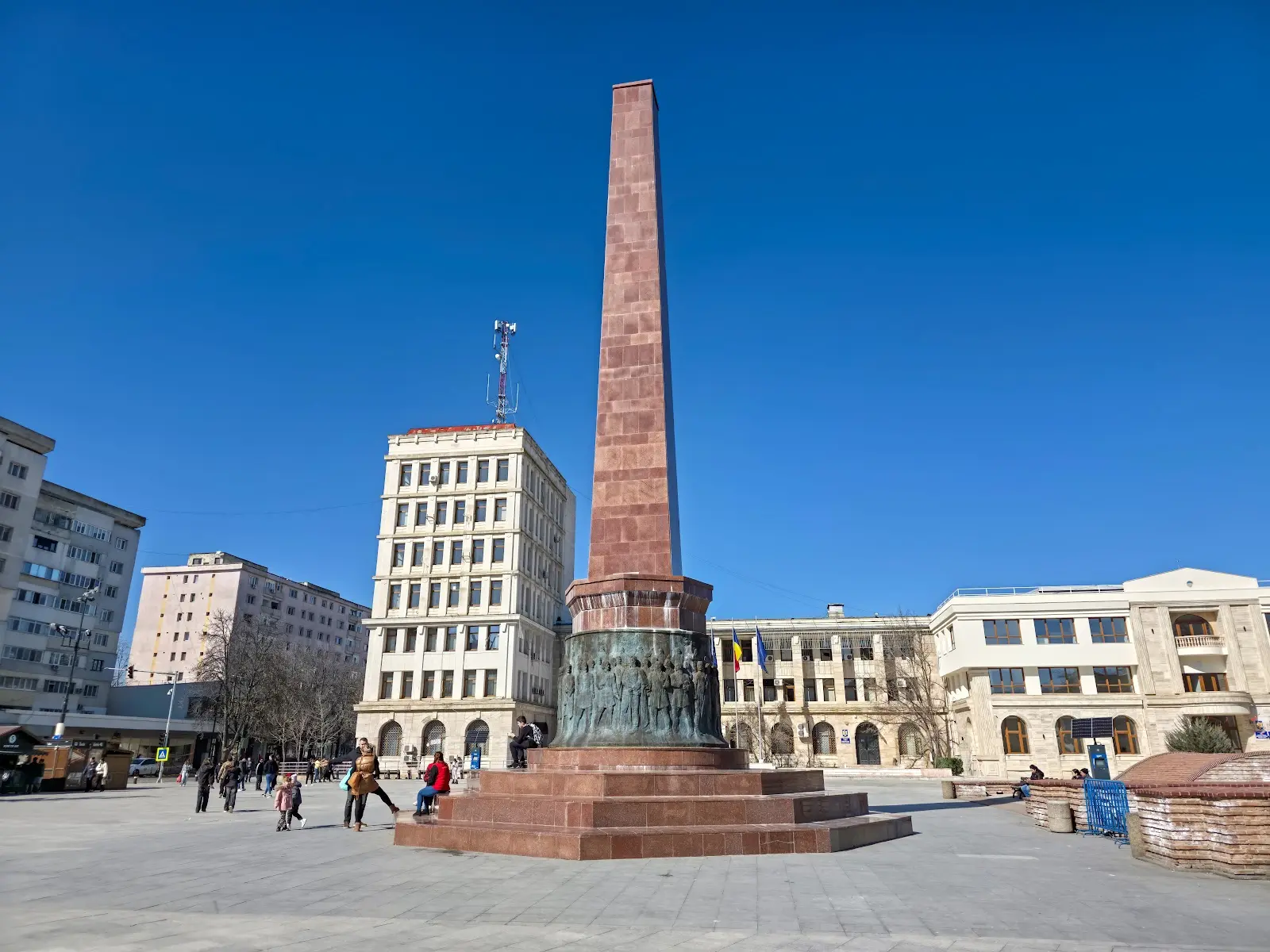
Focșani is a city built on a line that no longer exists. Until 1859, the border between Moldavia and Wallachia ran straight through its middle, along the Milcov river: two towns pressed together, two administrations, two customs posts and one name. Almost everything interesting here follows from the erasure of that line.
Why come here
Because this is a city that explains an idea. The Union of the Principalities did not happen in Focșani, but nowhere else can you see so clearly what it meant: an internal border that vanished from the middle of a street. The city has kept that as its symbol — in the name of its central square, in its monuments, in the way it tells its own story.
And because Focșani is the capital of wine country. The seat of Vrancea county stands in the middle of the Odobești–Panciu–Cotești vineyard region, one of the largest wine-growing areas in Romania. It is a base for tasting trips, not a five-day destination.
The city on the border
Until 1859, Moldavian Focșani and Wallachian Focșani were two separate places divided by the Milcov, with their own customs houses and authorities. Residents crossed a state border to visit relatives; trade lived off exactly that duplication.
The Union of 1859, achieved by electing the same ruler in both Principalities, wiped that border away. Focșani, which had more to lose than any other town from a frontier being abolished, in fact gained an identity: commissions of the Union were installed here, and the work of unifying the laws and administration of the two Romanian lands was done here.
The unionist symbolism is still visible in the city's names and statues. It is not tourist decoration — it is the memory of a role the city genuinely played.
Piața Unirii
Union Square is the centre of the city and the place any visit begins. Here stand its unionist monuments, its promenade walks and its evening life, with terraces and families out strolling.
Walk the central area: the broad boulevards, the buildings of the nineteenth and early twentieth centuries, the old institutions. The city was badly hit by earthquakes and by the rebuilding of the later twentieth century, so the centre is a mixture — but the layers can be read.
St John the Baptist Cathedral
St John the Baptist Cathedral is the city's principal religious monument and its vertical landmark. It is worth going in for the quiet, for the painting, and for the way a mid-sized Romanian city's cathedral remains the real centre of community life rather than simply a building to be visited.
Dress modestly, silence your phone, photograph only if the posted rules allow it. If you happen on a service, stand at the back for a few minutes: that is the best version of the visit.
The Heroes' Mausoleum and the memory of 1917
The Heroes' Mausoleum is a First World War monument and the place where Focșani keeps the hardest part of its history. In 1917 the Mărășești–Mărăști–Oituz area was the theatre of some of the fiercest battles fought on Romanian soil; the front ran through here, and the city was occupied.
Visit soberly. This is not a photo stop but a cemetery and a memorial. For anyone who wants to understand what happened, the memorial complexes elsewhere in the county — at Mărășești, Mărăști and Soveja — complete the story and ask for the same restraint.
The vineyards: Odobești, Panciu, Cotești
North and west of the city a sea of vines begins. Odobești, Panciu and Cotești together form one of Romania's most extensive wine-growing areas, with centuries of tradition and an output that long supplied the domestic market.
The best way to see it is with an appointment made in advance at a winery — most receive visitors, but not unannounced. If wine is the main reason for the trip, start from Romania's wine roads by region and the guide to Romanian wines, where you can see how Vrancea sits beside Dealu Mare or Transylvania.
Where to stay and what to eat
Focșani has city hotels and guesthouses — nothing collectable, but perfectly serviceable for one or two nights. Anyone coming primarily for the vineyards can sleep at a winery or at a guesthouse in the hills, especially around the harvest, when the wine villages are the liveliest part of the county.
The cooking has, as befits a border city, Wallachia and Moldavia on the same plate: soups soured with borș, stuffed cabbage rolls, stews, cheeses from the Vrancea hills, savoury pies. House wine is everywhere and is by far the most honest local product; in autumn, look for fresh grape must at the market.
Nearby
Vrancea does not end at the city limits. West of here the hills climb towards the Curvature Carpathians: Soveja, used for generations for its hill air, Lepșa and the Tișița Gorges, with forests and limestone ravines, and at Andreiașu de Jos the living fire — natural gas flames burning at the surface of the ground, a geological curiosity rare in Europe.
All of it needs a car and a full day, but it turns a city break into a journey through the county.
Getting there
Focșani lies on the axis linking Bucharest with Moldavia, on the European road following the Siret valley, and has a station on the main line towards Suceava. Train or coach are both comfortable; a car becomes necessary only for the vineyards and the county's memorial sites.
Good to know
Vrancea is Romania's most seismically active region, and Focșani has lived with that for generations: hence the rebuilt blocks and the visible structural strengthening downtown. It is no reason for concern on a visit, but it explains why the city looks the way it does.
When to come
Autumn, without hesitation: the harvest fills the vineyards with activity and the weather still allows long walks through the centre. Late spring and summer suit the county's memorial sites. Winter leaves the city working as usual, but without its main argument.
For the sight-by-sight list and a one- or two-day plan, carry on with what to see in Focșani and Vrancea.
Plan your trip
Stays nearby
Stays in Romania
Experiences
Tours & activities
Guided tours, day trips and hand-picked experiences via GetYourGuide — free cancellation on most.
See all experiencesGetting to Romania
Flights, transfer & car
Fly into Romania
Compare fares to Bucharest Otopeni (OTP) and regional airports — Cluj, Sibiu, Iași, Timișoara.
Airport transfer
Private, fixed-price door-to-door transfer — driver waiting from the moment you land.
Rent a car — see the real Romania
A rental car is the key to Romania: the Transfăgărășan, the painted monasteries of Bucovina, mountain roads and the villages of Maramureș that no train reaches.
Find a car











