
What to see in Focșani and Vrancea
Union Square, the city cathedral, the Heroes' Mausoleum and the Odobești–Panciu–Cotești vineyards. The sights worth the trip in Focșani and Vrancea, with a two-day itinerary and practical advice.
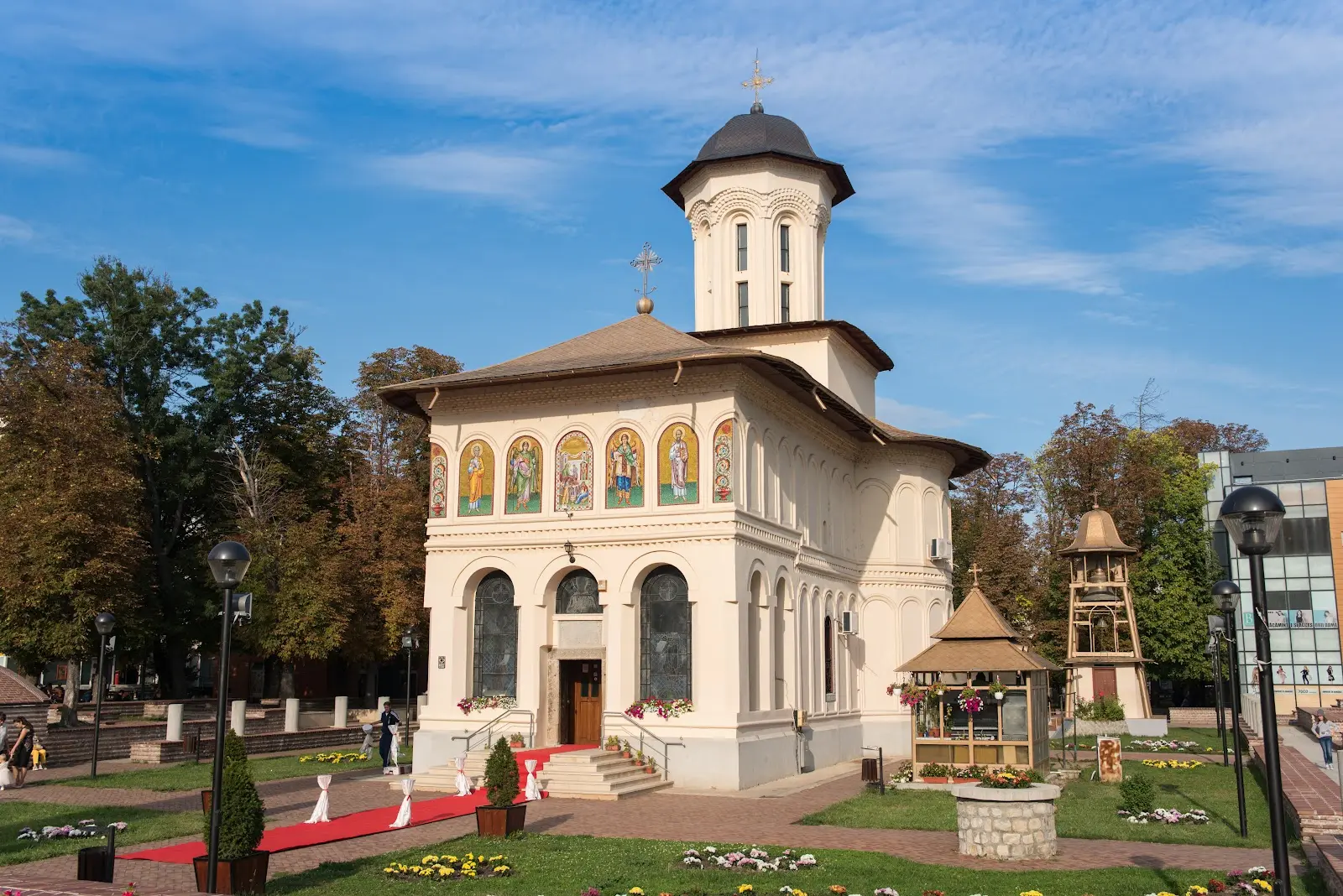
Focșani can be seen in a day and understood in two. The centre is compact and walkable, while the rest — the vineyards and the First World War sites — needs a car and half a day more. The list below puts in order what actually repays the trip.
1. Union Square
Union Square is the city's point zero and the best introduction to its story. Here, in the middle of a city that was cut in two by the border between Moldavia and Wallachia until the Union of 1859, stand its unionist monuments and its evening public life.
What to do in and around the square:
- Read the monuments — they all point to the same idea: a frontier abolished.
- Walk the central boulevards, with their nineteenth- and early twentieth-century buildings.
- Look for the course of the Milcov, which ran through town and separated the two Focșanis.
- Sit out for an hour on a terrace in the late afternoon; that is when the city shows itself best.
2. St John the Baptist Cathedral
St John the Baptist Cathedral is the vertical landmark of Focșani and the city's most important religious monument. Entry is simple, the visit short and, if you arrive during a service, richer than any tour.
Common-sense rules: modest dress, phone on silent, photographs only where permitted. In Romania's mid-sized cities the cathedral is still the real centre of community life rather than a building to tick off — and that comes across better on a Sunday than at midday on a Tuesday.
3. The Heroes' Mausoleum
The Heroes' Mausoleum is the city's First World War monument and the site that most demands care in how you visit. In 1917 the Mărășești–Mărăști–Oituz area was the theatre of some of the hardest battles fought on Romanian soil, and the front ran exactly through here.
Visit soberly: no selfies, no raised voices. This is a memorial and a resting place, not a box to tick. With time to spare, continue to the mausoleums elsewhere in the county — the complex at Mărășești is the best known of them.
4. The Odobești–Panciu–Cotești vineyards
North and west of the city begins one of Romania's largest wine regions. Odobești, Panciu and Cotești hold centuries of tradition and hills under vine to the horizon.
How to do it properly:
- Book the winery visit in advance. Many receive guests; few receive them unannounced.
- Arrange a driver who is not tasting, or local transport.
- Go in late summer or autumn, around the harvest, if you want to see the vineyards at work.
- Read Romania's wine roads by region and the guide to Romanian wines beforehand, so you know what you are looking for in the glass.
These vineyards long supplied the domestic market with volume wine, and the reputation for quantity has stuck to them. Today's reality is more nuanced: there are wineries working small and working seriously, and they are worth seeking out deliberately rather than stumbling upon.
5. The less obvious city
Beyond the square and the cathedral, Focșani has layers that only reveal themselves on foot: old institutions along the central boulevards, neighbourhood churches, and the farmers' market — the best place in town to understand what Vrancea grows. The market offers house wine, grape must in season, cheeses and fruit from the surrounding hills.
An aimless walk through the side streets behind the boulevards also repays the time: interwar houses, courtyards with vines over a pergola, old shops still trading. Focșani does not sell itself at first glance, but it answers anyone who walks it and looks at the details.
6. The hill country, if you have a third day
West of the city the county climbs into the Curvature Carpathians and becomes an entirely different journey. Soveja has been used for generations for its hill air; Lepșa and the Tișița Gorges offer forest and limestone ravines good for a day's walk; at Andreiașu de Jos the living fire burns — natural gas flames emerging at the surface of the ground, a geological rarity.
All of it needs a car. The roads are beautiful but narrow and slow, so pick two destinations a day rather than four.
When to come
- Autumn — the best season: the grape harvest, markets full of must and fruit, good walking weather.
- Late spring — green across the hills, ideal for the county's memorials and for the gorges.
- Summer — the hills are beautiful but midday is hot; put the open-air sights in the morning.
- Winter — the city runs as usual, the vineyards sleep. The weakest window for this particular trip.
A two-day itinerary
Day 1 — the city. Morning in Union Square and along the central boulevards, then St John the Baptist Cathedral. In the afternoon, the Heroes' Mausoleum, with time to breathe afterwards. In the evening, a terrace downtown.
Day 2 — Vrancea. The vineyards in the morning, with a booked winery visit, and a county mausoleum in the afternoon. Given a third day, head up towards Soveja and the sub-Carpathian hills.
Practical tips
- The centre is walkable; the vineyards and the county's monuments need a car.
- Wineries require appointments, and during the harvest their schedules shift — ask first.
- At the war memorials, take your time rather than photographs.
- Autumn is the best season; in summer the hills are beautiful but hot at midday.
- The farmers' market is the best place in town for local produce, and early morning gets you the good stock.
- If you arrive on a Sunday, the hours before noon are the liveliest downtown and at the cathedral.
For the history of the border city, the wider Vrancea context and the transport and accommodation side, read the complete guide to Focșani.
Plan your trip
Stays nearby
Stays in Romania
Experiences
Tours & activities
Guided tours, day trips and hand-picked experiences via GetYourGuide — free cancellation on most.
See all experiencesGetting to Romania
Flights, transfer & car
Fly into Romania
Compare fares to Bucharest Otopeni (OTP) and regional airports — Cluj, Sibiu, Iași, Timișoara.
Airport transfer
Private, fixed-price door-to-door transfer — driver waiting from the moment you land.
Rent a car — see the real Romania
A rental car is the key to Romania: the Transfăgărășan, the painted monasteries of Bucovina, mountain roads and the villages of Maramureș that no train reaches.
Find a car











