
Complete guide to Curtea de Argeș
One of the first capitals of Wallachia, with a monastery that is an architectural masterpiece, the necropolis of Romania's kings and 14th-century frescoes. A complete guide to the town at the gateway to the Transfăgărășan.
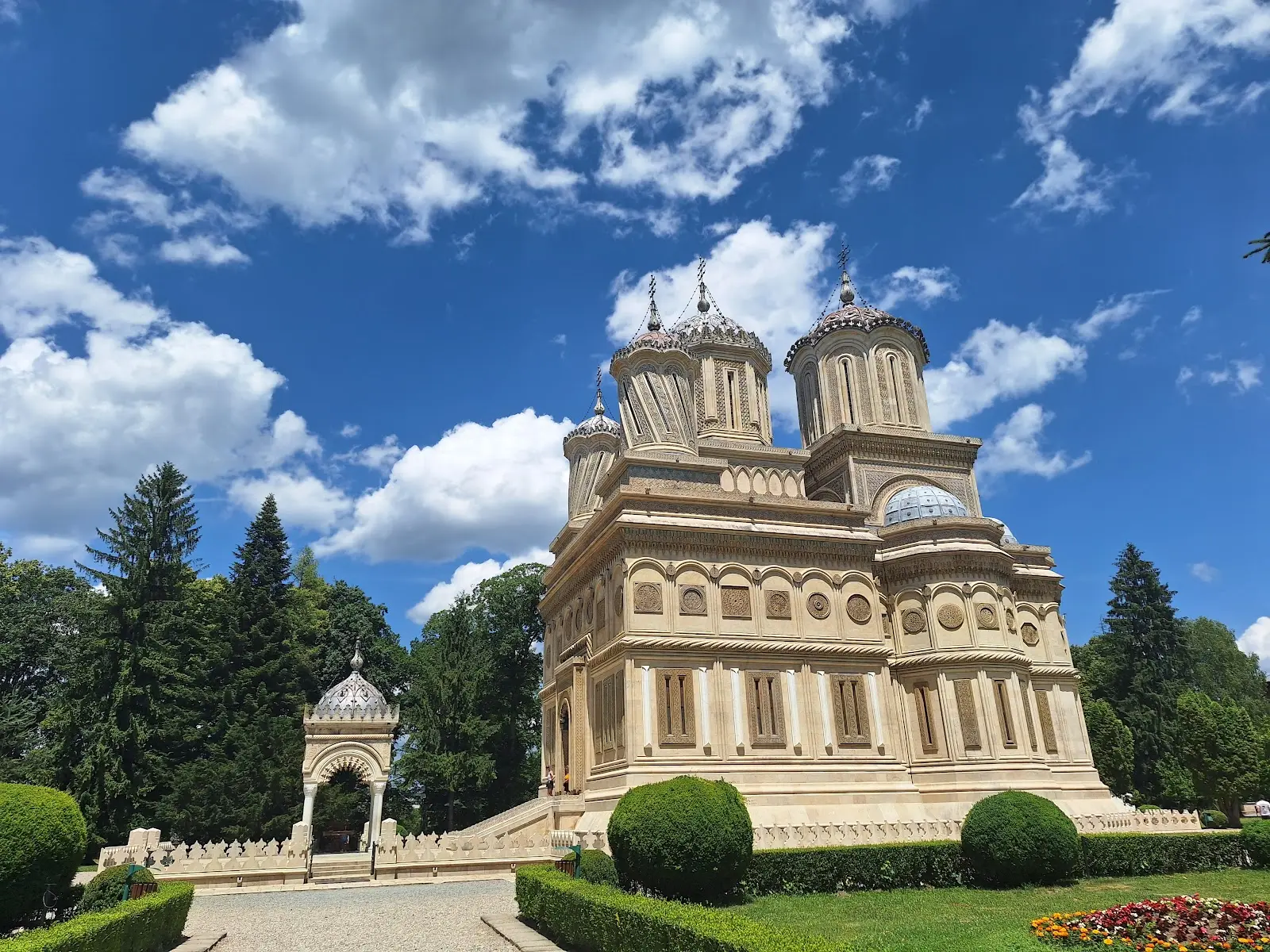
Some towns mattered far more in a country's history than they do on its tourist map today, and Curtea de Argeș is one of them. It was one of the first capitals of Wallachia, and from those founding centuries it has kept a concentration of old stone, legend and royal tombs that few places its size can match. You can see it in a single day, but it deserves two.
Why Curtea de Argeș
The name says almost everything: curte means court, and this was the princely court of Wallachia's first rulers, at a time when the state itself was only just taking shape at the foot of the Southern Carpathians. The town on the Argeș river was a royal seat, then a major ecclesiastical centre, and much later the place Romania's kings chose as the burial ground of their dynasty.
The result is unusual: a small, unhurried town with no pretensions, where two of the country's most important monuments stand a few kilometres apart. Add the road north — Poenari Fortress, Lake Vidraru and the start of the Transfăgărășan — and you have a complete weekend base, with history in the morning and mountains in the afternoon.
- It is the natural southern gateway to the Transfăgărășan.
- The sights inside town are within walking distance of one another.
- It has a provincial calm that, after busy Bucharest, feels like a holiday in itself.
The Monastery of Curtea de Argeș
Curtea de Argeș Monastery is why most visitors come, and it is not hard to see why. The church, founded by Neagoe Basarab in the 16th century, is one of the masterpieces of Romanian religious architecture: a building of almost oriental elegance, with twisted spires, lace-like stone rosettes and proportions that look calculated to the millimetre.
It rewards slowness. Walk a full circle around the outside before you go in — the carved ornament, the stone belt that girds the building at mid-height and the spiralling towers only reveal themselves close up. The walled park, with its fountain and manicured paths, is part of the experience and deserves an unhurried stroll, especially in morning light.
The monument also carries the legend of Master Manole, probably the best-known Romanian legend of all. The master builder whose walls kept collapsing overnight is said to have walled his own wife into the foundations to make them hold, and then, stranded on the roof when the scaffolding was taken away, to have tried to fly on wings of wooden shingle. The legend is not history, but it says something true about how Romanians have always seen this church: as a building too beautiful to have been raised without sacrifice.
The royal necropolis
Inside the monastery precinct lies the royal necropolis, where the kings of Romania are buried. The choice was deliberate: a new dynasty wanted to tie its memory to the country's oldest seat of power, the place where Wallachia began.
For a visitor from abroad it is the most direct encounter with modern Romanian history — the monarchy, unification, the two world wars, exile and the return of the royal remains after 1989 all gathered into a few slabs of marble. For a Romanian visitor it is a place of civic pilgrimage, often visited with family. Either way, dress modestly, speak quietly and respect the times of services.
The Princely Church of St Nicholas
A few minutes' walk away, in the middle of the former princely court, stands the Princely Church of St Nicholas — older, smaller and, for lovers of medieval art, even more precious than the monastery.
Built in the 14th century, it preserves a remarkable body of original frescoes, among the most valuable in south-eastern Europe. From the outside it does not impress: a massive, seemingly austere block of brick and stone with no spectacular towers. The interior changes that completely. Around it you can still read the traces of the princely court complex, which makes the visit useful for context too — this, not the monastery, was the political centre of the country in its first centuries.
The museum and the town
The Curtea de Argeș Municipal Museum is the stop that ties everything together: archaeology from the princely court area, local history and ethnography from the villages of the Argeș valley. It is small and does not take long, but afterwards the town reads far better, and the stones you saw in the morning suddenly acquire a chronology.
The rest of the centre needs no plan. The main boulevard, with its small shops and a few terraces, is not spectacular, but it is pleasant and honest — a provincial town living its own life rather than one staged for visitors. The farmers' market is worth a stop for cheeses, honey and seasonal fruit from the surrounding villages.
The full list of sights, in the order that makes sense over one or two days, is in our guide to what to see in Curtea de Argeș and around.
North: Poenari, Vidraru and the mountains
Curtea de Argeș is the last real town before the mountains, and the road heading north turns, a few dozen kilometres on, into Romania's most famous alpine highway.
- Poenari Fortress is conquered on foot: over 1,400 steps up to the stronghold perched on its ridge. It was rebuilt by Vlad the Impaler and is, historically speaking, far more genuinely connected to him than Bran Castle. If that part of the story interests you, we separate the fiction from the facts in the Dracula myth and the historical truth.
- Lake Vidraru, with its dam arched between two rock walls, is one of the most photographed views in the Carpathians. The road follows its shore for much of its length.
- Higher up the Transfăgărășan proper begins, with switchbacks, tunnels and alpine pasture. It is usually open only in the summer months, depending on snow.
Practical information
- When to go: the monastery and the churches can be visited all year. For the Transfăgărășan and Vidraru, plan for summer or early autumn. Late spring is lovely in town, but the alpine road may still be closed.
- How many days: one for the town, two if you add Poenari and Vidraru without rushing.
- Getting there: easiest by car from Bucharest or Pitești, on the road that continues up to the Transfăgărășan. The town has a station at the end of a branch line and coach links from Pitești, but for Poenari and Vidraru your own car makes the difference.
- Dress: the monastery and the necropolis are active places of worship — shoulders and knees covered.
- Where to sleep: the options, from the historic centre to the mountain lodges on the Transfăgărășan, are in our guide to where to stay in Curtea de Argeș.
Curtea de Argeș boasts about nothing. It simply puts in front of you a church you recognise from schoolbooks, the tombs of kings, frescoes seven centuries old and a road that climbs into the mountains, and lets you take them at your own pace. Few small towns in Europe offer so much with so little fuss.
Plan your trip
Stays nearby
Stays in Romania
Experiences
Tours & activities
Guided tours, day trips and hand-picked experiences via GetYourGuide — free cancellation on most.
See all experiencesGetting to Romania
Flights, transfer & car
Fly into Romania
Compare fares to Bucharest Otopeni (OTP) and regional airports — Cluj, Sibiu, Iași, Timișoara.
Airport transfer
Private, fixed-price door-to-door transfer — driver waiting from the moment you land.
Rent a car — see the real Romania
A rental car is the key to Romania: the Transfăgărășan, the painted monasteries of Bucovina, mountain roads and the villages of Maramureș that no train reaches.
Find a car











