
What to see in Curtea de Argeș and around
A monastery that is a masterpiece, the tombs of Romania's kings, 14th-century frescoes and, to the north, Vlad the Impaler's fortress and Lake Vidraru. The essential sights and the order that makes sense.
Curtea de Argeș is a small town with an unusually large share of Romanian history. It holds an architectural masterpiece, the tombs of kings, 14th-century frescoes and, half an hour to the north, one of the few fortresses that genuinely belonged to Vlad the Impaler. The order in which you see them matters more than you would think.
Curtea de Argeș Monastery
Start here, in the morning, before the coaches. Curtea de Argeș Monastery was founded by Neagoe Basarab in the 16th century and is one of the most beautiful churches in Romania: white marble, twisted spires, lace-like stone rosettes, a façade design that feels closer to the Orient than to the Carpathians.
- Walk a full circle around the outside before going in. The carved detail is half the value of the monument, and none of it is visible from inside.
- The twisted towers read best from the corners of the park, not from the front.
- Morning light falls on the main façade; by afternoon the marble is in shadow.
This is where the legend of Master Manole belongs — the builder said to have walled his own wife into the foundations so that the walls would stop collapsing. Manole's Well, a few minutes' walk away, marks the spot where, the story goes, he fell trying to fly from the roof. It is not history, but it is part of how Romanians read this place.
The royal necropolis
In the same precinct lies the royal necropolis, where the kings of Romania are buried. It is a short visit and a heavier one than you expect: in a space of a few square metres, the whole history of the Romanian monarchy is gathered, from the creation of the modern state to the return of the royal remains after 1989.
Dress modestly, keep photography discreet and respect the times of services. If you visit on a Sunday or a feast day, come either very early or in the afternoon.
The Princely Church of St Nicholas
If the monastery is the monument that impresses, the Princely Church of St Nicholas is the one that matters to historians. Built in the 14th century in the middle of the former princely court, it preserves a remarkable set of original frescoes — among the most valuable in south-eastern Europe.
The exterior is misleading: brick and stone, simple volumes, no spectacular spire. The interior is a treasure chamber. Give your eyes time to adjust to the dim light, or you will miss half the scenes. Around the church you can see the traces of the princely court complex, and that helps enormously in understanding the town: the centre of power was here, not at the monastery.
The Municipal Museum
The Curtea de Argeș Municipal Museum deserves half an hour straight after the Princely Church, not before it. Archaeology from the court area, local history and an ethnographic collection from the Argeș valley villages put into order what you have just seen on the ground. For families with children it is also a welcome break between two churches.
The town on foot
Between the monuments, Curtea de Argeș needs no plan, and the walk is half the pleasure of the visit. Distances are short, the town is settled and quiet, and the area of the former princely court has a human scale that few Romanian towns still keep.
- Manole's Well, a few minutes from the monastery, is the natural stop after the church — modest as a monument, but tied to the best-known Romanian legend of all.
- The farmers' market is worth a pause for mountain cheeses, honey and seasonal fruit from the Argeș villages.
- The main boulevard is not spectacular, but it has terraces and small shops, good for a break between two churches.
- The riverbank offers a short, quiet walk at the end of the day, particularly at sunset.
Poenari Fortress
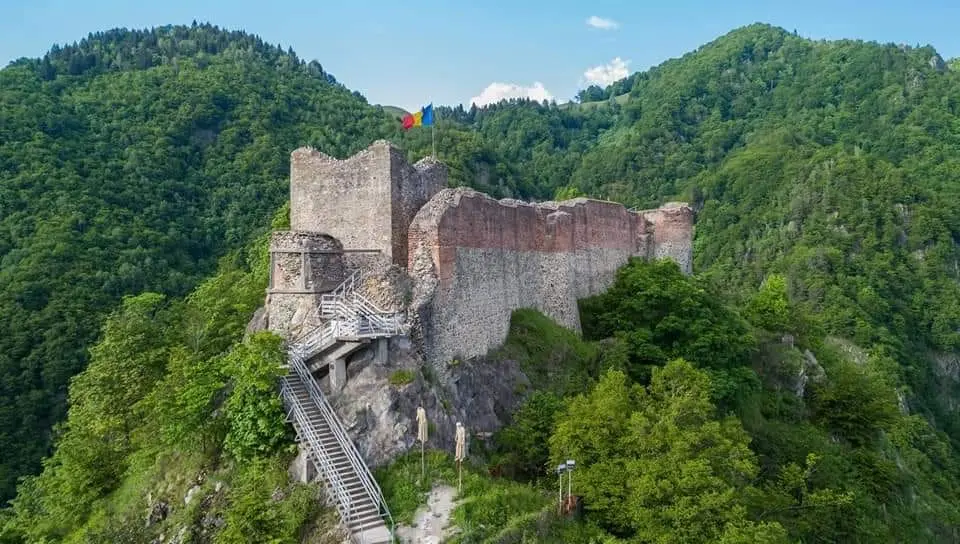
North of town, the mountain road passes beneath Poenari Fortress, perched on a rocky ridge above the Argeș. You climb to it by staircase — over 1,400 steps — and that is the most honest part of the visit: you arrive at the top out of breath, exactly as one should at a stronghold built to be untakeable.
The fortress was rebuilt by Vlad the Impaler and is, historically speaking, far more genuinely linked to him than Bran Castle, which owes its fame to literature and tourism. From the summit you see the narrow valley it controlled, and the military logic of the site becomes obvious in seconds.
- Proper shoes, no argument. The steps are many and uneven.
- Do not climb in midday heat; early morning or evening is far more bearable.
- The ruins are exposed and may close temporarily for safety reasons or works — check before you drive up.
If you want the whole arc of the story, from the real ruler to Bram Stoker's character, it is in on the trail of Dracula.
Lake Vidraru and the dam
Higher up, the valley ends in Lake Vidraru — a long reservoir of blue-green water held back by a dam arched between two rock walls. The view from the crest, with the lake on one side and the plunging valley on the other, is one of the most dramatic in the Carpathians.
- Stop at both ends of the dam: the perspectives are completely different.
- The road follows the lakeshore for much of its length, with short viewpoints where you can pull over.
- Weather changes fast at altitude; bring a jacket even in August.
Onwards on the Transfăgărășan
From Vidraru the alpine section begins: tight hairpins, a tunnel, high pasture and views that justify the road's international reputation. It is usually open only in the summer months, depending on snow, and the full crossing into Transylvania takes a whole day, not an hour. If you are choosing between Romania's two great alpine roads, the comparison is here: Transfăgărășan vs Transalpina.
How to combine them
One day (no car, or short on time): monastery and necropolis in the morning, lunch in the centre, Princely Church and museum in the afternoon. The whole town on foot, unhurried.
Two days (with a car): day one in town, as above. Day two heading north — Poenari early, while it is still cool, then Vidraru and the dam, and if the season allows, a stretch of the Transfăgărășan before turning back.
Three days: add a day in the mountains or in the villages of the Argeș valley, and sleep higher up, by the lake or on the road itself — the options are in where to stay in Curtea de Argeș. Historical context and practical information about the town are in the complete guide to Curtea de Argeș.
Few places in Romania give you, within 50 kilometres, an architectural masterpiece, the tombs of a dynasty, seven-century-old frescoes, a warlord's fortress and a world-class alpine road. Curtea de Argeș has all of them, and makes no fuss about it whatsoever.
Plan your trip
Stays nearby
Stays in Romania
Experiences
Tours & activities
Guided tours, day trips and hand-picked experiences via GetYourGuide — free cancellation on most.
See all experiencesGetting to Romania
Flights, transfer & car
Fly into Romania
Compare fares to Bucharest Otopeni (OTP) and regional airports — Cluj, Sibiu, Iași, Timișoara.
Airport transfer
Private, fixed-price door-to-door transfer — driver waiting from the moment you land.
Rent a car — see the real Romania
A rental car is the key to Romania: the Transfăgărășan, the painted monasteries of Bucovina, mountain roads and the villages of Maramureș that no train reaches.
Find a car











