Transfăgărășan vs Transalpina: Which Alpine Road to Drive
Two legendary roads cross the Romanian Carpathians, each with its own character. The Transfăgărășan is pure hairpin drama; the Transalpina is the calm of high alpine plateaus. Here is how to choose.
Romania has two alpine roads that appear on every list of Europe's dream drives. Both climb above 2000 meters, both open only a few months a year, but the experience behind the wheel is completely different. Here is the honest comparison, so you know exactly what you are choosing.
The Transfăgărășan (DN7C): pure drama
The Transfăgărășan is the road that entered global consciousness after the Top Gear team called it one of the most spectacular driving routes on the planet. It crosses the Făgăraș Mountains from Transylvania toward the south, and the alpine stretch is a dizzying run of tight hairpins that stack up the mountainside one above the other.
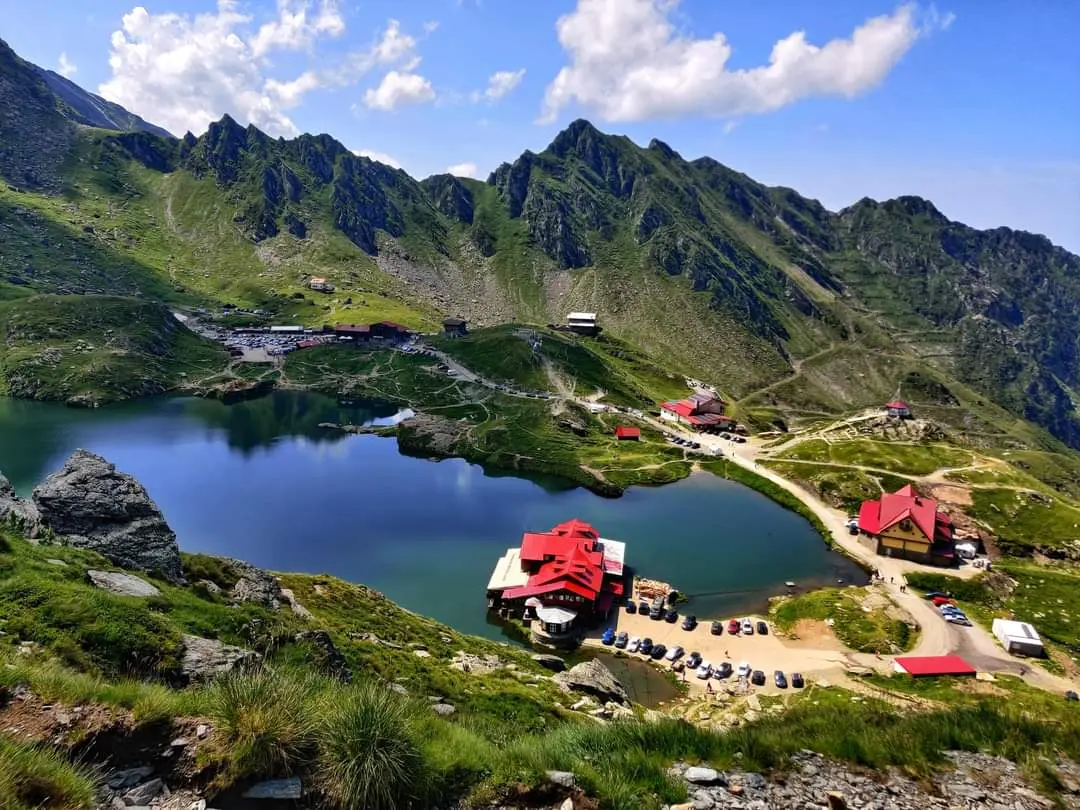
The highlight is the Bâlea area. Bâlea Waterfall is visible from the road, and higher up you reach Bâlea Lac, a stunning glacial lake set beneath the ridges. Here the road enters a long tunnel, the longest road tunnel in Romania, which pierces the mountain and delivers you to the opposite slope.
At the southern end, the road has treasures of its own:
- Poenari Citadel, the fortress perched on a crag reached by climbing over 1400 steps, linked to the figure of Vlad the Impaler.
- Vidraru Dam and its reservoir, an imposing structure more than 160 meters tall.
- Curtea de Argeș nearby, with its famous monastery and royal necropolis.
The Transfăgărășan demands concentration. The hairpins are short and frequent, traffic can be heavy in peak season, and in places the road is narrow. This is a road you drive, not one you daydream through.
The Transalpina (DN67C): the highest road
If the Transfăgărășan is adrenaline, the Transalpina is contemplation. It is Romania's highest road, topping out at Pasul Urdele, around 2145 meters. It crosses the Parâng Mountains, linking the south with Transylvania.
The difference is immediate. The Transalpina is smoother, with wide, sweeping curves that follow the line of the ridge rather than hairpin switchbacks. The landscape opens into vast alpine plateaus, treeless meadows and views that seem to run on forever. It is the kind of road you cruise, window down.
Along the way you meet Rânca, a fast-growing mountain resort and a good stop for lodging, a meal, or a short walk. Overall the Transalpina is a more serene experience, better suited to anyone who wants to savor the mountains without the constant tension at the wheel.
When they are open
Both roads are seasonal. Sitting at high altitude, snow closes them in winter, and the alpine section stays open roughly from late June until October. The exact dates vary year to year, depending on how quickly the spring snow melts and how early winter arrives.
The practical rule: July and August are the safest months, but also the busiest. Early September often offers the best compromise, with weather still good and fewer crowds. Always check the road status before you set off, because it can close temporarily even in summer after unexpected snowfall or roadwork.
Which is harder to drive
Without question, the Transfăgărășan is the more demanding. The tight hairpins, the elevation changes, the heavy traffic and the narrow stretches require constant attention and some mountain-driving experience. For a driver unaccustomed to alpine roads it can be a test of nerves, especially on the descent, where the brakes work hard.
The Transalpina is more forgiving. The wide curves and generally broader surface make it less intimidating, even though the altitude is higher. It is still a serious mountain road: long grades, changeable weather and sections without guardrails. It is no motorway, but it is clearly gentler on anyone who spooks easily.
How to choose
The choice comes down to what you are after:
- Want spectacle, adrenaline and dense sightseeing along the way (citadel, dam, tunnel)? Choose the Transfăgărășan.
- Want calm, wide-open views and a relaxed drive? Choose the Transalpina.
- Have time for both? Perfect. They are close enough to combine into a road trip of a few days across the southern Carpathians.
Practical tips
- Fill up first. Fuel stations are rare or nonexistent on the alpine stretch. Set off with a full tank.
- Check the weather. Fog and rain change everything at altitude. A clear day is the difference between memorable views and a wall of white.
- Allow half a day for each road if you want to stop at the sights and take photos without rushing.
- Start early. In the morning the road is quieter, the light is better, and the crowds at Bâlea Lac or on the Transalpina are only just forming.
- Dress in layers. Even in August, above 2000 meters it can be cold and windy, while the valley below bakes in the heat.
Both roads are among the most beautiful in Europe. There is no wrong choice, only different experiences. And if you can, do them both, in a single summer.
Plan your trip
Stays nearby
Stays in Romania
Getting to Romania
Flights, transfer & car
Fly into Romania
Compare fares to Bucharest Otopeni (OTP) and regional airports — Cluj, Sibiu, Iași, Timișoara.
Airport transfer
Private, fixed-price door-to-door transfer — driver waiting from the moment you land.
Rent a car — see the real Romania
A rental car is the key to Romania: the Transfăgărășan, the painted monasteries of Bucovina, mountain roads and the villages of Maramureș that no train reaches.
Find a car