
Complete guide to Bistrița
One of Transylvania's seven fortified Saxon towns, with the Șugălete arcades, one of Romania's tallest stone towers and the road to Tihuța Pass — Bram Stoker's Borgo Pass.
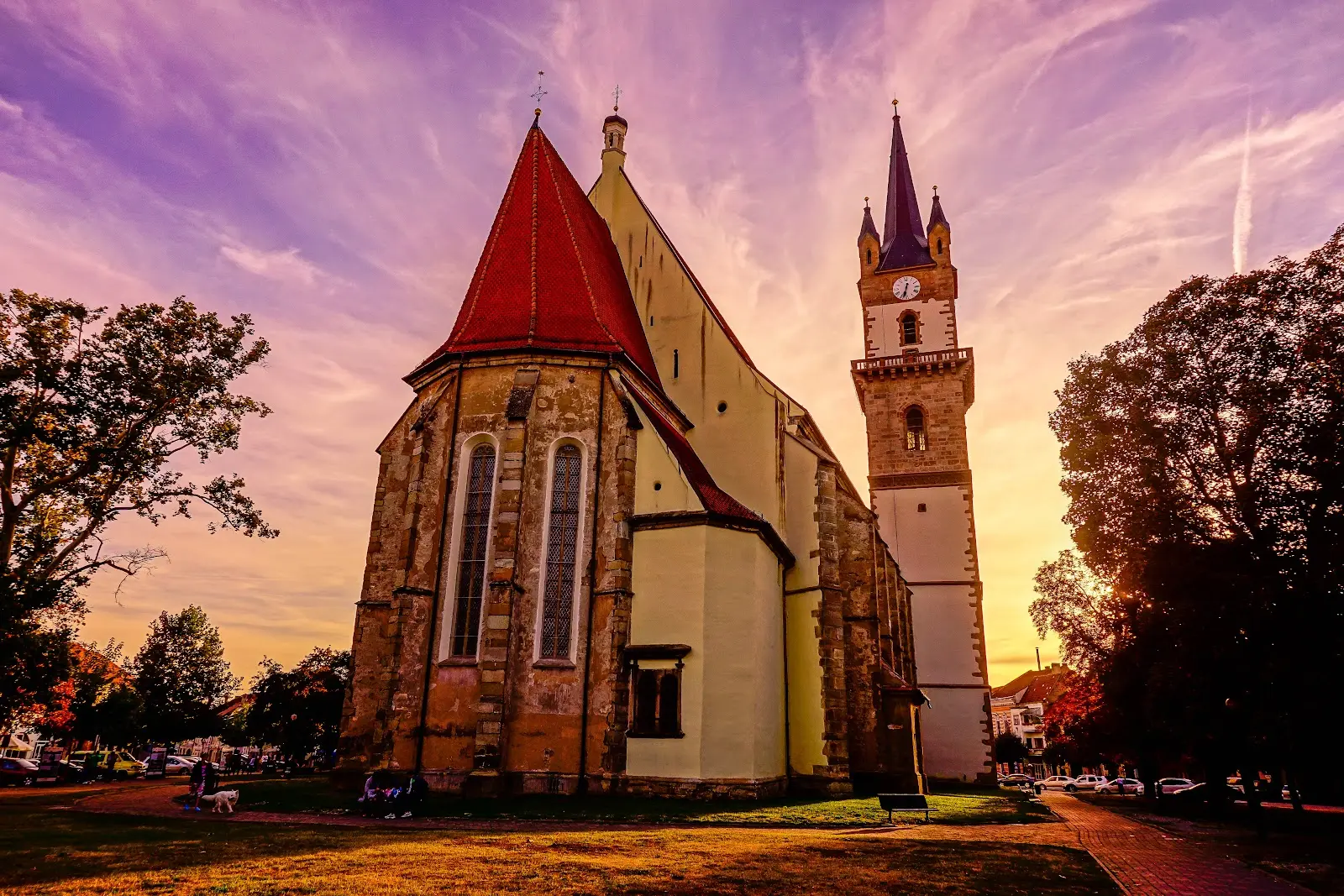
Bistrița is one of Transylvania's seven fortified Saxon towns and probably the least visited of them. It is also the only one from which you can reach, in under an hour, a mountain pass that made it into world literature. This guide covers the town, the valley and the mountain — in the order they deserve to be seen.
A Saxon town on the Bistrița river
The town grew up on the river that shares its name, on the northern edge of Transylvania, exactly where the hills begin turning into mountains. Saxon settlers made Bistrița a town of guilds and trade: the last significant marketplace before the road that climbs towards Moldavia, up the valley leading to the pass through the Carpathians. Its status as a fortified town brought walls, towers and gates, of which fragments survive today — among them the Coopers' Tower, the most visible witness of the old defensive belt.
Unlike Sibiu or Sighișoara, Bistrița did not keep its medieval core intact. Fires, demolitions and the twentieth century cut deeply into it. What remains, however, is concentrated and genuine: a wide central square, an arcaded ensemble that is rare anywhere in Central Europe, and a stone tower you can see from the edge of town.
Șugălete: the row of arcades on the main square
The most valuable thing in Bistrița takes a few minutes to see and a few hours to understand. Șugălete is a row of guild houses linked by a continuous gallery of arcades on the central square — a Gothic-Renaissance ensemble preserved as a whole rather than as an isolated fragment.
- Walk underneath the arcades, not along the pavement in front: only from there do you read the rhythm of the vaults and the way each house joins its neighbour.
- Look at the keystones, the worn thresholds and the side entrances — many of them once led into guild workshops and storerooms.
- The square still works as public space, with terraces and events, so the ensemble is not a museum set but a place where the town spends its evenings.
The Evangelical Church and its stone tower
The Evangelical Church dominates the centre and is the easiest landmark to navigate by. The Evangelical Church has one of the tallest stone towers in Romania, and its silhouette is visible from almost every street around the square. The tower was badly damaged by the 2008 fire and was subsequently rebuilt — worth knowing in advance, because it explains why some details look newer than the rest of the masonry.
The interior is austere, in the logic of Saxon churches: cool light, clean geometry, few decorative flourishes. It is the kind of space where you stand quietly for ten minutes and leave with an idea of how the community that built it thought.
Bram Stoker's Bistrița
This is where the town picks up a second identity. In Bram Stoker's novel, Jonathan Harker spends the night in Bistrița before climbing towards the Borgo Pass — the pass that in reality is called Tihuța Pass. That turned the whole area into a Dracula landmark, with everything that comes with it: literary curiosity on one side, tourist folklore on the other.
The two layers are worth separating. The novel is fiction written by an author who never visited Transylvania, but the geography he chose is real and still spectacular. If you want the full thread, from book to places, we unpick it in on the trail of Dracula.
The Bârgău Valley, Tihuța and Colibița
Bistrița is effectively the gateway to three distinct day trips, all less than an hour and a half from the centre.
- The Bârgău Valley climbs east through a string of long villages, with houses set along both sides of the road. It is the classic route to the pass and the best introduction to the county's high-hill landscape.
- Tihuța Pass links Transylvania with Bukovina, over the mountain. The views from the top are wide and the weather changes fast — this is a real mountain road, not a stroll.
- Lake Colibița, nicknamed the sea in the mountains, is a reservoir ringed by forest at the foot of the Călimani Mountains. In summer half the county moves there; for the rest of the year it is surprisingly quiet.
Museums, memory and local culture
The Bistrița-Năsăud Museum Complex gathers archaeology, history, ethnography and art across several sections — useful above all if you want the Saxon and Romanian context of the region before heading out into the field. The ethnography section is the one that changes how you look at everything else: once you have seen the tools, the costumes and the household objects, the villages up the valley stop being mere scenery.
The county also has a strong literary heritage. The Liviu Rebreanu memorial house preserves the rural world that produced one of the most important bodies of work in Romanian prose — the same geography of hills, farmsteads and country roads you cross on the way to the mountain. It is a useful counterweight to the Dracula layer: here the region is not imported Gothic scenery but the subject of literature written from the inside.
Food and local life
Bistrița is not a gastronomic city and does not claim to be. What it does have is exactly what you need: a handful of restaurants and cafés around the central square, a good farmers' market, and farmhouse cooking in the villages around.
- In town, look for Transylvanian cooking with Saxon and Hungarian influences: sour soups, stews, savoury pies, substantial desserts.
- In the countryside and up the valley, meals at your guesthouse are usually the best option — many cook from their own yard and orchard, but only on request, so give notice.
- The area has a tradition of orchards and homemade spirits. If you are offered something produced on the farm, that is part of the experience rather than commerce.
- The farmers' market is the quickest way to read the season: cheeses, orchard fruit, honey, garden vegetables.
Practical information
- How many days: one day covers the historic centre; two or three if you add the Bârgău Valley, the pass and Colibița.
- Getting there: Bistrița is well connected by road with Cluj-Napoca, Târgu Mureș and Suceava. A car is what opens up the rest of the county, because the villages and the lake are awkward to reach by public transport.
- When to go: May to October for the mountain and the lake. In winter the pass stays open, but it asks for proper seasonal tyres and patience.
- Planning your days: we break down the routes, villages and sights in what to see in Bistrița and the Bârgău Valley, and the neighbourhoods and accommodation areas in where to stay in Bistrița and around.
Bistrița does not ask for a week. It asks for one day in town, to understand what a guild town actually was, and one more on the road to the mountain, to see why this area became — by literary accident — one of the best-known in Romania.
Plan your trip
Stays nearby
Stays in Romania
Experiences
Tours & activities
Guided tours, day trips and hand-picked experiences via GetYourGuide — free cancellation on most.
See all experiencesGetting to Romania
Flights, transfer & car
Fly into Romania
Compare fares to Bucharest Otopeni (OTP) and regional airports — Cluj, Sibiu, Iași, Timișoara.
Airport transfer
Private, fixed-price door-to-door transfer — driver waiting from the moment you land.
Rent a car — see the real Romania
A rental car is the key to Romania: the Transfăgărășan, the painted monasteries of Bucovina, mountain roads and the villages of Maramureș that no train reaches.
Find a car











