
What to see in Bistrița and the Bârgău Valley
From the Șugălete arcades and the Evangelical church tower to the Bârgău Valley, Tihuța Pass and Lake Colibița — the sights of Bistrița and its county, in the order best travelled.
Bistrița can be seen in a day, but the county around it asks for at least one more. The town gives you Gothic arcades and a stone tower; the valley to the east gives you long villages, a mountain pass and a lake locals talk about as if it were a sea. The list below runs in the order it is best travelled, from the centre towards the mountain.
Șugălete, the heart of the town
Start on the central square, with Șugălete — the row of guild houses joined by a continuous gallery of arcades. It is a Gothic-Renaissance ensemble rarely preserved as a whole, and the main reason Bistrița's centre deserves more than a photograph in passing.
Walk under the vaults from one end to the other, then come back along the opposite pavement to see the row in perspective. On market and event days, the place recovers the commercial function it had centuries ago.
The Evangelical Church and its tower
A few steps away, the Evangelical Church has one of the tallest stone towers in Romania — the landmark you navigate by anywhere in the centre. The tower was rebuilt after the 2008 fire, so part of the masonry looks visibly newer.
Step inside for the interior too: austere, geometric, free of decorative excess, exactly in the tradition of Transylvania's fortified Saxon churches.
The Coopers' Tower
The Coopers' Tower is what remains visible of the town's ring of fortifications. The name comes from the guild that maintained it — in Saxon towns, each guild was responsible for a stretch of wall and for its tower.
It is small and quick to visit, and its real value is showing you the true scale of the medieval town: from here to the church and the square, practically everything that mattered was enclosed. Seen up close, the tower also explains why Bistrița does not look like Sighișoara today — the fortifications were dismantled piece by piece, and what survives is an isolated witness rather than a continuous ring.
The best way to read it is to walk from the tower towards the square, following the line of the old wall. The streets around it still preserve, in stretches, the alignment of that time.
The Bistrița-Năsăud Museum Complex
If you have an hour, the Bistrița-Năsăud Museum Complex is the best investment in town. Its sections cover archaeology, history, ethnography and art, and together they explain why this area was always a place of passage: between Transylvania and Moldavia, between Saxon, Romanian and Hungarian communities.
Visit it before the drive into the mountains, not after. The villages of the Bârgău Valley read completely differently once you know what to look for in the architecture of a farmstead.
The Bârgău Valley
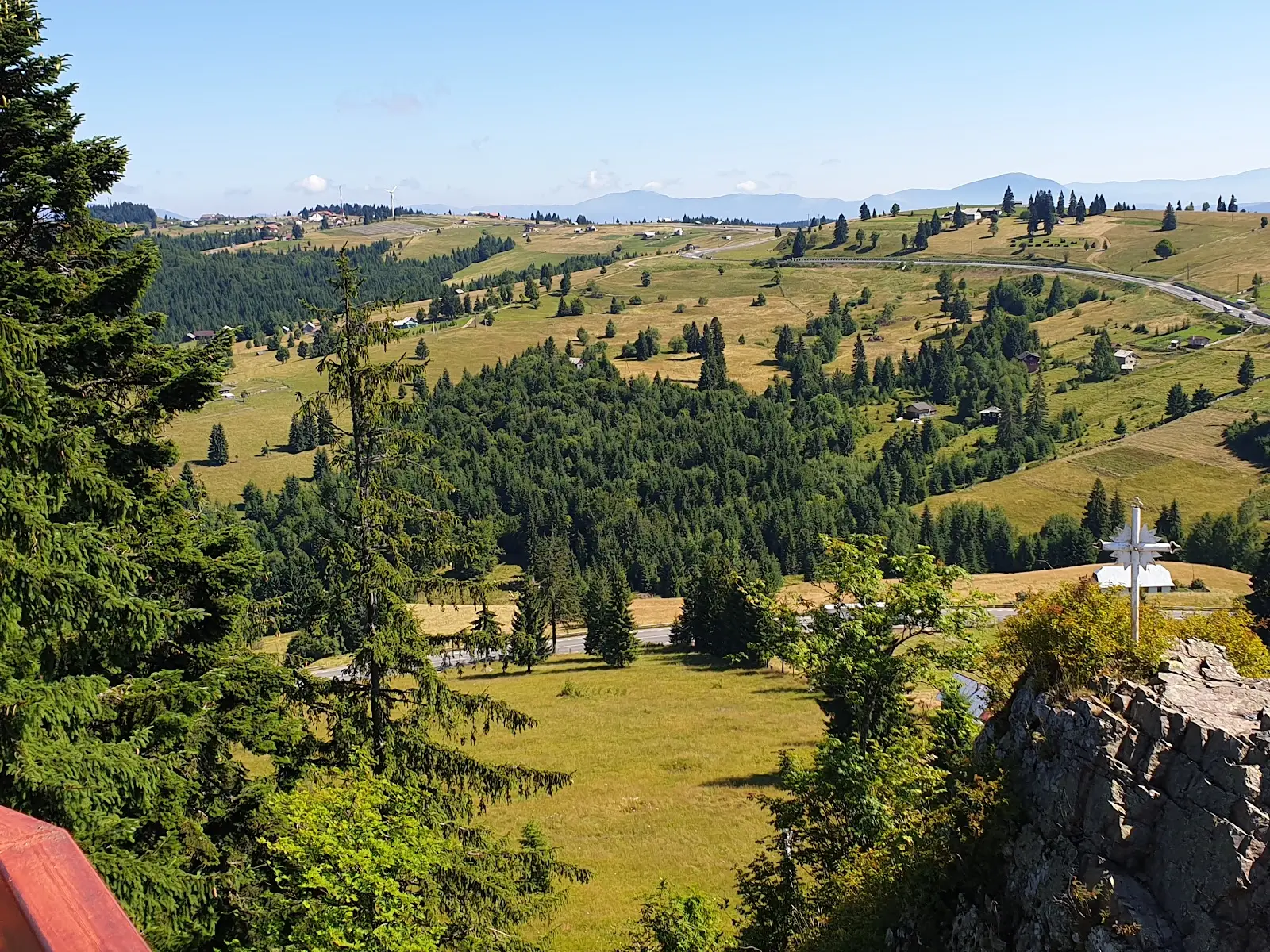
The Bârgău Valley climbs east, along the road that leads to the pass. It is spectacular not through cliffs and gorges but through rhythm: villages several kilometres long, houses strung along both sides of the road, orchards, hay meadows and hills that keep gaining height.
- Stop in the villages, not only at the viewpoints — the farmsteads, gates and outbuildings are the most authentic part of the drive.
- Look for the wells and roadside crosses: they are the old markers of these communities.
- Take your time. The valley can be driven in under an hour, but it is worth twice that.
Tihuța Pass
Tihuța Pass is the high point of the area, literally and otherwise. It crosses the mountain between Transylvania and Bukovina, between the Bârgău and Călimani ranges, and from the top the view opens in both directions.
Tihuța is also the Borgo Pass of Bram Stoker's novel: this is where the author sends his character, Jonathan Harker, after the night spent in Bistrița. That Stoker never saw the place takes nothing away from the landscape — it only moves the conversation from history to literature, and we settle the difference between the two in the Dracula myth and the historical truth.
Practically: the weather turns fast, fog settles often, and in winter this is a mountain road with everything that implies. Leave in the morning.
Lake Colibița
Lake Colibița is nicknamed the sea in the mountains, and on clear days it does look the part: a broad sheet of water, forest right to the shoreline, the Călimani ridges behind. It is a high-altitude reservoir, with a microclimate locals talk about with pride.
- Summer: walks along the shore, kayaking and paddleboarding, terraces with a view.
- Spring and autumn: the best light and the smallest crowds.
- Winter: complete quiet and a postcard landscape, if you catch the road clear.
This is also the start of the trails into the Călimani Mountains, a volcanic massif of broad plateaus and old forest — territory covered in detail by munte.online.
The Liviu Rebreanu memorial house
To finish, a detour that changes register. The Liviu Rebreanu memorial house preserves the Transylvanian village world his prose grew out of — the same geography of hills, farmsteads and country roads you have been driving through all day.
It is a short visit with a lasting effect: after it, the villages in the valley stop being scenery and become literary context.
Breaks, food and the farmers' market
Between the sights, the town works well as a logistical base. Around the central square there are restaurants and cafés a few steps from the arcades, serving Transylvanian cooking — sour soups, stews, savoury pies and desserts with Saxon and Hungarian influences.
- The farmers' market is worth a fifteen-minute detour: cheeses, orchard fruit, honey and garden vegetables show you immediately what the county's season is giving.
- If you are heading up the valley or to the lake, buy water and snacks in town. Higher up, shops are few and keep short hours.
- Up the valley, eating at your guesthouse is usually the best option, but they cook on request — give notice.
Route tips
- Order matters. Museum and centre in the morning, the valley and the pass at midday, the lake towards evening: that way you catch the good light on the water.
- Leave room for unplanned stops. The Bârgău Valley is a road you keep pulling over on, not one you drive in a single run.
- Check the forecast for the pass, not for the town. Between central Bistrița and the Tihuța ridge the difference can be several degrees and a layer of fog.
- Combine with Bukovina. The pass is the natural road to Vatra Dornei and on towards the painted monasteries in the north, if you have extra days.
How to split your days
- One day: the historic centre — Șugălete, the church, the Coopers' Tower, the museum.
- Two days: add the Bârgău Valley and the pass, with a stop at the memorial house.
- Three days: add Colibița and a day's hiking in the Călimani.
The town's historical and practical context is in the complete guide to Bistrița, and the accommodation areas, from the centre to the guesthouses up the valley, in where to stay in Bistrița and around.
Plan your trip
Stays nearby
Stays in Romania
Experiences
Tours & activities
Guided tours, day trips and hand-picked experiences via GetYourGuide — free cancellation on most.
See all experiencesGetting to Romania
Flights, transfer & car
Fly into Romania
Compare fares to Bucharest Otopeni (OTP) and regional airports — Cluj, Sibiu, Iași, Timișoara.
Airport transfer
Private, fixed-price door-to-door transfer — driver waiting from the moment you land.
Rent a car — see the real Romania
A rental car is the key to Romania: the Transfăgărășan, the painted monasteries of Bucovina, mountain roads and the villages of Maramureș that no train reaches.
Find a car











