
Complete guide to Băile Herculane
Băile Herculane is one of the oldest thermal resorts in Europe: the Romans used these springs under the name Ad Aquas Herculi Sacras, and the Habsburg Empire gave it, in the nineteenth century, the monumental architecture that still makes it unmistakable. Much of that historic centre is now severely decayed — and this guide tells you plainly what you will find, and why the trip is still worth making.
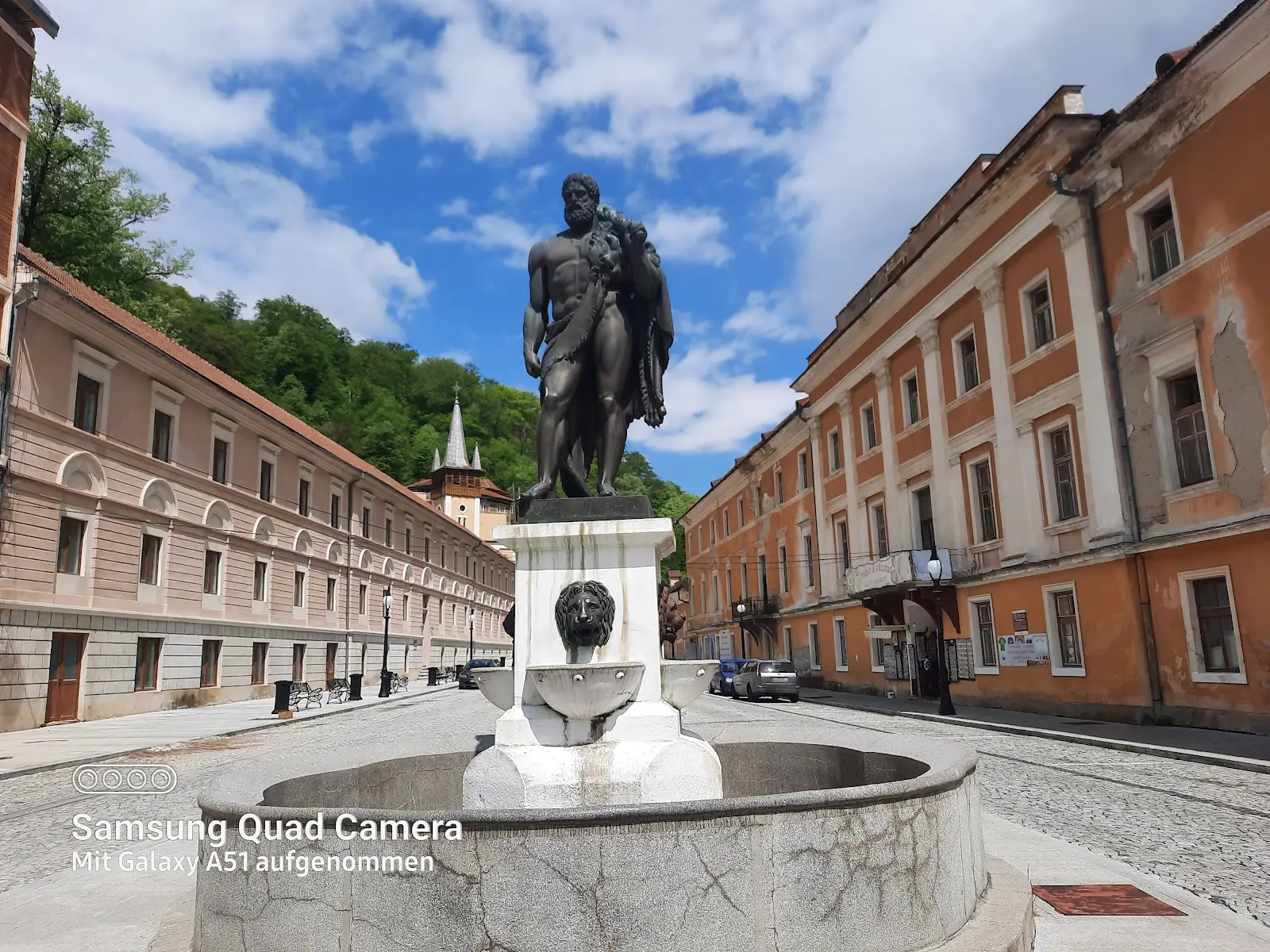
At Băile Herculane, the water arrived before the people. The hot springs in the Cerna gorge were already in use in Roman times, nearly two thousand years before the resort took the shape you see today. And what you see today is a place with two faces: an imperial architecture largely fallen into ruin, and a natural setting that has not decayed at all.
Why Băile Herculane
The resort sits in a narrow gorge between forested slopes at the south-western end of the Carpathians, in Caraș-Severin county. It is one of the oldest thermal resorts in Europe, and that is not brochure language: the Romans exploited these sulphurous springs and named the place Ad Aquas Herculi Sacras — the waters sacred to Hercules.
Reasons the journey is worth it:
- The thermal water, used almost without interruption for two millennia and still the basis of the resort's life.
- The Habsburg historic centre — an ensemble of monumental nineteenth-century buildings unique in Romania, and today in a difficult state.
- Domogled–Cerna Valley National Park, which begins practically where the last building ends.
- The location — a short drive from the Danube and the Danube Cauldrons, which makes the resort easy to fold into a longer itinerary.
The water that made the resort
Everything here starts with geology. The Cerna gorge cuts through a limestone massif, and the water surfaces hot and heavily sulphurous at several points close together. The Romans built bathing installations here and left the name — Ad Aquas Herculi Sacras — while local legend ties the springs to Hercules, the hero said to have rested in them.
The real leap came much later, under the Habsburg Empire. In the nineteenth century Herculane became one of the prestige spas of Central Europe: bath houses, hotels, villas, pavilions and promenades were built in an imperial architectural language you recognise instantly if you have ever seen a period Austrian spa town. Those are the buildings that still give the historic centre its silhouette.
For the wider context of Romania's spa tradition, we wrote about it separately in the article on Romania's spa and balneary resorts.
The historic centre: what you will actually find
Here we have to be blunt, because a lot of promotional material is not. A large part of the Habsburg historic centre is in an advanced state of decay. You will see façades with the stucco fallen away, boarded-up windows, collapsed roofs, courtyards taken over by vegetation, and closed, fenced-off buildings waiting for something to happen. This is not an impression from a distance; it is what the street looks like.
The reasons are tangled — disputed ownership, decades of neglect, enormous restoration costs for monuments of this scale. In recent years restoration projects have appeared, some of them under way, driven by volunteers, associations and public funding, and the first buildings to enter works are visible. But the process is slow and uneven: on the same street you can find a consolidated façade next to one that is falling in.
How to read this as a visitor:
- You will not find an intact imperial spa town. If you arrive expecting a Carpathian Baden-Baden, you will leave disappointed.
- You will find instead one of the most impressive ensembles of nineteenth-century spa architecture in the country, even in its current state — the scale, the proportions and the detail are all still there.
- Respect the signs and the fencing. Derelict buildings are dangerous and parts of them can give way. Do not enter closed structures.
- Do not treat the place as a stage set. For the people who live here, the decay is not an aesthetic; it is a daily problem.
The landmarks
Statuia lui Hercule is the undisputed symbol of the place and the point where everyone stops: the hero who gave the waters their name, standing right in the heart of the resort. If you take one photograph in Herculane, you take it here.
A short way off, on the heights above the resort, stands Crucea Albă, the White Cross — the classic viewpoint over the gorge. The climb follows a footpath, needs no special equipment but does ask for decent shoes and a little breath; the reward is a perspective that explains in one second why the resort looks the way it does: it had nowhere to grow except along the valley.
The rest of the resort is walked slowly: the promenade along the Cerna, the bridges, the little squares, the old bath buildings, the captured springs. The full list, surroundings included, is in the article on what to see in Băile Herculane and the Cerna Valley.
A national park at the door
The resort lies inside Domogled–Cerna Valley National Park, one of Romania's most valuable protected areas. The park is known for the rare sub-Mediterranean flora that thrives on the sun-baked limestone of the gorge — a mix of southern species that have nowhere else to live in this country — and for its exceptional diversity of butterflies and birds.
In practice this means you can have breakfast in the resort and, twenty minutes of walking later, be on a mountain path between limestone crags and forest. That combination is what makes Herculane different from every other spa town in Romania.
When to go
Spring and autumn are the best windows. The gorge has a mild microclimate, with winters warmer than you would expect at this altitude, and October on these slopes is spectacular. Summer is warm and occasionally heavy in the gorge, but the Cerna, the forest shade and early-morning walks make up for it. In winter the resort is quiet, and the treatments and thermal pools become the main reason to come — the steam rising off the water in the cold is a sight in itself.
Practical: getting there and how long to stay
By car is the most comfortable option: the resort lies close to the national road linking Banat to Oltenia through the Danube gorge, with the final stretch turning up into the Cerna valley. By train, the station serving the resort sits outside the centre, a few kilometres away, on the line that follows the Danube valley — budget for a local transfer to the hotels.
How long: one day covers the historic centre, the Hercules statue and a walk along the Cerna. Two or three days also allow a waterfall, a cave, a day of treatments and an excursion towards the Danube. A week is the classic format if you come for a course of spa treatment.
For choosing where to base yourself, see where to stay in Băile Herculane.
How to leave satisfied
Herculane rewards the visitor who arrives informed. If you expect a polished resort, the gorge will look tired to you. If you expect instead a place with two thousand years of history in its water, an imperial architecture wounded but still imposing, and a national park that starts at the end of the street — then Băile Herculane is exactly what you pictured, and probably more.
Plan your trip
Stays nearby
Stays in Romania
Experiences
Tours & activities
Guided tours, day trips and hand-picked experiences via GetYourGuide — free cancellation on most.
See all experiencesGetting to Romania
Flights, transfer & car
Fly into Romania
Compare fares to Bucharest Otopeni (OTP) and regional airports — Cluj, Sibiu, Iași, Timișoara.
Airport transfer
Private, fixed-price door-to-door transfer — driver waiting from the moment you land.
Rent a car — see the real Romania
A rental car is the key to Romania: the Transfăgărășan, the painted monasteries of Bucovina, mountain roads and the villages of Maramureș that no train reaches.
Find a car











