Where to stay in Băile Herculane
Four areas, four different holidays: the Austrian historic centre, full of atmosphere and largely decayed buildings; the modern zone with the spa hotels and thermal pools; the guesthouses up the Cerna Valley, for quiet and trails; and Orșova as a base for the Danube Cauldrons. How to choose, without surprises.
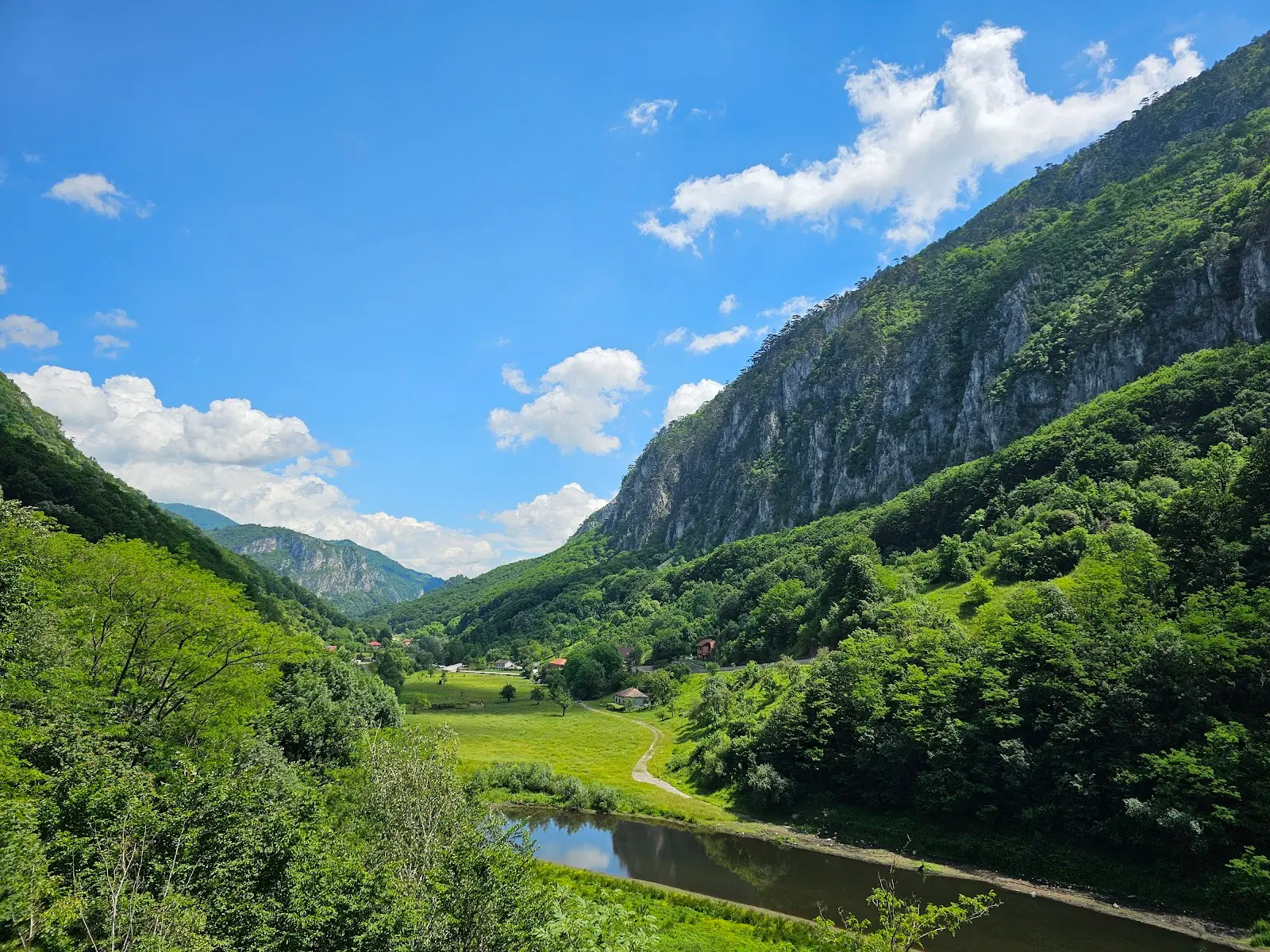
Băile Herculane is a resort stretched out lengthwise in a narrow gorge, and the area you sleep in changes the holiday completely. There is no single centre where everyone stays: you have a Habsburg-era historic core, a modern zone built around the spa hotels, a valley of guesthouses, and a town on the Danube that works as an alternative base.
How the resort is divided
Before any booking, it helps to understand the geography. The Cerna runs through the gorge and the resort follows it. At the lower end sits the historic centre, with its monumental nineteenth-century buildings. Further along, towards the mouth of the gorge, lies the modern zone, built in the second half of the twentieth century around the treatment facilities. Upstream, along the Cerna Valley, stretches the belt of guesthouses and holiday houses. And about half an hour away, on the Danube, stands Orșova.
The full context of the resort is in the guide to Băile Herculane.
The Austrian historic centre
This is where the atmosphere is. Narrow streets along the Cerna, the promenade, the bridges, the little squares, Statuia lui Hercule a few steps away — all of it on your doorstep, no car needed.
And this is also the part we have to state plainly: a large share of the buildings in the historic centre is in an advanced state of decay. You will sleep in an area where, on the same street, a consolidated façade stands next to one with fallen stucco and boarded-up windows. There are restoration projects under way, and a few buildings have genuinely entered works, but for now the ensemble remains uneven.
Who it suits: anyone who comes for architecture, history and walking, and who accepts the contrast between period splendour and a difficult present.
What to expect:
- Rooms in converted older buildings and small properties — varied in quality, from well kept to modest.
- Everything within walking distance: the centre, the promenade, the path up to Crucea Albă.
- Fewer resort-style facilities — the big pools and treatment bases are in the modern zone.
- Difficult parking on narrow streets; ask explicitly where you leave the car.
The modern zone and its spa hotels
This is the part built for treatment: large hotels, treatment bases, thermal pools, gyms, procedures. The architecture has nothing of the historic centre's charm — these are concrete volumes from the later twentieth century, some fully renovated, others less so.
Who it suits: classic spa stays, families with children who want pools and meals included, and winter visits, when hot water becomes the main reason to travel.
What to expect:
- Everything under one roof: room, board, treatments, pool.
- Direct access to the thermal water, with no commute.
- The historic centre a short walk or a few minutes' drive away.
- The feel of an organised spa resort rather than a period town.
The real advantage of this zone shows in winter: when the gorge is cold and damp, not having to step outside to reach hot water changes the comfort of the whole trip. The drawback is just as real — you sleep away from the beautiful part of the resort and need a walk or a few minutes' drive for every outing into the historic centre.
Guesthouses up the Cerna Valley
Upstream from the resort, along the valley, guesthouses and holiday houses are scattered between forest and water. This is the quiet option: at night you hear the Cerna, not the resort.
Who it suits: walkers, anyone with a car, couples after seclusion, and visitors who intend to explore Domogled–Cerna Valley National Park more than the town.
What to expect:
- Quick access to the trails, to Grota Haiducilor and to the waterfalls up the valley.
- A car is effectively essential; public transport along the valley is limited.
- Very few shops and restaurants — buy in the resort before you drive up.
- Patchy phone signal in parts of the gorge.
Orșova, as a base for the Danube Cauldrons
Where the gorge opens to the south, the Cerna reaches the Danube, and there stands Orșova. It is a serious alternative base if you want to combine the resort with the river: from Orșova you set out in the morning for the Danube Cauldrons and come back in the evening, with Herculane still only half an hour away.
Who it suits: longer itineraries, anyone who wants short Danube boat trips and river views, and travellers who treat Herculane as a day trip rather than the main destination.
What to expect:
- River scenery rather than mountain gorge — two completely different atmospheres.
- Better access to boat trips and to the sights of the Danube gorge.
- No spa treatment base: for thermal water you drive back to Herculane.
How to choose, in short
- You want architecture and walking → the historic centre, with accurate expectations about the state of the buildings.
- You want treatments, pools and everything in one place → the modern zone with the spa hotels.
- You want quiet and trails → guesthouses up the Cerna Valley.
- You want the Danube and the Cauldrons → Orșova.
What to check before booking
- The real distance to the thermal pools. In a gorge, a few hundred metres on the map can mean a climb.
- Whether the thermal water is on site or paid for separately elsewhere. Do not assume every property in Herculane has pool access.
- Parking, especially in the historic centre.
- The season. Treatment periods fill the spa hotels, while valley guesthouses fill up on summer weekends.
For the list of sights to build your days around, see what to see in Băile Herculane and the Cerna Valley.
Plan your trip
Stays nearby
Stays in Romania
Experiences
Tours & activities
Guided tours, day trips and hand-picked experiences via GetYourGuide — free cancellation on most.
See all experiencesGetting to Romania
Flights, transfer & car
Fly into Romania
Compare fares to Bucharest Otopeni (OTP) and regional airports — Cluj, Sibiu, Iași, Timișoara.
Airport transfer
Private, fixed-price door-to-door transfer — driver waiting from the moment you land.
Rent a car — see the real Romania
A rental car is the key to Romania: the Transfăgărășan, the painted monasteries of Bucovina, mountain roads and the villages of Maramureș that no train reaches.
Find a car