
What to see in Băile Herculane and the Cerna Valley
The Hercules statue, the White Cross on the heights above the gorge, the Outlaws' Cave and the Vânturătoarea Waterfall — plus the Habsburg historic centre, impressive even in its current, severely decayed state. The full list of sights in the resort and along the Cerna Valley, organised by day.
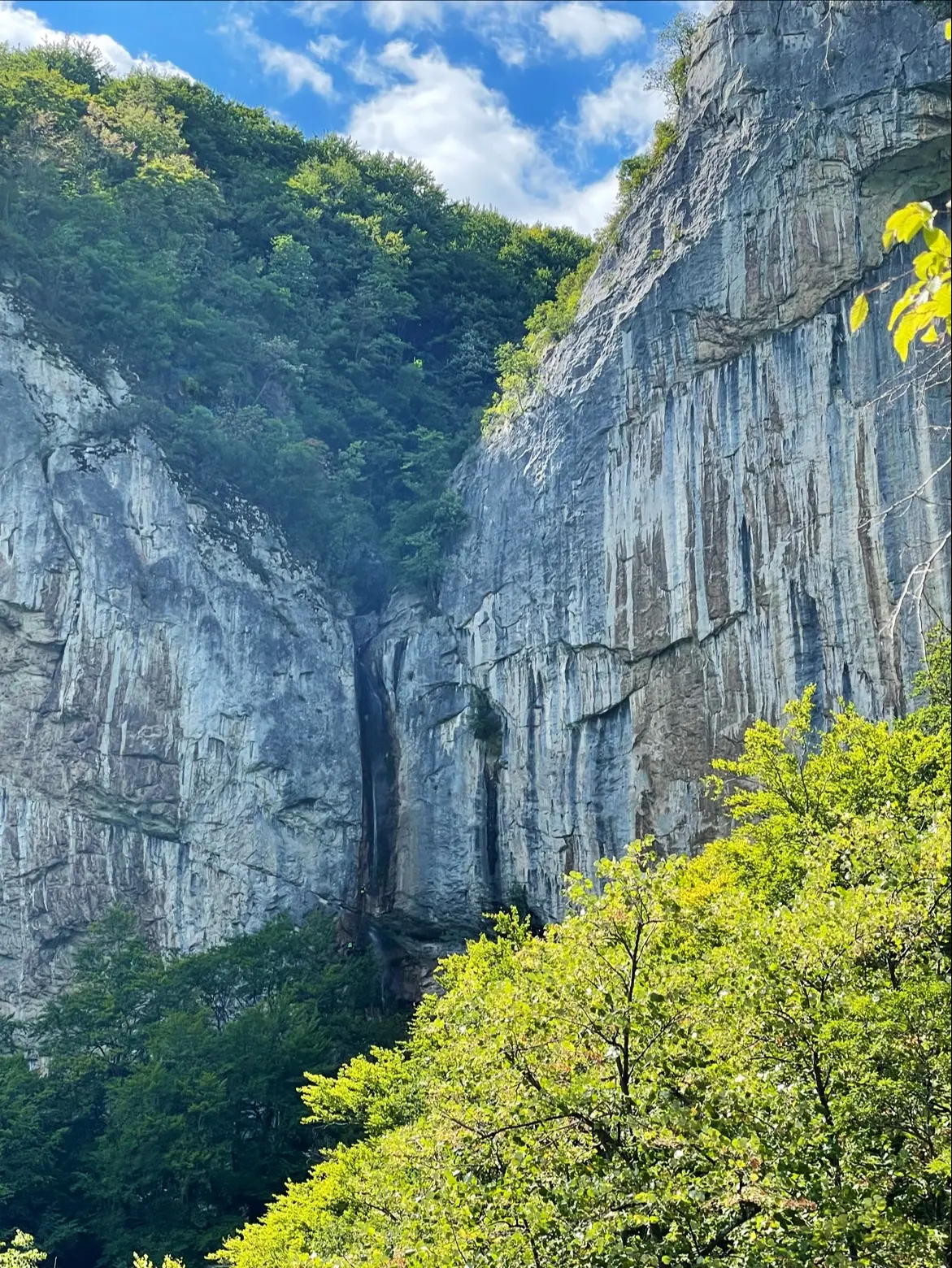
Băile Herculane is visited on two levels. Down in the gorge there is the resort: a narrow promenade, captured springs and a Habsburg historic centre that impresses and wounds in equal measure. Above, on both sides, the national park begins — with paths that climb from asphalt into limestone in twenty minutes.
The Hercules statue, ground zero
Statuia lui Hercule is the symbol of the resort and, in practice, the landmark everyone navigates by. The hero who gave the waters their name — the Romans called the place Ad Aquas Herculi Sacras — stands in the heart of the centre, exactly where he should.
It is not a sight that takes time, but it is the one you do not skip: from here you orient yourself towards the promenade, the bridges, the old bath buildings. If you have a single hour in Herculane, you spend it here and in the few hundred metres around it.
The historic centre: impressive and severely decayed
This has to be said plainly, because promotional images do not say it: a large part of the Habsburg-era historic centre is in an advanced state of decay. Façades with the stucco fallen away, boarded-up windows, collapsed roofs, buildings closed and fenced off. There are restoration projects under way, and the first buildings to enter works are visible — but the rest are waiting their turn.
How to visit the area properly:
- Walk it slowly, along the promenade and the streets parallel to the Cerna — the nineteenth-century ensemble reads itself as you go.
- Do not enter closed or fenced-off buildings. This is not a formality: decayed structures can give way.
- Look at the proportions, not only at the state of the plaster. The scale of the bath houses and period hotels tells you how important this resort once was.
- Remember that local people live among these buildings. The decay is not a photogenic backdrop; it is an unresolved problem.
The full historical context is in the guide to Băile Herculane.
The White Cross, the view that explains the gorge
If you make one climb in the resort, make it to Crucea Albă, the White Cross. The landmark stands on the heights above the resort, and the path starts near the centre. It is not a technical route, but it is a real ascent: shoes with grip, water and a little patience.
From up there you see exactly what you cannot see from below: how narrow the Cerna gorge really is, how the resort was forced to stretch along the water, and how the forest closes everything in on both sides. It is the best half-day in Herculane.
The Outlaws' Cave
Grota Haiducilor, the Outlaws' Cave, is the cave immediately above the resort and the most accessible underground experience in the area. The name comes from the local tradition of outlaws said to have sheltered here, and its position on the slope over the gorge makes it a natural combination of short climb and visit into the rock.
It is the kind of sight to pair with a walk on the surrounding paths in the same morning: you arrive, go in, come down and are back in the resort by lunchtime. Take a light jacket; inside the rock it is cool even in August.
Vânturătoarea Waterfall
Cascada Vânturătoarea is the best-known natural sight in the Cerna Valley and one of the finest waterfalls in south-western Romania. The water drops off a limestone wall, and access is by a marked path climbing from the valley — a short route, but not a flat one.
A few things that matter:
- The flow varies a great deal. In spring, with the snowmelt, and after rain, the fall is spectacular. In dry summers it shrinks noticeably.
- The path has wet, slippery sections near the drop. Boots or trail shoes, not sandals.
- It is the ideal sight to combine with a day spent up the Cerna Valley, above the resort.
Up the Cerna Valley
Beyond the resort, the road follows the valley deep into the massif. The landscape changes quickly: limestone walls, narrows, dense forest, bridges over the water and very little human settlement. This is the part of Herculane most weekend visitors never see — a pity, because here you can see exactly why the area became a national park.
Drive as far as the road allows, then continue on foot. There are no shops along the way: take water and food from the resort.
The springs and the thermal water
The water is the reason the resort exists, so it deserves to be treated as a sight rather than a hotel service. Several captured, built-up springs sit within the resort, some visible straight from the promenade, with their unmistakable sulphur smell. The Romans were using them nearly two millennia ago, and that continuity is the most remarkable thing about the place.
If you want to bathe rather than just look, the pools and treatment bases are in the modern part of the resort, not in the historic centre — check in advance where you have access, because not every property includes thermal water.
Domogled–Cerna Valley National Park
Domogled–Cerna Valley National Park is the frame the whole resort sits in. Its value lies in the rare sub-Mediterranean flora on the sun-baked limestone of the gorge — southern species with nowhere else to live in Romania — and in a remarkable diversity of butterflies, birds and rock plants.
For a visitor that translates simply: paths leave the resort and climb quickly into the rock zone, with views over the gorge at every bend. For serious mountain routes, ridge walks and multi-day planning, this range is the territory of our colleagues at munte.online — that is where the technical detail lives.
Common-sense rules in a national park:
- Stay on the marked paths. Sun-baked limestone is fragile and full of protected species.
- Do not pick plants or move stones.
- Leave nothing behind; there is no waste collection on the trails in the gorge.
How much time you need
A split that works:
- One day: the Hercules statue, the historic centre, the promenade along the Cerna, the climb to the White Cross.
- Two days: add the Outlaws' Cave and a day up the Cerna Valley with the Vânturătoarea Waterfall.
- Three days: add a day of thermal pools and an excursion towards the Danube, to Orșova and the Danube Cauldrons.
For accommodation and areas, see where to stay in Băile Herculane.
What not to expect
Herculane is not a polished resort and it has no neatly signposted tourist circuit at every corner. It is a gorge with two thousand years of history in its water, an imperial architecture half lost and half salvageable, and a national park that starts at the end of the street. Come for that, and you will leave satisfied.
Plan your trip
Stays nearby
Stays in Romania
Experiences
Tours & activities
Guided tours, day trips and hand-picked experiences via GetYourGuide — free cancellation on most.
See all experiencesGetting to Romania
Flights, transfer & car
Fly into Romania
Compare fares to Bucharest Otopeni (OTP) and regional airports — Cluj, Sibiu, Iași, Timișoara.
Airport transfer
Private, fixed-price door-to-door transfer — driver waiting from the moment you land.
Rent a car — see the real Romania
A rental car is the key to Romania: the Transfăgărășan, the painted monasteries of Bucovina, mountain roads and the villages of Maramureș that no train reaches.
Find a car











