
What to see in Sighetu Marmației and Maramureș
The memorial in the former political prison, the Maramureș Village Museum, the ethnographic collection, the Merry Cemetery at Săpânța, Peri Monastery and the villages of the Iza Valley — everything worth seeing in and around Sighet, in two or three days.
Sighet is visited in two layers: the town, with its heavy twentieth-century memory, and the villages around it, with wooden churches, carved gates and painted cemeteries. The distances are short but the roads wind, and the places ask for time. Here is what genuinely deserves your days, and in what order.
The Memorial to the Victims of Communism and of the Resistance
In the centre of town, in a building that was once a political prison, stands the Memorial to the Victims of Communism and of the Resistance. Many of interwar Romania's leaders were imprisoned and died here — ministers, academics, bishops — without real trial and, in many cases, with no known grave. The former cells have been turned into thematic rooms, and the institution is at once a museum and a centre of studies, one of the most important sites of memory in Central Europe.
Others may write about unmissable attractions; this is not one of them. It is a place you enter with your hat off, where you read names and leave quieter than you arrived. Give it at least two hours, and do not schedule it between two other visits.
The Maramureș Village Museum
On a hill at the edge of town, the Maramureș Village Museum gathers houses, barns, gates and wooden churches brought from the region's villages and carefully rebuilt. It is more than a collection of buildings: it is a lesson in how people built here — in timber alone, with joints and no nails, steep shingle roofs and massive carved gates whose motifs announced who lived behind them.
- Walk the side paths, not only the main alley — the more interesting houses are at the margins.
- Step inside the wooden churches moved here: the low doorways and the darkness within say a great deal about how faith was lived.
- It is the best preparation before heading into the villages: once you have seen the structures here, you recognise them in the field.
The Ethnographic Museum of Maramureș
The natural complement to the open-air museum is the Ethnographic Museum of Maramureș, the region's indoor collection: woven textiles and blankets, festive costumes, farming and craft tools, pottery, household objects, ceremonial masks. At the Village Museum you see the house; here you see what was in it, and who filled it.
The Reformed Church and the old centre
The Reformed Church is one of the town's oldest places of worship and the clearest testimony of Sighet's Hungarian community. Around it, the historic centre keeps facades from the nineteenth and early twentieth centuries, with the air of a Central European provincial town — good to wander without a plan for an hour.
The same streets also hold an absence. Until the middle of the twentieth century Sighet was an important centre of Jewish life in northern Transylvania, and in 1944 the town's Jewish community was deported. Sighet is also the birthplace of Elie Wiesel, the Nobel Peace Prize laureate who made his testimony about the Holocaust into both literature and a public duty. It is worth knowing before the walk, not after.
Grădina Morii
Grădina Morii is Sighet's leisure park, where the town goes for a stroll. After a morning at the memorial it is exactly what is needed: paths, greenery, an hour of nothing. It is not a spectacular sight and does not need to be — it is the town's release valve.
Săpânța: the Merry Cemetery and Peri Monastery
Less than half an hour to the west, Săpânța holds Romania's most unusual cemetery. The Merry Cemetery is a field of wooden crosses painted in a distinctive blue, each with a naive portrait of the person who died — at the scythe, at the wheel, at the loom — and an epitaph in verse, sometimes funny, sometimes blunt, almost always direct. It is a way of looking death in the face without false solemnity, and the best place in the country to understand Maramureș humour.
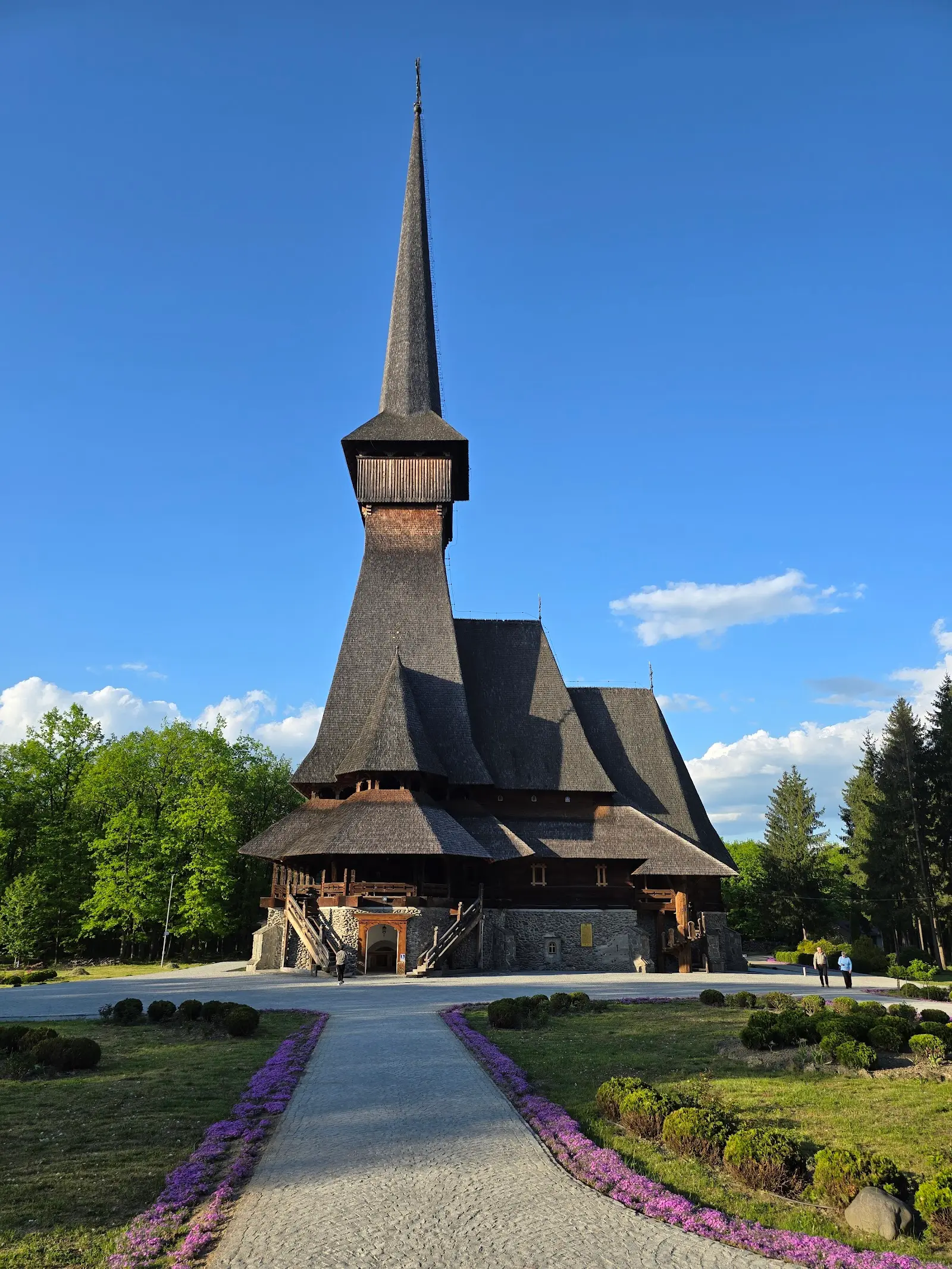
The same village holds Peri Monastery, with one of the tallest wooden churches in the world — a building that pushes traditional timber craft to its limit. The two are easily seen in one morning, and the contrast between them, folk irony and monumental verticality, says a great deal about the region.
The villages of the Iza and Mara valleys
From Sighet, two valleys run south-east and south, and they are the main reason people come to Maramureș. In the villages along the Iza and the Mara you still find working farmsteads, massive wooden gates, tall churches with sharp spires and, on Sundays, people in festive dress walking to the service — not for visitors, but for themselves.
- Go early or towards evening, when the light is low and the villages are not flattened by midday glare.
- Stop at random: the best moments are in no itinerary.
- Ask before photographing people or courtyards. The answer is almost always yes, but the asking matters.
What you are actually looking for along these valleys:
- The wooden gates — massive, carved with twisted-rope bands, rosettes and solar motifs, raised as a mark of status and of protection. The old ones are recognisable by their blackened timber and nail-free joints.
- The wooden churches — tall, with sharp spires that look out of proportion to the body of the building; small, dark, painted interiors.
- Working farmsteads — barns, hay, animals, orchards. Not scenery: a living.
Village-by-village detail and routes are in the guide to the villages of Maramureș.
Crafts and food
In the villages around Sighet people still work wood, still weave blankets on the loom and still distil plum spirit in copper stills. Not every workshop keeps opening hours, but many hosts will take you to the neighbour who works, if you ask. The table runs in the same register: cheeses, smoked fat, cabbage rolls, stews, pies, and horincă at the end in small glasses.
- Buy directly from the craftspeople, not from the roadside stalls.
- Ask your host about workshops, a sheepfold or a still — the best experiences are listed nowhere.
Practical advice for the visit
- Start the day early. At Săpânța, the difference between eight and twelve o'clock is the difference between silence and coaches.
- Allow double the time in the valleys. The roads are short on the map and winding on the ground.
- Carry cash for churches, donations and local produce.
- Do not schedule the memorial in the same half-day as anything else. They do not mix well.
How to organise two or three days
- Day 1 — the memorial in the morning, the Ethnographic Museum and the old centre in the afternoon, Grădina Morii at the end.
- Day 2 — the Village Museum in the morning, then Săpânța: the Merry Cemetery and Peri Monastery.
- Day 3 — a day along the Iza and Mara valleys, stopping at the wooden churches.
For context, orientation and logistics, see the complete guide to the town; for the areas and villages to sleep in, see where to stay.
Plan your trip
Stays nearby
Stays in Romania
Experiences
Tours & activities
Guided tours, day trips and hand-picked experiences via GetYourGuide — free cancellation on most.
See all experiencesGetting to Romania
Flights, transfer & car
Fly into Romania
Compare fares to Bucharest Otopeni (OTP) and regional airports — Cluj, Sibiu, Iași, Timișoara.
Airport transfer
Private, fixed-price door-to-door transfer — driver waiting from the moment you land.
Rent a car — see the real Romania
A rental car is the key to Romania: the Transfăgărășan, the painted monasteries of Bucovina, mountain roads and the villages of Maramureș that no train reaches.
Find a car











