
Complete guide to Sfântu Gheorghe and Covasna
Sfântu Gheorghe, the heart of Szekler Land: the museum designed by Kós Károly, the Hungarian theatre, the mofettes and springs of Covasna, the noble castles at Micloșoara and Tălișoara, the gorges, the Reci dunes and the Ciucaș Mountains — everything to know before you go.
Sfântu Gheorghe is the seat of a county that introduces itself differently from the rest of Transylvania. Covasna is the heart of Szekler Land: a majority-Hungarian town with its own theatre and a dense cultural life, ringed by villages with noble castles, carbonated mineral springs and mountains. This guide shows you how it all fits into a trip with no wasted hours.
Where you actually are
Sfântu Gheorghe (Sepsiszentgyörgy in Hungarian) is one of Romania's smallest county seats and probably the easiest to read on foot: one main axis, a few squares, a theatre and a museum worth the drive on its own. The population is majority Hungarian, and you feel it everywhere — in the language on the terraces, in the kitchen, on the playbill of the Tamási Áron Theatre, one of the most respected Hungarian-language theatres in Romania.
Around it spreads the Covasna country: a wide basin closed in by wooded hills, with villages that kept their manor houses, and with a resource few regions in Europe have at this density — carbonated mineral waters and natural carbon dioxide emanations.
The museum that explains everything else
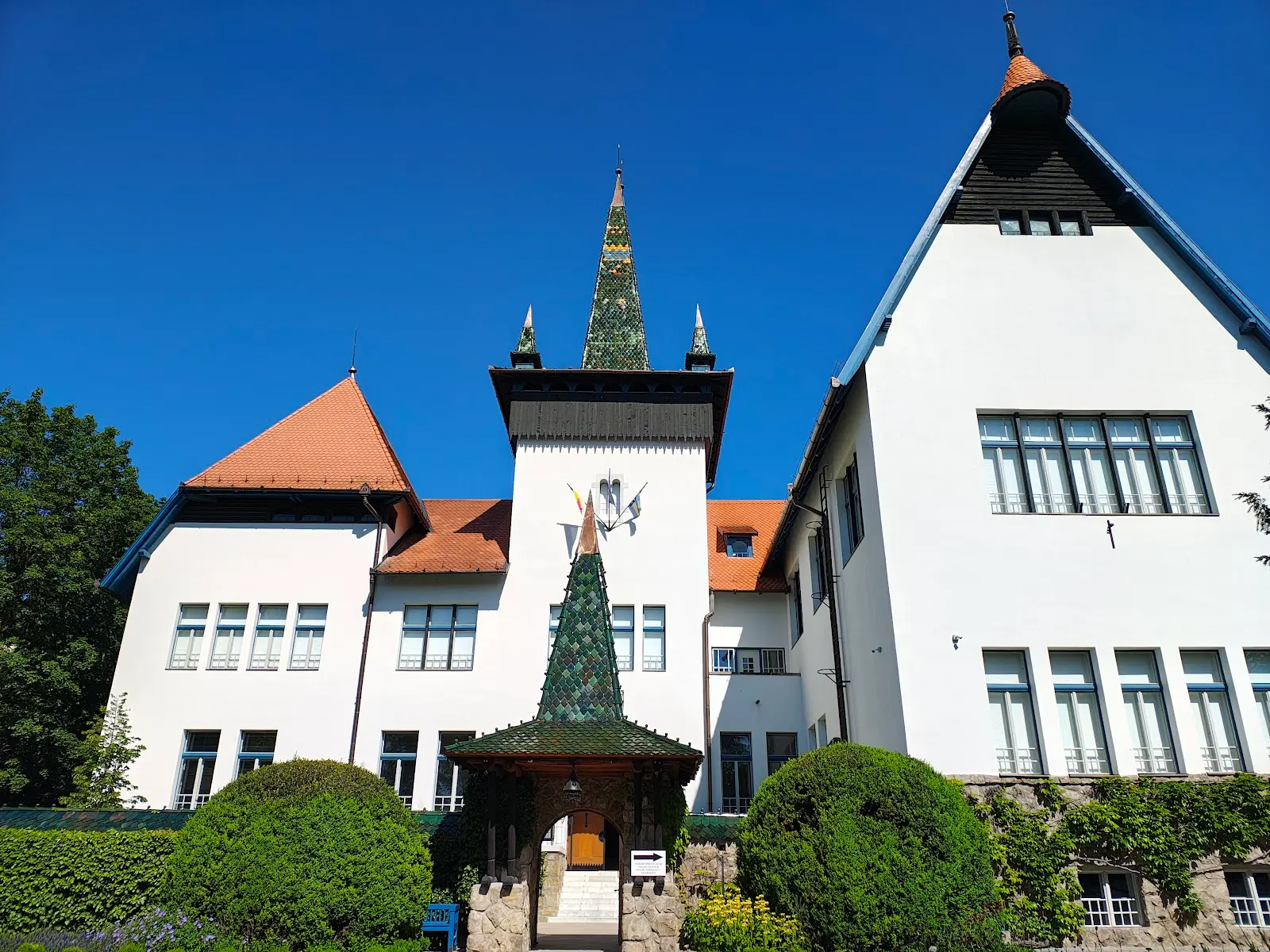
If you have one hour in town, give it to the Székely National Museum. The building is the work of Kós Károly, the master of Transylvanian vernacular architecture, and it is a lesson in itself: he took the forms of peasant houses — broad roofs, timber, river stone, open galleries — and raised them to the scale of a national institution. The collections cover the history, ethnography and art of Szekler Land, so you walk out understanding why the surrounding villages look the way they do.
A few minutes away stands the fortified Reformed church, with its defensive wall and tower — proof that here too, as across Transylvania, communities barricaded themselves around the church when danger came.
Getting there and getting around
- A car is the best option. Sfântu Gheorghe sits on the road between Brașov and Harghita, and the interesting villages — Micloșoara, Tălișoara, Vârghiș, Reci — are poorly connected to one another by public transport.
- By train it is a little over an hour from Brașov, and the station is close to the centre; a good choice if you stay in the town and the spa resort only.
- Distances are short. Almost everything worth seeing in the county is under an hour from town, which makes Sfântu Gheorghe a very comfortable base.
- Secondary roads are generally fine, but narrow and patchy on the last few kilometres into the villages; in winter, ask locally before heading up toward the mountains.
Covasna spa resort and the mofettes
Half an hour from town, Covasna resort is the reason many travellers come to the county at all. The ground here releases carbonated mineral water and carbon dioxide at so many points that the place is still known as the resort of a thousand springs. Its speciality is the mofette: a low chamber where natural CO₂ collects, used therapeutically for cardiovascular and peripheral circulation conditions. You step in fully dressed and stay standing, because the gas is heavier than air and pools around your feet — hence the basic rule: do not bend down and do not sit.
This is not decorative wellness but classic balneotherapy, taken under medical supervision. Even if you come purely as a visitor, give it a day: the air, the surrounding forests and the slow rhythm of the resort are a good counterweight to the driving.
The same phenomenon appears raw at the Devil's Pond, where gas escapes the ground through water and lifts bubbles to the surface in an aptly named patch of marsh. A short stop, but oddly memorable.
Castles, manors and villages
The Szekler nobility left Covasna a string of family houses that can be visited today. The best known is Kálnoky Castle at Micloșoara, carefully restored and now the core of a small manor-tourism ecosystem in the villages around it. Further north, Daniel Castle at Tălișoara is the region's other aristocratic story, with the same mix of 17th–18th-century architecture and unaltered farmland.
Drive the villages in between slowly: timber barns, carved Szekler gates, graveyards with wooden grave posts, small churches with sharp spires. It is a cultural landscape that does not advertise itself, but it is alive.
Nature: dunes, gorges, mountains
- Reci nature reserve — continental sand dunes and wetlands on the Olt floodplain, a rare combination, excellent for birds and for a quiet morning with binoculars.
- Vârghiș Gorges — a limestone defile riddled with caves on the Covasna–Harghita border; the basic walk is easy, while the big caves need gear and a guide.
- Ciucaș Mountains — to the south-west, with their conglomerate towers; this is where the serious trails start.
When to go
May–June and September are the sweet spots: full greenery or autumn colour, dry roads, villages without crowds. July–August brings the Hungarian-language festivals and cultural life at full volume, along with the most cars in the resort. Winter is beautiful and very quiet — as long as you accept that some village and mountain roads become a lottery.
At the table
The cooking is Hungarian-Transylvanian and rich in the best sense: sour soups, goulash, cabbage, paprika, potato dumplings, cakes with walnut and poppy seed. People drink the local mineral water, straight from the source in the resort, and pálinka is part of the protocol of any meal taken seriously.
A three-day itinerary
- Day 1 — the town. The museum in the morning, lunch in the centre, the fortified church and a walk along the main axis in the afternoon, a play or a terrace in the evening.
- Day 2 — the manors. Micloșoara in the morning, a slow drive through the villages to Tălișoara, a stop at the Devil's Pond on the way back.
- Day 3 — outdoors. The Vârghiș Gorges or the Reci dunes in the morning, Covasna resort in the afternoon, with an hour of forest and mineral water at the spring.
If you have a fourth day, give it to the mountains: the Ciucaș trails take a full day, not half of one.
Practicalities
- Romanian is spoken in all public institutions, but a köszönöm (thank you) at the till earns you a smile.
- Many manors and house-museums run by appointment rather than on shop hours — write ahead.
- For the mofettes, ask at reception or at the treatment base about access rules; they are strict and they exist for medical reasons.
- Cards work in town, in the resort and at hotels, but carry cash for the small villages, for entry fees at minor sights and for whatever you buy directly from your hosts.
- Book dinner at your guesthouse or manor. Villages offer no alternative once darkness falls, and a meal cooked in the house is often the best thing about the day.
Next: see what to see in Sfântu Gheorghe and Covasna for the sights day by day, and where to stay for choosing your base.
Plan your trip
Stays nearby
Stays in Romania
Experiences
Tours & activities
Guided tours, day trips and hand-picked experiences via GetYourGuide — free cancellation on most.
See all experiencesGetting to Romania
Flights, transfer & car
Fly into Romania
Compare fares to Bucharest Otopeni (OTP) and regional airports — Cluj, Sibiu, Iași, Timișoara.
Airport transfer
Private, fixed-price door-to-door transfer — driver waiting from the moment you land.
Rent a car — see the real Romania
A rental car is the key to Romania: the Transfăgărășan, the painted monasteries of Bucovina, mountain roads and the villages of Maramureș that no train reaches.
Find a car











