
What to see in Sfântu Gheorghe and Covasna
The Székely National Museum designed by Kós Károly, the fortified church, the mofettes and springs of Covasna resort, the Devil's Pond, Kálnoky and Daniel castles, the Vârghiș Gorges, the Reci dunes and the Ciucaș Mountains — the sights worth the drive, strung into days.
Covasna is a small county with an unusual density of things to see: a museum that is itself a work of architecture, two noble castles, a defile riddled with caves, sand dunes in the middle of Transylvania and a resort where the ground breathes out gas. Below are the sights genuinely worth the drive, grouped so you can string them into one day or three.
The Székely National Museum
This is sight number one and the logical starting point. The Székely National Museum gathers the history, ethnography and art of Szekler Land, but the building competes with the collections: it was designed by Kós Károly, the master of Transylvanian vernacular architecture, who translated the forms of the peasant house — broad roof, timber, river stone, galleries — into institutional architecture. Give the courtyard and the wooden outbuildings their time too.
Why here first: after an hour inside, you understand the carved gates, the wooden grave posts and the village layouts you will meet for the rest of the trip.
The town centre and the fortified church
Sfântu Gheorghe is a half-day on foot. The central axis has 19th- and 20th-century buildings, a few squares and terraces, and in the evening everything gathers around the Tamási Áron Theatre — a Hungarian-language company with a reputation across Romania; it is worth checking the playbill even without the language, since some productions carry surtitles.
At the old end of town, the fortified Reformed church keeps its defensive wall and bell tower. It is not an hour-long visit but a twenty-minute one that explains centuries of local history: this is where the community withdrew when danger came.
The centre also holds a few small galleries and cultural venues, old-fashioned patisseries and a produce market worth half an hour on a Saturday morning — cheeses, honey, smoked meat, vegetables from the Olt floodplain. This is a town where the tourist is not yet an economic category, and you feel it in the prices and in the way you are treated.
Covasna resort and the gas phenomena
Half an hour east, Covasna resort is famous for its carbonated mineral waters and for its mofettes — low chambers where natural carbon dioxide collects, used therapeutically for cardiovascular conditions. So many vents and springs earned it the nickname of the resort of a thousand springs. Even without treatment the place deserves an afternoon: you drink mineral water at the source, walk the surrounding forests and see what a classic Romanian spa town looks like.
The wild version of the same phenomenon is the Devil's Pond: a patch of marsh where gas escapes through water and makes it boil cold, with no fire under it. Short, strange, photogenic — and a good lesson in what is happening under Covasna.
Kálnoky Castle, Micloșoara
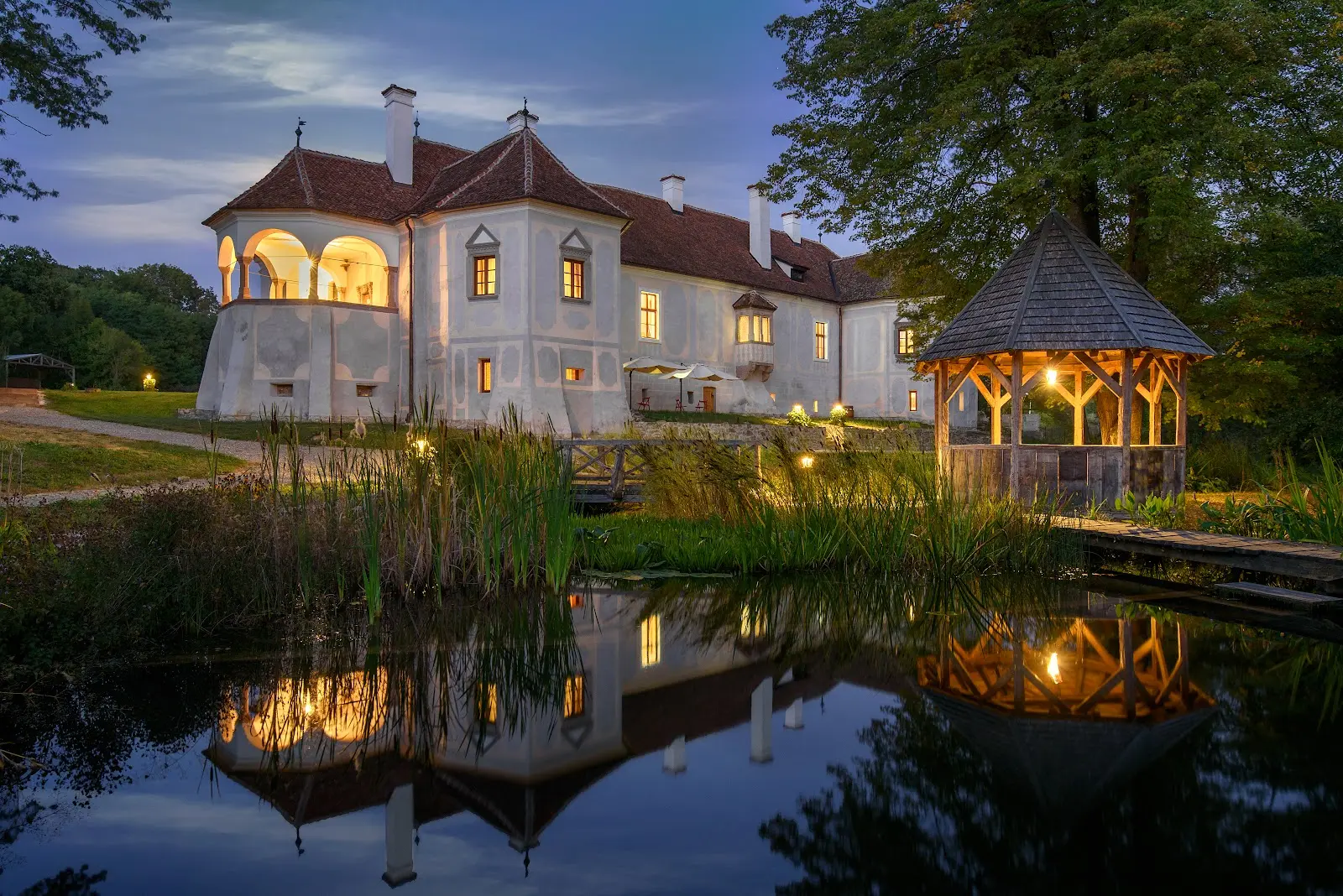
Kálnoky Castle at Micloșoara is the county's best-known aristocratic monument and a rare example of restoration done with judgement: the Kálnoky family manor was brought back to life together with the village houses, in a quiet tourism model that changed the local economy. You can visit the courtyard, the furnished interiors and the cellars, and the village around it — gates, barns, orchards — is part of the experience.
Daniel Castle, Tălișoara
Further north, Daniel Castle at Tălișoara is the other Szekler noble house open to visitors: 17th–18th-century architecture, a quiet park and the same unaltered farmland all around. The two castles pair well in a single day, on a route that cuts through the villages between them.
Tip: both run by appointment more often than on fixed hours. Write or call ahead, especially outside summer.
The villages between the castles
Between Micloșoara and Tălișoara lies the part of Covasna that never makes the posters and that, for many visitors, stays the most beautiful. Look for the Szekler gates — roofed, carved and dated, marking the entrance to a farmyard like a peasant triumphal arch; the big timber barns, their beams joined without nails; the graveyards with wooden grave posts whose carved symbol states the age and marital status of the person buried. The small churches, with sharp spires and painted coffered ceilings, usually open if you ask at the parsonage.
This is not a waymarked route but an area for slow driving and unplanned stops. Set off with a full tank and patience for tractors.
The Vârghiș Gorges
The Vârghiș Gorges are the most spectacular natural sight in the area: a limestone defile carved by the river, with vertical walls and more than a hundred caves in the massif. The basic route, along the water and over footbridges, works for families; the big caves, with their archaeological record, need a guide, a helmet and a lamp. Bring grippy shoes — the rock is wet most of the year.
Reci nature reserve
The Reci reserve is the county's surprise: continental sand dunes held in place by vegetation, next to wetlands and ponds on the Olt floodplain. The combination is rare in Central Europe and makes this a good birdwatching spot. It is not spectacular at first glance — it is an early-morning sight, for binoculars and patience. Spring, when the ponds are full and migration is under way, is the liveliest time; in summer the hot sand and the pines give the place an air that feels almost out of place in Transylvania.
The Ciucaș Mountains
To the south-west rise the Ciucaș Mountains, with their conglomerate towers and mushroom rocks — among the most photogenic low ridges in the Carpathians. From Covasna you approach via Întorsura Buzăului; for trails, waymarking and conditions, munte.online is our network's reference. Even a day at the foot of the range, through pasture and forest, is worth it. The comfortable version: sleep in a village at the base and set off early, to catch the light on the conglomerate towers before midday, when the ridge fills up.
How to string them together
- One day: the museum, the centre, the fortified church, then Covasna resort in the afternoon.
- Two days: add Micloșoara and Tălișoara, with a stop at the Devil's Pond.
- Three days: the Vârghiș Gorges one morning, Reci the next, or a full day toward Ciucaș.
If you only have half a day
The Székely National Museum, and nothing else. It is the one sight in the county that stands entirely on its own: the Kós Károly building plus the ethnographic collections give you, in an hour and a half, exactly what you came to understand. The second option, if you have a car and sunshine, is a quick run out to Covasna resort for water at the spring and a walk through the park.
For context, orientation and logistics, read the complete guide to Sfântu Gheorghe and Covasna; for your base of operations, see where to stay.
Plan your trip
Stays nearby
Stays in Romania
Experiences
Tours & activities
Guided tours, day trips and hand-picked experiences via GetYourGuide — free cancellation on most.
See all experiencesGetting to Romania
Flights, transfer & car
Fly into Romania
Compare fares to Bucharest Otopeni (OTP) and regional airports — Cluj, Sibiu, Iași, Timișoara.
Airport transfer
Private, fixed-price door-to-door transfer — driver waiting from the moment you land.
Rent a car — see the real Romania
A rental car is the key to Romania: the Transfăgărășan, the painted monasteries of Bucovina, mountain roads and the villages of Maramureș that no train reaches.
Find a car











