
Complete guide to Horezu
A small town in northern Vâlcea with two UNESCO listings: the Brâncovenesc monastery of Hurezi and the rooster ceramics still turned on the wheel. Everything you need before you go.
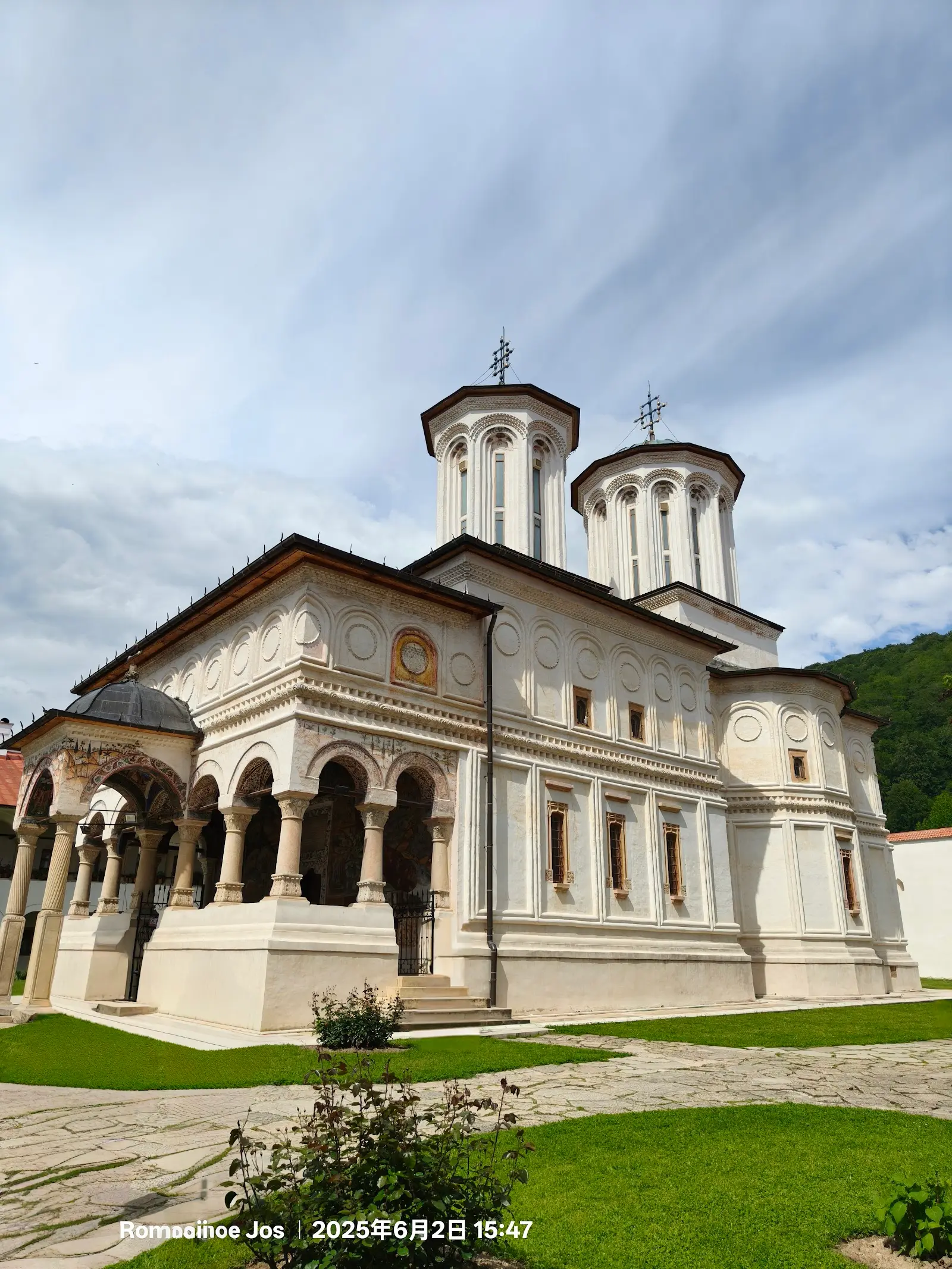
Horezu is a small town in northern Vâlcea county that carries two UNESCO listings a few kilometres apart. One is made of stone and fresco: the monastery founded by Prince Constantin Brâncoveanu, the largest surviving ensemble of Brâncovenesc architecture. The other is made of clay, still turned on the potter's wheel every week, and it goes home with you on a plate painted with a rooster.
Why Horezu is worth it
This is the Oltenia that sits under the mountains, where the sub-Carpathian hills stop abruptly against the wall of the Căpățânii range. The landscape is orchards and hay meadows, with long villages strung along the ridges, wooden churches and roads that climb towards gorges and caves. Horezu itself is not a spectacular town — it is a market centre with a square, a few streets and a potters' lane worth more than any boulevard.
The strength of the place is density: within a 30-kilometre radius you have a World Heritage monastery, two fortified boyar tower-houses unlike anything else in Europe, two mountain monasteries clinging to rock, two show caves and a field of stones that appear to grow. You can see all of it in a long weekend without ever driving more than half an hour between stops.
Hurezi Monastery, the Brâncovenesc masterpiece
Hurezi Monastery is why most people come here the first time. Founded by Constantin Brâncoveanu in 1690, it is the largest surviving ensemble of Brâncovenesc architecture and is inscribed on the UNESCO World Heritage list — the only monastery in Oltenia with that status.
What you actually see:
- the great church, with an open porch on carved stone columns — the signature of the Brâncovenesc style, that blend of Byzantine, Baroque and Romanian folk motif;
- the original wall paintings, including the votive portrait of the princely family, one of the most important early Romanian portrait galleries;
- the chapel, the infirmary church and the garden pavilion, smaller buildings around the courtyard, each with its own painting;
- the precinct wall with cells and guest range, which turns the whole ensemble into a quiet little fortress.
The Brâncovenesc style was born here and travelled from here across Wallachia: richly carved capitals, lace-like stone frames, open loggias. If you have only seen the painted monasteries of Bukovina, Hurezi is the other end of the story — also World Heritage, but with the elegance of a princely court. There is more on Romania's listed sites in our guide to UNESCO heritage.
The monastery is a working religious community, not a museum: dress modestly, keep your voice down, no flash, and put the camera away during services.
Horezu ceramics and the rooster that reached UNESCO
The town's second UNESCO listing is intangible: Horezu ceramics is inscribed on the Representative List of the Intangible Cultural Heritage of Humanity. This is not a museum collection, it is a living trade, practised in family workshops along the potters' lane.
Step into a workshop and you see the whole process: local clay, cleaned and kneaded, going up on the wheel; the shape pulled by hand; the decoration drawn with the cow horn and the gaița, a quill or needle that drags the line of slip into spirals; then the glaze and the firing.
The motifs are an alphabet: the spiral, the tree of life, the house snake, the star, the fish, the oak leaf. And above them all, the Horezu rooster — the bird with its tail fanned out, which has become the emblem of the town and, for many people, of Romanian pottery in general.
What makes Horezu special is not the age of the craft but the fact that it never stopped. The shapes survived because they were used: the soup bowl, the wall plate, the small jug, the narrow-necked pitcher, the big wedding platter. Every potter family has its own hand, and a trained eye can name the workshop from the way the spiral is drawn. Even the decoration follows a rule: it is applied to clay that is still damp, in a single movement, with no corrections — which is where the liveliness of the line comes from.
The potters' fair is held in summer, when makers from Horezu and other centres exhibit in town and work in front of the public — check the exact dates before you travel, as they are set each year.
How to spot a good piece: wheel-thrown (you can feel fine concentric rings inside), decorated by hand rather than printed, with an even glaze, no bubbles and no cracks; tableware should be fired for food use. Ask the potter — here, people answer.
Getting there and getting around
Horezu sits on DN67, the road linking Râmnicu Vâlcea to Târgu Jiu along the foot of the mountains. Visitors arrive from three directions: from Vâlcea and the Olt valley (coming from Sibiu or Bucharest), from Târgu Jiu, and from Craiova.
- A car is by far the best answer. The sights are scattered across villages — Măldărești, Costești, Bistrița, Arnota, Polovragi — and public transport does not connect them to each other.
- There are buses and minibuses towards Vâlcea and Târgu Jiu, but the timetable will not build you a day of visits.
- Main roads are good; the roads up to Arnota and to Bistrița Monastery are narrow and steep, and can demand care in winter.
How much time you need
- One day: Hurezi Monastery in the morning, the pottery workshops at midday, the tower-houses of Măldărești in the afternoon.
- Two days: add Bistrița and Arnota monasteries, the caves and the Costești trovants.
- Three days: climb towards Polovragi and the Olteț gorges and, if you want real mountains, up to the ridge.
The full list, with ready-made routes, is in our article on what to see in Horezu and around, and we have written separately about where to stay in Horezu and northern Vâlcea.
When to come
- Late spring (May–June): orchards in blossom, green hills, dry roads. The loveliest window.
- Summer: reasonable crowds, the potters' fair, easy access to the mountains. Days can be hot in the valley, but caves and forests rescue you.
- Autumn (September–October): colour, markets full of fruit, beautiful light for photography. The connoisseurs' choice.
- Winter: the monasteries are magnificent in snow and silence, but the hill roads demand good tyres and some sights keep shorter hours.
What to eat and what to take home
The cooking is Oltenian, with hill-country accents: sour soups sharpened with bran broth or cabbage brine, stews, polenta, sheepfold cheeses, sausages and smoked meats, savoury pies. The orchards produce plum brandy, and the autumn markets fill with fruit, walnuts and honey. Serious meals happen at the guesthouse rather than in a restaurant — in the villages a restaurant is the exception, not the rule, so give notice about dinner in advance.
To take home: ceramics straight from the workshop (a soup bowl, a wall plate, a jug), forest honey, preserves, walnuts. If you want a single object that sums up the place, take a rooster plate — that is precisely what reached the UNESCO list.
Practical tips
- Check opening hours for the monasteries, the tower-houses and the caves before you set out; they shorten off-season.
- Carry cash for workshops, small museums and the market — not every place takes cards.
- Shoes with decent soles: gravel courtyards, stone steps, earth paths.
- For the pottery workshops, call ahead if you want to catch a maker at the wheel; many welcome visitors but work to order.
- Buy straight from the workshop: the price is fair and the money stays with the craftsman.
- Bring a bag with something soft in it — a rooster plate deserves to get home in one piece.
Plan your trip
Stays nearby
Stays in Romania
Experiences
Tours & activities
Guided tours, day trips and hand-picked experiences via GetYourGuide — free cancellation on most.
See all experiencesGetting to Romania
Flights, transfer & car
Fly into Romania
Compare fares to Bucharest Otopeni (OTP) and regional airports — Cluj, Sibiu, Iași, Timișoara.
Airport transfer
Private, fixed-price door-to-door transfer — driver waiting from the moment you land.
Rent a car — see the real Romania
A rental car is the key to Romania: the Transfăgărășan, the painted monasteries of Bucovina, mountain roads and the villages of Maramureș that no train reaches.
Find a car











