
What to see in Horezu and around
Brâncovenesc monasteries, fortified tower-houses, caves, gorges and stones that seem to grow — all within a thirty-kilometre circle around Horezu.
Horezu has a rare advantage: everything worth seeing fits inside a thirty-kilometre circle. Brâncovenesc monasteries, fortified boyar tower-houses, caves, gorges and a field of stones that grow — all a few minutes' drive from one another. Here are the sights, in the order that makes a sensible route.
Hurezi Monastery, the heart of the area
Hurezi Monastery is the largest surviving ensemble of Brâncovenesc architecture, founded by Constantin Brâncoveanu in 1690 and inscribed on the UNESCO World Heritage list. You pass under the stone vault, step into the great courtyard, and suddenly understand why this style gave its name to an era: the open porch on carved columns, the lace-like window frames, the wall paintings with the votive portrait of the princely family.
Allow at least two hours. Walk the courtyard past the cells, look for the chapel and the infirmary church — the smallest buildings often hold the finest painting, and the open garden pavilion shows best how carved stone meets whitewashed masonry. It is a working monastery, so remember: modest dress, low voices, no flash and no camera during services.
Come early in the morning and the courtyard is nearly empty, with the light slanting in under the porch — the moment when the ensemble looks exactly as it does in the art-history books.
The potters' lane in Horezu
The town's second UNESCO listing is not a building but a trade: Horezu ceramics, inscribed as intangible cultural heritage. It is practised in family workshops in the potters' quarter, and the visit could not be simpler — you walk in, watch, ask, buy.
You see the clay pulled on the wheel, the decoration drawn with the cow horn and the quill, the glaze, the kiln. The motifs repeat like an alphabet: the spiral, the tree of life, the fish, the star and the Horezu rooster, the fan-tailed bird that became the town's emblem. The potters' fair is held in summer, with makers working in front of the public; dates are set each year, so check before you travel. There is more on techniques and the country's other living craft centres in traditional crafts.
The tower-houses of Măldărești
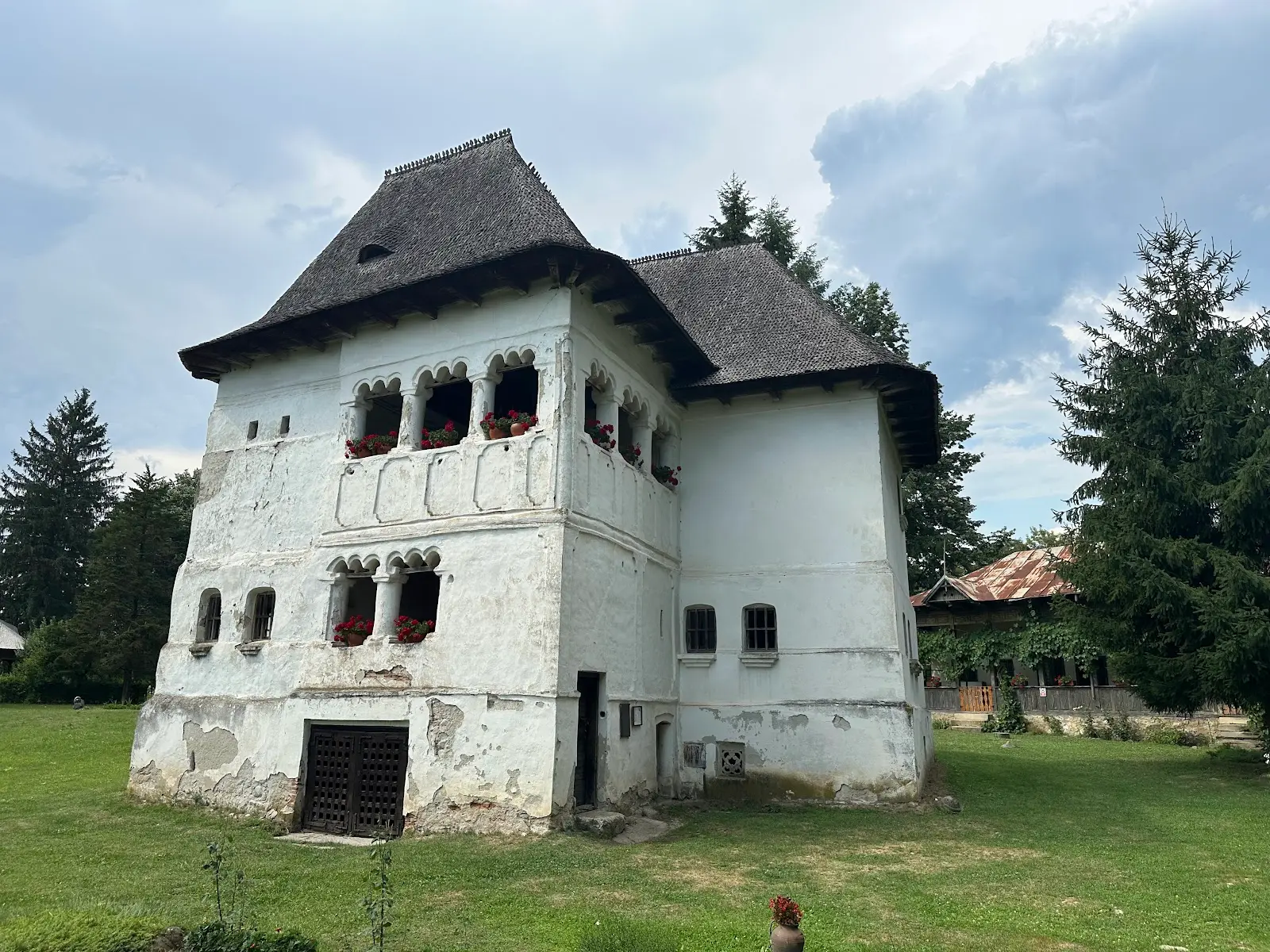
A few kilometres from Horezu, the village of Măldărești keeps Romania's best-known pair of cule — fortified boyar tower-houses typical of Oltenia, built as refuges in unsafe times: a massive stone ground floor, an internal stair, an open loggia at the top, windows as small as embrasures.
- Cula Greceanu is the older and more elegant of the two, with a painted loggia and architectural detail that connects it to the Brâncovenesc style.
- Cula Duca, its neighbour, is laid out as a period boyar interior, with furniture and household objects.
Together they make the most instructive visit in the area: this is how Oltenia's rural elite actually lived, between display and fear.
Arnota Monastery, high on the rock
Arnota Monastery sits at the end of a road that climbs in earnest, on a limestone shelf above the village of Bistrița. It is small, white, extremely quiet, and it has one of the finest panoramas in northern Vâlcea: the hills unfold below you, with the Buila-Vânturarița ridge at your back.
The climb is the hard part — a narrow road, steep gradients, gravel in places. Take it slowly, in a car you trust, and avoid it in heavy rain or ice.
Bistrița Monastery and the cave above it
Bistrița Monastery stands exactly where the river leaves the mountain, in a setting of rock and forest that stops conversation. The ensemble is large, with gardens, and the air at the mouth of the gorge is cool even in August.
From here a path leads up to Bistrița Cave, cut into the limestone above the monastery. The combination — monastery, gorge and cave in a single two- or three-hour stop — is one of the best in Oltenia. Bring a jacket: caves stay cool all year.
Polovragi Cave and the Olteț gorges
Westwards, already on the Gorj border, Polovragi Cave opens in the walls of the Olteț gorges, one of the narrowest defiles in the Carpathians. The approach road, squeezed between cliffs, is worth the trip on its own.
The cave is visited with a guide along a prepared route, with formations and local stories of hermits and buried treasure. Polovragi Monastery sits nearby in a meadow at the foot of the mountain — a short stop, but a beautiful one, especially towards evening when the gorge walls warm in colour. From here you can carry on along the Transalpina towards Rânca, if you have the time and the road is open.
The trovants of Costești
The trovants of Costești are a few minutes from Horezu, and you leave with a question. They are concretions of cemented sand, round and bulbous, emerging from the slope and apparently growing — hence the legend of the living stones. The explanation is geological rather than magical, but the effect stays strange: a field of boulders shaped like mushrooms, eggs, sleeping animals.
It is the ideal visit with children: short, outdoors, and with something to talk about on the way back.
The villages along the road under the mountain
Between the big sights, DN67 runs through long villages of hill houses, wooden gates and small churches, many of them modestly painted and looked after by the community. They are not ticketed attractions, but they are the reason to drive this road slowly: orchards, haystacks, horses at the roadside, improvised stalls with fruit and honey.
Stop wherever something catches your eye — a gate, a wayside cross, a sheepfold. If you happen to be here on a Sunday, the villages come alive around their churches, and that tells you more about northern Vâlcea than any information panel.
How to string it together
One unhurried day:
- Hurezi Monastery in the morning, in good light.
- Pottery workshops and lunch in Horezu.
- The Măldărești tower-houses in the afternoon.
- The Costești trovants at the end, if you still have an hour.
Two days:
- Day 1 as above.
- Day 2: Bistrița plus the cave, the climb to Arnota, then Polovragi and the Olteț gorges towards evening.
Three days: add a mountain day, or a slow drive through the villages along DN67, stopping at wooden churches and local markets.
The full context of the area, with seasons and access, is in our complete guide to Horezu, and we have broken down the lodging bases in where to stay in Horezu and northern Vâlcea.
Tips for the visit
- Check opening hours for the caves and the tower-houses; off-season they open in short windows, sometimes only with a guide.
- Cash for tickets, workshops and the market.
- A jacket even in summer: caves and gorge mouths are cold.
- Start early. The monasteries are quieter, and the hill roads are far more comfortable in daylight.
Plan your trip
Stays nearby
Stays in Romania
Experiences
Tours & activities
Guided tours, day trips and hand-picked experiences via GetYourGuide — free cancellation on most.
See all experiencesGetting to Romania
Flights, transfer & car
Fly into Romania
Compare fares to Bucharest Otopeni (OTP) and regional airports — Cluj, Sibiu, Iași, Timișoara.
Airport transfer
Private, fixed-price door-to-door transfer — driver waiting from the moment you land.
Rent a car — see the real Romania
A rental car is the key to Romania: the Transfăgărășan, the painted monasteries of Bucovina, mountain roads and the villages of Maramureș that no train reaches.
Find a car











