
Complete guide to Făgăraș
A small town on the Olt, with one of the best preserved medieval fortresses in Romania and the country's highest mountains above it. A complete guide to Făgăraș and the Făgăraș Land: the fortress, the Transfăgărășan and Bâlea, the monasteries, when to go and how long to stay.
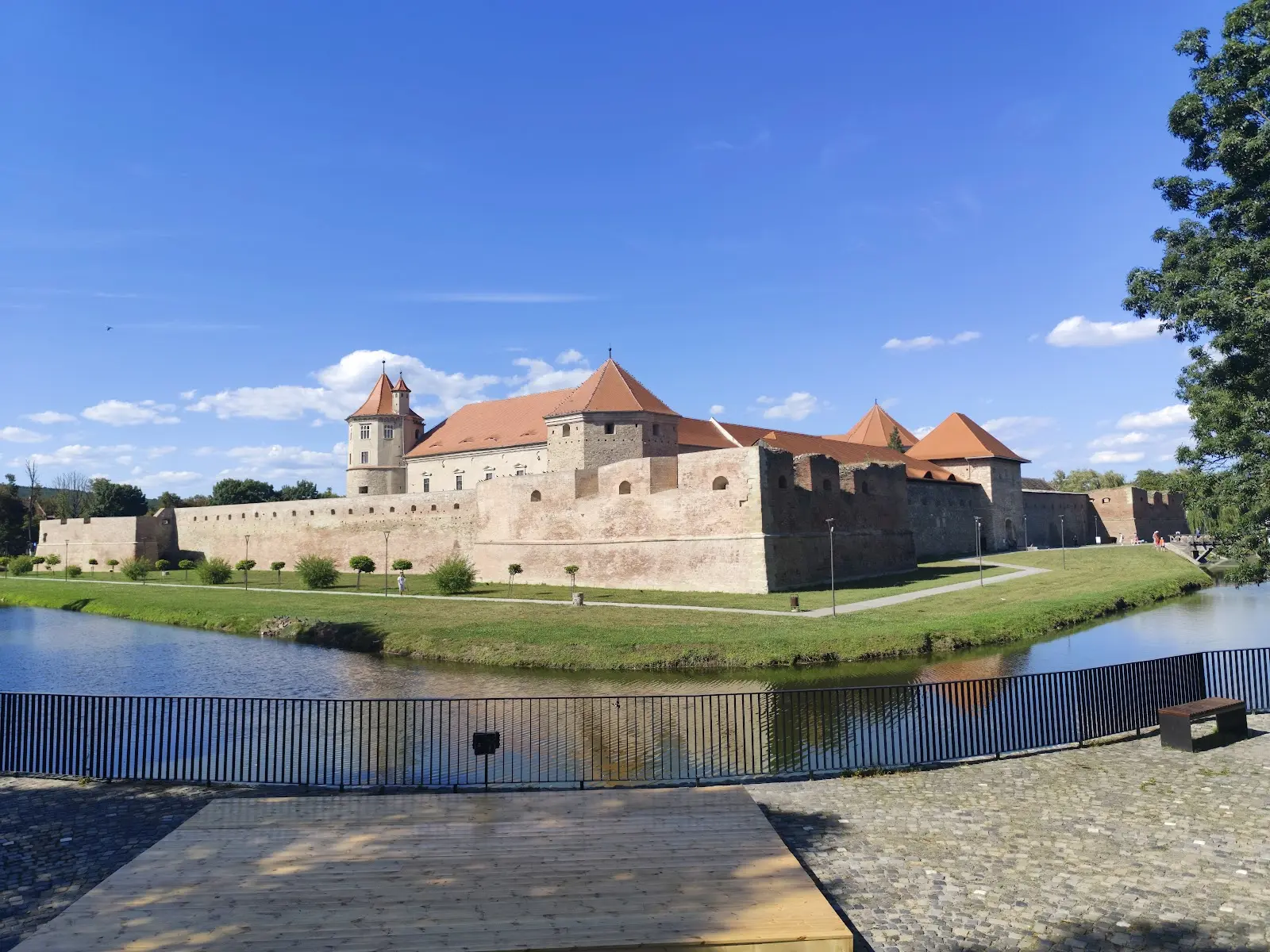
Few towns in Romania wear their history quite as openly as Făgăraș. You come for a fortress ringed by a water-filled moat, one of the best preserved in the country, and you stay for what you see at the end of the streets: the ridge of the Făgăraș Mountains, the highest in Romania. This guide explains what Făgăraș is, what surrounds it, and how to divide your time here.
Where you actually are
Făgăraș is a town in southern Transylvania, set on the river Olt, on the axis between Brașov and Sibiu. Around it spreads the Făgăraș Land — the lowland between the river and the mountains, with a string of villages at the foot of the ridge, each with its own church, its own pastures and its own road climbing into the forest.
It is one of the most clearly drawn regions in Transylvania: water to the north, mountains to the south, and between them an old farming country with its own customs and its own dialect. For a visitor that translates simply — the town is your base, and the attractions fall into two families: heritage (the fortress, the monasteries, village churches) and mountains (an alpine road, glacial lakes, waterfalls, trails). Most people arrive for one and leave surprised by the other.
Făgăraș Fortress, the heart of the town
There is no visit to Făgăraș without Făgăraș Fortress. It sits right in the centre, a few steps from the main square, and it is one of the best preserved medieval fortresses in Romania: a massive quadrangle of walls and bastions, with an elegant inner courtyard and — the detail that makes it instantly memorable — a water-filled moat that encircles it completely. Very few fortifications in the country have kept that element, and the effect is of a fortress afloat.
The building served as a Transylvanian princely residence, with everything that implies: a court, ceremony, political power. Under the communist regime it had another, far darker function — it was used as a political prison. We mention this not as an attraction but because it is part of the place you walk into: it is worth crossing the threshold knowing these walls have seen both.
Allow an hour or two inside, then walk the full circuit along the moat — it is the best perspective on the bastions.
The town: small, settled, a good base
Făgăraș is easy to see on foot. The centre has the scale of a Transylvanian provincial town: a few shopping streets, a park, churches of several denominations, simple terraces. It is not an open-air museum and does not try to be — it is a town that is used, with a market, schools and ordinary daily life.
That is exactly why it works as a starting point. You sleep here, you eat here, and in the morning you are half an hour from the foot of the mountains or on the road to the monasteries. For what is worth seeing in town and in the surrounding villages, see what to see in Făgăraș and the Făgăraș Land.
The mountains above the town
Făgăraș is the northern gateway to the Făgăraș Mountains, the highest massif in Romania. Here stands Moldoveanu Peak, the country's highest summit, along with the main ridge that carries kilometre after kilometre of alpine crest, with glacial lakes, cirques and rock walls.
Seen from the lowland, the mountains form one long, almost unbroken wall, and the height difference between the villages and the ridge is among the greatest in Romania. Which is why the weather down here tells you nothing about the weather up there: it can be summer in town and a storm on the crest within the same hour.
For the ridge, for trails described step by step and for multi-day traverses, munte.online is our dedicated mountain site — Făgăraș, Moldoveanu and Bâlea are precisely its territory.
The Transfăgărășan, Bâlea and the cable car
From the Făgăraș Land the Transfăgărășan climbs south, the alpine road that crosses the massif and reaches Bâlea Lake, right below the ridge. On the way up, before the final hairpins, is Bâlea Waterfall, one of the best known waterfalls in the Carpathians.
Two things change the plan completely and are worth checking before you leave:
- The alpine section of the road closes in winter. The dates vary from year to year with the snow and ground conditions — check for the year you are travelling rather than relying on last season's calendar.
- The cable car runs even when the road is closed. Going up with the Bâlea Lac cable car is how you reach the top outside the driving season, deep winter included.
If you are wondering how this road compares with the country's other great alpine route, we have a dedicated comparison: Transfăgărășan or Transalpina.
The monasteries of the Făgăraș Land
At the foot of the mountains, in the village of Sâmbăta de Sus, stands Brâncoveanu Monastery — a Brâncovean foundation and one of the most important spiritual centres in the region. The complex sits right where the forest begins, and even if monasteries are not usually your thing, the setting earns the detour: mountains behind, wide alleys, quiet.
To the west, on the road towards Sibiu, lie the Gothic ruins of Cârța Monastery, the oldest Cistercian ensemble in the area — something entirely different, sterner and more northern to the eye. Both are covered in detail in our sights guide.
When to go
- Summer is the full season: the alpine road open, dry trails, long days. It is also the busiest time up at Bâlea, especially at weekends — start early.
- Autumn may be the most beautiful: coloured forests on the slopes, clear air, far fewer people. Weather at altitude can turn fast, so pack properly.
- Winter leaves the town, the fortress and the monasteries perfectly visitable, and the cable car takes you up. The landscape is spectacular, but the plan is built around the weather, not the other way round.
- Spring is the least predictable season: green already down in the valleys, still snow and avalanche risk on the slopes above.
Getting there and getting around
Făgăraș sits on the Brașov–Sibiu road, so it is easy to reach from either city, by car or by train. The nearest airports are those of Brașov and Sibiu, both a reasonable drive away.
For the Făgăraș Land itself, though, a car makes the difference. The villages under the mountains, the monasteries and the trailheads are hard to catch by public transport, and the Transfăgărășan effectively requires your own car or an organised tour. If you arrive without one, stay in town and book a transfer or a day trip up to Bâlea.
How long to stay
- One day: the fortress, the centre, perhaps a stop at Sâmbăta de Sus.
- Two days: add a mountain day — the Transfăgărășan and Bâlea, or a day hike.
- Three or four days: the villages under the ridge, Cârța, one serious hike and time to breathe.
For accommodation options, from town hotels to the chalets on the Transfăgărășan, see where to stay in Făgăraș and around.
Best for
Făgăraș suits anyone who wants two holidays in one: Transylvanian heritage in the morning and serious mountains in the afternoon. It works beautifully as a two-night stop on the Brașov–Sibiu route, as a base for the Transfăgărășan and as a launch point for the highest ridge in Romania. One firm piece of advice: bring mountain clothing even in August — there is more than a thousand metres between the town and the crest, and up there it is always another story.
Plan your trip
Stays nearby
Stays in Romania
Experiences
Tours & activities
Guided tours, day trips and hand-picked experiences via GetYourGuide — free cancellation on most.
See all experiencesGetting to Romania
Flights, transfer & car
Fly into Romania
Compare fares to Bucharest Otopeni (OTP) and regional airports — Cluj, Sibiu, Iași, Timișoara.
Airport transfer
Private, fixed-price door-to-door transfer — driver waiting from the moment you land.
Rent a car — see the real Romania
A rental car is the key to Romania: the Transfăgărășan, the painted monasteries of Bucovina, mountain roads and the villages of Maramureș that no train reaches.
Find a car












