
What to see in Făgăraș and the Făgăraș Land
From the moated fortress in the town centre to Bâlea Waterfall, the cable car below the ridge, Brâncoveanu Monastery at Sâmbăta de Sus and the Cistercian ruins at Cârța — the sights worth the trip in Făgăraș and the villages beneath Romania's highest mountains.
Few areas in Romania hand you a moated fortress and a waterfall above 1,000 metres on the same day. The Făgăraș Land is exactly that: a strip of Transylvania caught between the river Olt and the highest mountain chain in the country. Here are the sights that genuinely earn the trip, in the order you would visit them.
Făgăraș Fortress
Făgăraș Fortress is why most people stop in town — and it lives up to it. This is one of the best preserved medieval fortresses in Romania: thick walls, corner bastions, an arcaded inner courtyard and, all the way around, a water-filled moat that separates it completely from the town. The image is unusual for Romania, where most fortifications lost their water long ago.
The fortress served as a Transylvanian princely residence, and under the communist regime it was used as a political prison — a chapter worth holding in mind as you walk under the gate.
Practical tip: do the full circuit on the outside, along the water, before going in. The bastions reflected in the moat make the best photograph in town, especially early in the morning or towards sunset.
The town centre, on foot
Făgăraș does not have a sprawling old town, but it does have a pleasant hour's walk: the main square, the shopping streets around the fortress, churches of several denominations and the park. It is a real town rather than a stage set — good for a coffee, a meal and a pause between two mountain outings. More on the town as a base in our complete guide to Făgăraș.
Bâlea Waterfall
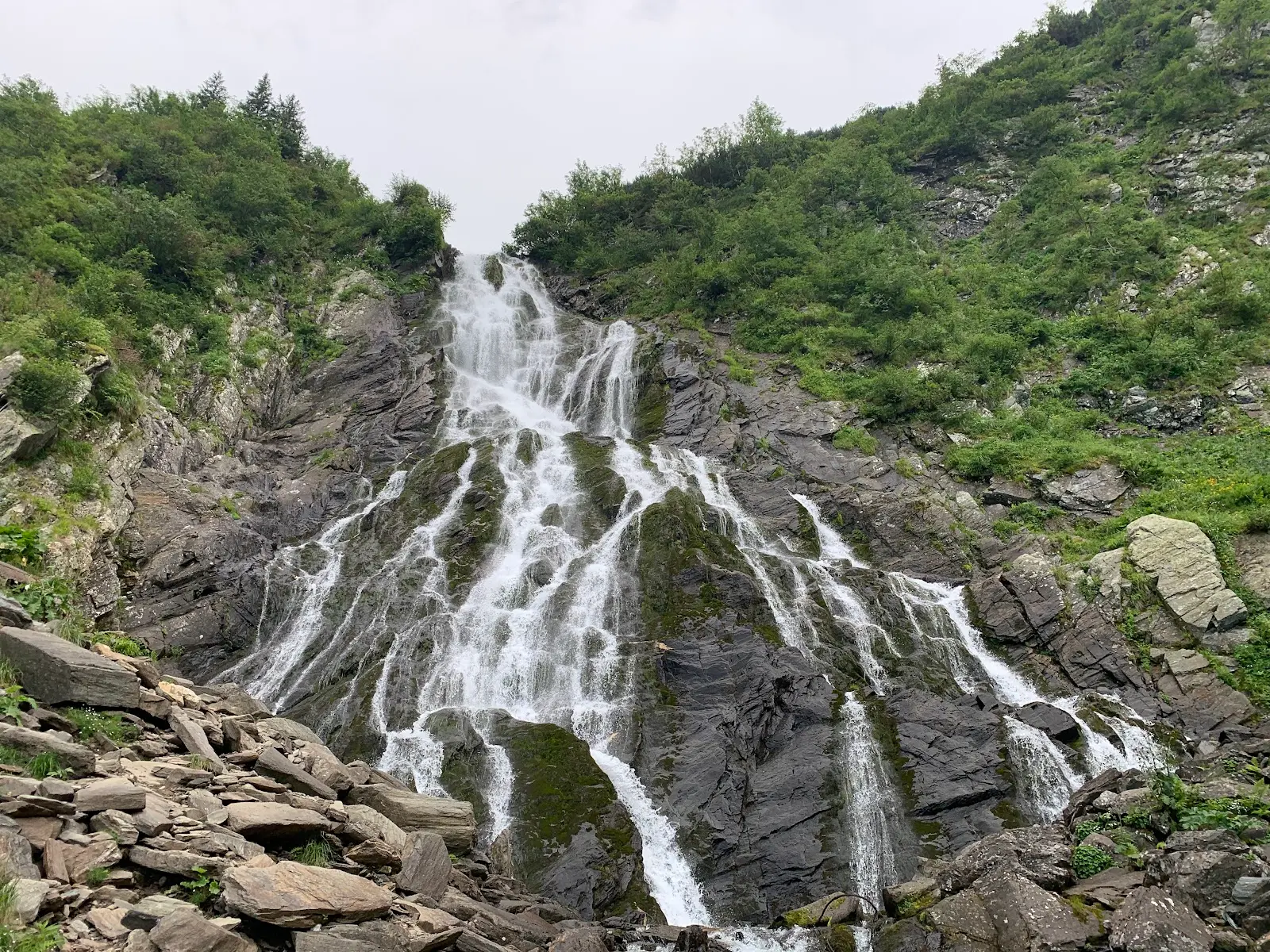
Climbing the Transfăgărășan from the Făgăraș side, the first major stop is Bâlea Waterfall, one of the best known waterfalls in the Carpathians. The water drops in steps over the glacial threshold, and you hear the roar before you see it. The flow varies considerably by season: it is at its most spectacular during snowmelt and after long rain.
From the lower car park a few minutes' walk gives you a good view; from the cable car station you look down on it instead. Wear shoes with proper grip — the rocks around it stay wet and slippery.
The Bâlea Lac cable car
The Bâlea Lac cable car is one of the most useful tourist installations in Romania, for a simple reason: it runs even when the alpine section of the Transfăgărășan is closed, which is to say all winter. It lifts you from the waterfall up to the lake basin, and the ride across the slope is a sight in itself.
Use it in two situations: in winter, when the road up does not exist, and on busy summer weekends, when the car park at the lake is full. The weather up top decides everything — check whether the lift is running on the day.
Bâlea Lake and the ridge above it
Up under the crest, Bâlea Lake is a glacial lake set in a wide cirque, ringed by walls and scree. In summer it is the most visited spot in the Făgăraș range; in winter it is the launch point for snow routes. Even if you walk no trail at all, an hour spent on the lake shore explains why this massif is considered the sternest in the Romanian Carpathians.
Trails radiate from here in every direction, from an easy stroll around the water to serious climbs onto the ridge.
The Făgăraș Mountains and Moldoveanu Peak
The Făgăraș Mountains are the highest massif in Romania and, for many people, the most beautiful. The main ridge holds above 2,000 metres for kilometre after kilometre, with glacial lakes hidden in cirques, exposed saddles and long valleys dropping north towards the Făgăraș Land.
At the eastern end of the massif stands Moldoveanu Peak, the country's highest summit. It is not a technical climb, but it is a long day with big elevation gain and full exposure to the weather — it is planned properly, not improvised. For route descriptions, access options and multi-day ridge traverses, munte.online is our dedicated mountain site. If you want a broader selection of walks across the country, see also the finest hiking trails in Romania.
Brâncoveanu Monastery, Sâmbăta de Sus
Brâncoveanu Monastery at Sâmbăta de Sus is the region's most important spiritual site: a Brâncovean foundation set at the far end of the village, exactly where the pastures give way to the forest at the foot of the mountains. The complex is large and carefully kept, with wide alleys and a quiet you feel the moment you pass the gates.
Dress modestly, speak softly and treat the courtyard as a place of prayer rather than an attraction. The village is also one of the best starting points for the ridge.
Cârța Monastery
To the west, on the road towards Sibiu, Cârța Monastery is something else entirely: the ruins of a Gothic Cistercian complex, with broken arches open to the sky and a partly preserved church still used by the local community. The stonework has a northern severity, very different from the baroque and the timber you see elsewhere in Transylvania.
It is a short stop — half an hour, an hour with photographs — but among the most memorable in the area, especially if you catch afternoon light through the arches.
The villages under the mountains
Between Făgăraș and the ridge runs a string of villages worth driving slowly, with unplanned stops: old houses with wooden gates, village churches, pastures that climb straight into the forest and, at the top, forest roads that turn into trailheads. These are not ticketed sights; they are a cultural landscape — precisely the part a hurried visitor misses.
If you have a single free afternoon, pick a village at random between Făgăraș and Sâmbăta de Sus and follow its road uphill for as long as the asphalt lasts.
How to build your days
- Day 1 — heritage: the fortress in the morning, the centre at lunch, Cârța or Sâmbăta de Sus in the afternoon.
- Day 2 — mountains: climb the Transfăgărășan early, stop at the waterfall, reach the lake, walk or take a short trail, and come down before the weather turns.
- Day 3 — your choice: a serious ridge hike, or a slow day through the villages below the mountains.
For where to sleep between those days — in town, at Sâmbăta de Sus or up on the Transfăgărășan — see where to stay in Făgăraș and around.
What not to forget
The height difference between the town and the ridge is over a thousand metres, and the weather changes in minutes. Even for a simple drive up to the lake, take a windproof jacket, water and closed shoes. And set off early: in Făgăraș, the best hours are always the first ones.
Plan your trip
Stays nearby
Stays in Romania
Experiences
Tours & activities
Guided tours, day trips and hand-picked experiences via GetYourGuide — free cancellation on most.
See all experiencesGetting to Romania
Flights, transfer & car
Fly into Romania
Compare fares to Bucharest Otopeni (OTP) and regional airports — Cluj, Sibiu, Iași, Timișoara.
Airport transfer
Private, fixed-price door-to-door transfer — driver waiting from the moment you land.
Rent a car — see the real Romania
A rental car is the key to Romania: the Transfăgărășan, the painted monasteries of Bucovina, mountain roads and the villages of Maramureș that no train reaches.
Find a car












