
Complete guide to Câmpulung Moldovenesc
Câmpulung Moldovenesc is a Bucovinian town on the Moldova river, at the foot of the Rarău massif. It holds the Wood Museum, unique in Romania, has Pietrele Doamnei and Rarău Peak above it, and makes an easy starting point both for mountain trails and for the painted monasteries of Bucovina.
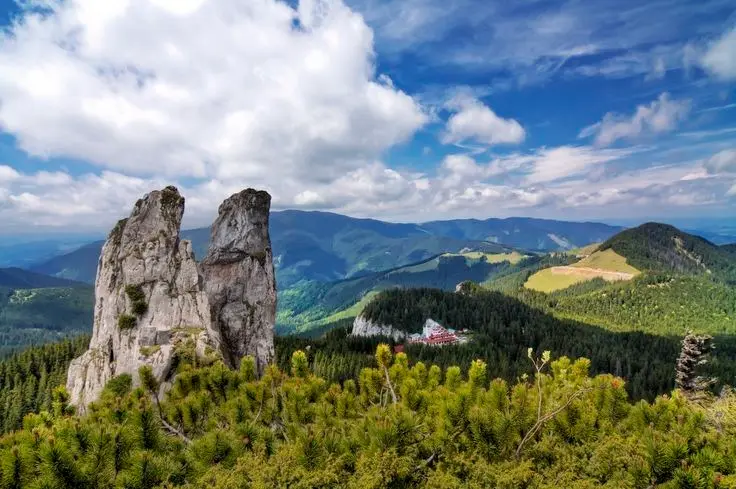
Câmpulung Moldovenesc tells its own story through its name: a long clearing squeezed between mountains, on the thread of the Moldova river. Above the town rises the Rarău massif with its limestone towers, and down in the centre stands a museum with no equal anywhere in Romania. This is a working base, not a shop window — and that is precisely what makes it valuable.
Why Câmpulung Moldovenesc
The town sits in Bucovina, on the Moldova river, at the foot of the Rarău massif. That position gives it a double nature rare in Romania: it is both a trailhead for the mountains and a comfortable base for heritage. You can climb to a limestone ridge in the morning and stand in front of a church painted five centuries ago in the afternoon.
The reasons, in short:
- The Wood Museum — unique in Romania, devoted to the civilisation of wood.
- Pietrele Doamnei — the best-known landmark of the area, spectacular limestone formations in the Rarău.
- Rarău Peak — the mountain that presides over the town, reachable without alpine experience.
- The painted monasteries of Bucovina — the town is one of the best bases for visiting them.
- Crafts that are still alive — from woodwork to the painted eggs of the surrounding villages.
A town built out of wood
To understand Câmpulung, start at the Wood Museum. It is unique in Romania: not a general ethnographic collection, but an institution dedicated entirely to the civilisation of wood — crafts, tools and traditional objects from a region where wood was the basic material of life.
That is not a tourist-brochure metaphor. In a mountain valley with conifer forest on every slope, wood was simultaneously house, roof, fence, tool, kitchen vessel, toy, musical instrument and trade good. The museum lays out exactly that chain: how a tree was chosen, felled, moved, worked, and how it ended up — through axe and knife — as the object someone used every day.
For a visitor the value is twofold. First, the quality of the pieces: tools and objects showing a practical intelligence refined over generations, in which no shape is accidental and every species of wood is chosen for what it had to hold. Second, the key they give you. After this museum you read every Bucovinian house, every carved gate and every shingle roof along the road to the monasteries differently. What looked merely picturesque becomes legible.
The museum also explains the town's economy. Câmpulung lived for centuries off the forest — felling, rafting timber down the Moldova, working it, selling it — and the crafts displayed here are not folklore but the traces of an industry that shaped the valley, the villages and the way the farmsteads around still look today.
Rarău, the town's mountain
Above Câmpulung rises the Rarău massif, and for many travellers it is the whole reason for coming. Its absolute landmark is Pietrele Doamnei, limestone formations that lift abruptly out of the forest like towers — the most photographed and best-known landscape in the region. Beside them, Rarău Peak offers the full panorama of mountain Bucovina, with Giumalău opposite and the long ridges of the Obcine beyond.
The third target is the Moara Dracului waterfall, hidden in a narrow gorge cut into rock — a fall of water you hear before you see, and a short but memorable walk.
The Rarău has the great advantage of suiting several levels of fitness: you can reach the heights by road and set off from there on short walks to the rocks, but there are also long, full-day routes that start in the town itself. For marked trails, real elevation gain, honest timings and winter conditions, our colleagues at munte.online cover the Rarău and Giumalău in detail.
Bucovina, within half a day
This is where the town proves its worth as a base. From Câmpulung you reach the painted monasteries of Bucovina easily — one of the most important ensembles of medieval art in Europe, with exterior frescoes that have survived centuries on the church walls at Voroneț, Humor, Moldovița and Sucevița.
Very close by, at Vama, is the Egg Museum, with a large collection of painted eggs. It is not a cabinet of curiosities: egg painting is a living Bucovinian craft, still practised in households, and the collection shows how far geometric decoration can be pushed on a surface a few centimetres across. Together with the Wood Museum it makes a logical pair: two fragile materials, the same discipline of the hand.
For the full regional context — what Bucovina is, how the Moldova valley connects to the Obcine ridges and the Suceava area — see the guide to Bucovina.
The long town and the Moldova valley
Câmpulung has no compact historic core built around a medieval square. It has one long artery following the river, with the town unfolding on either side and mountains closing off every view. That gives it an unusual geometry: you walk along it rather than around it, and at the end of every side street the forested slope appears.
The walk is best taken without a checklist. You pass timber and masonry houses from the early twentieth century, yards with barns and carefully stacked firewood, streams coming down off the Rarău through the middle of town. This is a place that has not rearranged itself for visitors — which, for anyone tired of identically restored centres, is exactly the quality they are looking for.
The Moldova valley, further out, is the thread that links everything: Bucovinian villages line it kilometre after kilometre, houses turned towards the road, farmsteads readable from the car. Every trip you make — to the monasteries, to Vama, to Vatra Dornei — runs along this valley.
When to go
Summer and early autumn are the safest windows for the mountain: the Rarău trails are dry, the days are long, and the walk out to the rocks asks for no special kit. September and the first half of October add the colour of the beech forests and far fewer people at Pietrele Doamnei.
Winter changes the town completely: Câmpulung becomes a snow destination, picture-postcard in appearance, with the emphasis shifting to the cultural half of the visit, because the alpine routes on Rarău then demand winter experience and equipment. Spring is the most unpredictable season — snow holds high on the massif long after the valley has turned green.
Practical: getting there and how long to stay
By car, the town lies on the main road linking Suceava to Vatra Dornei and onward to Transylvania, following the Moldova valley — a beautiful drive in itself, with Bucovinian villages strung out for kilometres.
By train, Câmpulung Moldovenesc is a station on the line climbing from Suceava to Vatra Dornei, which makes the visit workable without a car, at least for the town and for Vama.
How long: one full day covers the Wood Museum, the centre and a climb to Pietrele Doamnei. Two or three days is the honest answer if you also want the monasteries, the Moara Dracului waterfall and a longer route on the Rarău.
The full list of sights is in what to see in Câmpulung Moldovenesc and the Rarău, and for choosing where to base yourself see where to stay in Câmpulung Moldovenesc.
Câmpulung Moldovenesc is not a town that sells itself at first glance. You understand it after one climb to Pietrele Doamnei and an hour in the Wood Museum — and then it becomes exactly what you need in Bucovina: a place you set out from in every direction.
Plan your trip
Stays nearby
Stays in Romania
Experiences
Tours & activities
Guided tours, day trips and hand-picked experiences via GetYourGuide — free cancellation on most.
See all experiencesGetting to Romania
Flights, transfer & car
Fly into Romania
Compare fares to Bucharest Otopeni (OTP) and regional airports — Cluj, Sibiu, Iași, Timișoara.
Airport transfer
Private, fixed-price door-to-door transfer — driver waiting from the moment you land.
Rent a car — see the real Romania
A rental car is the key to Romania: the Transfăgărășan, the painted monasteries of Bucovina, mountain roads and the villages of Maramureș that no train reaches.
Find a car











