
What to see in Câmpulung Moldovenesc and the Rarău
The Wood Museum, unique in Romania, Pietrele Doamnei and Rarău Peak, the Moara Dracului waterfall and the Egg Museum at Vama — every major sight in Câmpulung Moldovenesc and the Rarău massif, with itineraries for one, two or three days.
The list of things to see in Câmpulung Moldovenesc splits neatly in two: what you visit in town, and what you climb on the Rarău. The first half is done on foot in a few hours. The second asks for a day, decent shoes and a long look up at the limestone towers above the valley.
The Wood Museum, the sight that explains the region
If you have time for one thing in town, make it the Wood Museum. It is unique in Romania — a museum devoted entirely to the civilisation of wood, meaning the crafts, tools and traditional objects of a region where wood was the basic material of life.
What you actually see:
- Forester's and craftsman's tools — adzes, drawknives, saws, the whole arsenal by which a tree became an object.
- Household objects — vessels, spoons, pails, troughs, pieces made from species chosen for what they would hold.
- Architectural elements — how beams were jointed, roofs raised and gates closed.
- Decorative work — carvings and motifs showing that the useful never excluded the beautiful.
The museum works as a key: once you have been through it, you no longer walk past a Bucovinian house or a shingle roof without looking. For the wider context of these trades, see the article on traditional crafts.
Pietrele Doamnei, the absolute landmark
Pietrele Doamnei are the reason the Rarău appears in every album about Bucovina. They are limestone formations rising abruptly out of the conifer forest like isolated white towers on a ridge — an apparition that resembles nothing around it, and the best-known landmark of the area.
Their drama is a matter of contrast: white limestone, dark spruce green, open sky above. In fine weather they are a viewpoint; in mist they become silhouettes that appear and vanish; in morning or evening light they take on warm colour. The ground at the foot of the rocks is covered by short, clear paths; for any variant involving scrambling or exposed passages, go with someone experienced.
Two practical pieces of advice separate a good visit from a wasted one. First: go up early. The morning air is clearer, the rock catches side light, and on summer weekends the place fills up by midday. Second: don't only look up. The vegetation on the limestone is unlike the surrounding forest — rock plants, mosses, dwarf shrubs growing out of fissures — and it is part of why the area matters, not merely why it photographs well.
Rarău Peak, the full panorama
A little higher, Rarău Peak gives you what the rocks cannot: the 360-degree view. From here the whole of mountain Bucovina can be read — bulky Giumalău opposite, the Obcine ridges running north like long waves, and below, the Moldova valley with the town stretched along it.
The peak has accessibility on its side. The heights can be reached by road, and the short paths to the ridge and to Pietrele Doamnei start from there, so the panorama is not reserved for trained walkers. If you do want the full ascent on a marked trail from the town, though, you are looking at a serious mountain day: elevation gain, honest timings and seasonal conditions for the Rarău and Giumalău are documented by our colleagues at munte.online.
Moara Dracului waterfall, the best short walk
The Moara Dracului waterfall is the sight that rewards you fastest. The water drops through a narrow gorge cut into rock, and the tightness of the place makes the noise: you hear it before you see it, and the last few metres of approach, between close walls and wet stone, are the finest part of the walk.
A few things to know first:
- The rocks and roots along the way are slippery almost permanently — proper soles, not sandals.
- The flow varies a lot: after rain and during snowmelt the fall is impressive, in a dry summer it is far more modest.
- It is a short walk, so it pairs well with Pietrele Doamnei on the same day.
The Egg Museum at Vama
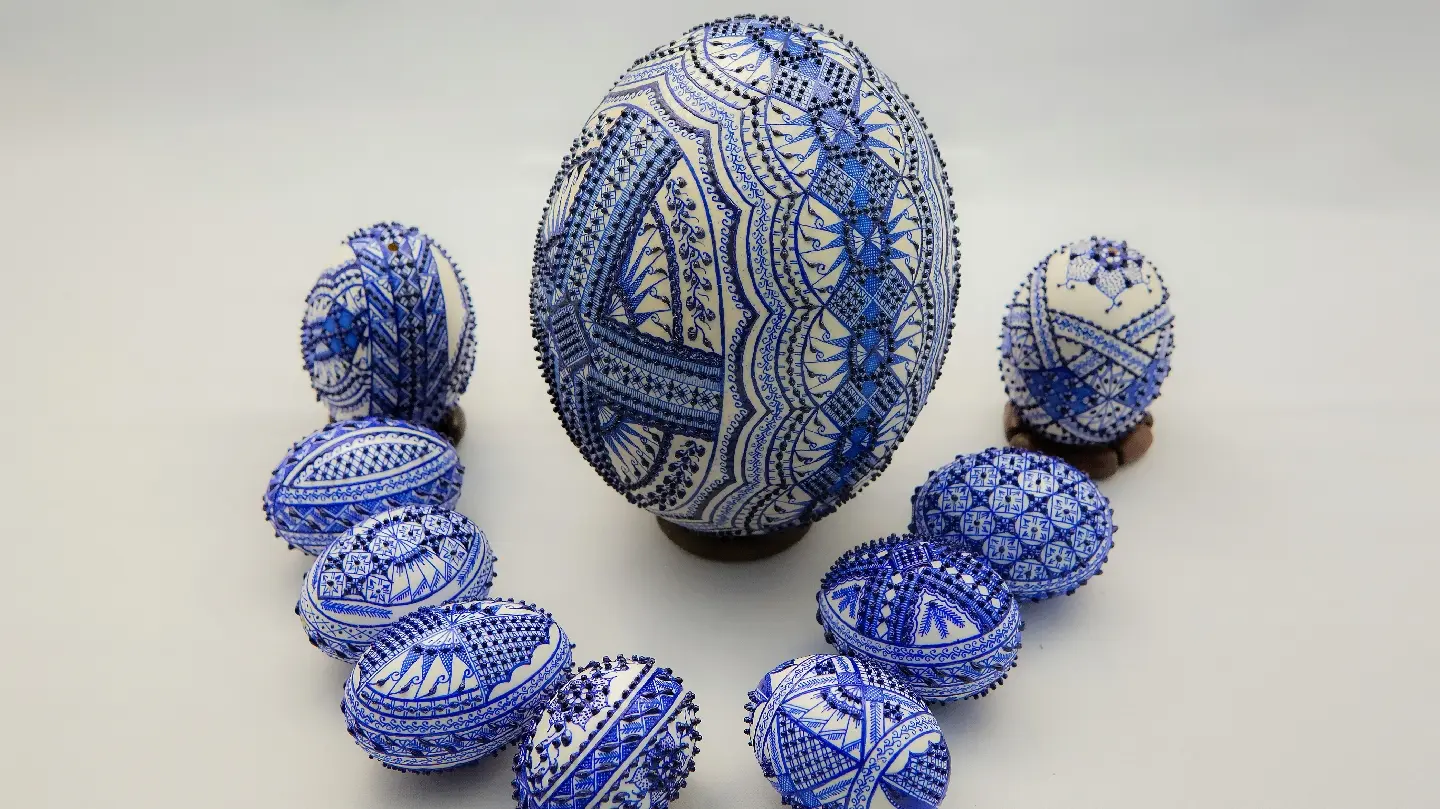
At Vama, very close to town, is the Egg Museum — a large collection of painted eggs, and one of the best demonstrations of patience you can see anywhere in Bucovina.
Egg painting is not a museum craft but a living one: it is still practised in households across the region, with wax, stylus and colour, on a calendar tied to the spring festivals. The collection shows how far geometric decoration can be pushed on a surface a few centimetres across — dozens of motifs, schemes that repeat and vary, an entire grammar of symbols on an eggshell.
It is also the perfect sight for a rainy day, when the Rarău trails are not a good idea. And it is a good argument for stopping in Vama and the villages around it rather than driving through them on the way to the monasteries.
The painted monasteries, from Câmpulung
The town's strongest argument as a base is its proximity to the painted monasteries of Bucovina. The exterior frescoes at Voroneț, Humor, Moldovița and Sucevița are among the most important ensembles of medieval art in Europe, and from Câmpulung you can reach them without moving your luggage.
The order of visits, the time required and the access rules are in the guide to the Bucovina monasteries.
The town, on foot
The centre of Câmpulung is best taken slowly, with no checklist. The town is long — exactly as its name says — stretched along the Moldova valley, with one main street running its length and mountains visible at both ends of every view. You walk it for the old houses, for the quiet, and for the fairly rare feeling of a town that has not rearranged itself for visitors.
What is worth looking at as you go:
- Early twentieth-century houses — timber and masonry, with verandas, worked door frames and steep roofs built for snow.
- Working yards — barns, firewood stacked with geometric care, gates repeating the motifs you saw in the museum.
- The streams coming down off the Rarău through the middle of town, with small bridges over them.
- The side views — every street climbing away from the main artery ends in a forested slope.
This is not an hour of ticking off monuments. It is the kind of town you understand by walking it, best in the morning or evening when the light comes straight down the valley.
Tying it into an itinerary
- One day: the Wood Museum in the morning, Pietrele Doamnei and Rarău Peak in the afternoon.
- Two days: add the Moara Dracului waterfall and the Egg Museum at Vama.
- Three days: a full day for the painted monasteries, or a long route on the Rarău.
The full context of the town is in the guide to Câmpulung Moldovenesc, and for the right area to sleep in see where to stay in Câmpulung Moldovenesc.
Plan your trip
Stays nearby
Stays in Romania
Experiences
Tours & activities
Guided tours, day trips and hand-picked experiences via GetYourGuide — free cancellation on most.
See all experiencesGetting to Romania
Flights, transfer & car
Fly into Romania
Compare fares to Bucharest Otopeni (OTP) and regional airports — Cluj, Sibiu, Iași, Timișoara.
Airport transfer
Private, fixed-price door-to-door transfer — driver waiting from the moment you land.
Rent a car — see the real Romania
A rental car is the key to Romania: the Transfăgărășan, the painted monasteries of Bucovina, mountain roads and the villages of Maramureș that no train reaches.
Find a car











