
Complete guide to Târgu Mureș
The complete guide to the bilingual city in the heart of Transylvania: the Palace of Culture and its Hall of Mirrors, the medieval citadel, Piața Trandafirilor with its two cathedrals, the food, the logistics and a one- or two-day plan.
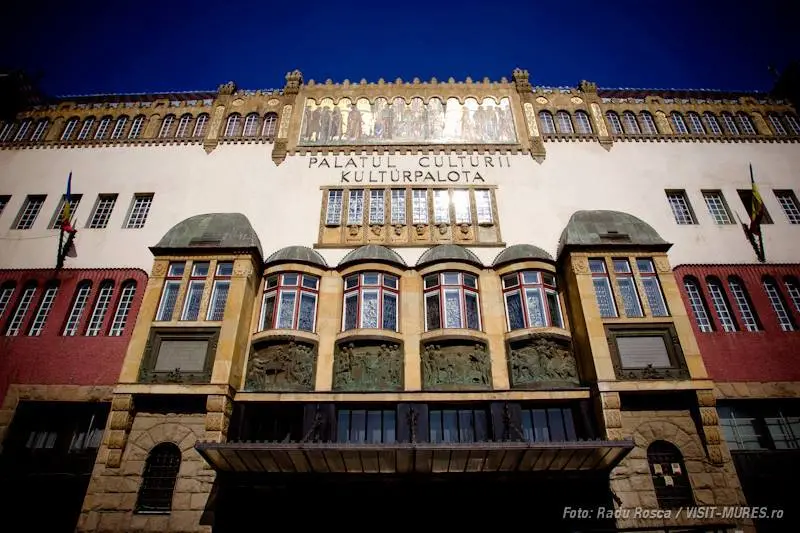
Târgu Mureș is the city most people drive through on the way somewhere else. That is a mistake: few places in central Transylvania pack an Art Nouveau palace lined with stained glass and an intact medieval citadel within a few minutes of each other. And over all of it sits the thing that sets the tone — two languages spoken as a matter of course.
Why Târgu Mureș
Set on the Mureș river in the heart of Transylvania, the city works as a quiet regional capital: a university town with a respected medical tradition and a cultural life that runs in Romanian and Hungarian at the same time. It has neither the bustle of Cluj nor the steady tourist flow of Sibiu and Sighișoara — and that is precisely the appeal. You see remarkable things without queueing, and without sharing the main square with three tour groups.
The second argument is density. The centre is compact and entirely walkable: the Secession administrative ensemble stands at one end of Piața Trandafirilor, the medieval citadel a few minutes from the other, and the museums, cafés and two cathedrals fit in between. A full day without ever getting into a car.
- A genuinely bilingual Romanian-Hungarian city, with theatre, schools and press in both languages
- One of Romania's finest Art Nouveau / Secession ensembles
- A restored medieval citadel, right in town
- Castles worth visiting less than an hour from the centre
The Palace of Culture and the Secession city
If you have time for one thing, make it this. The Palace of Culture is an Art Nouveau / Secession masterpiece built in the early twentieth century, from the same family as the great Hungarian buildings of the era: a roof of coloured tiles, mosaics, wrought iron, and a façade that changes character with the light.
The interior, though, is the real reason to come. The Hall of Mirrors is a long gallery whose walls are covered in stained glass — scenes drawn from legend and from Transylvanian village life, rendered in amber, deep green and blue. When the sun hits them, the colour moves onto the parquet and the mirrors, and the room becomes an object in its own right rather than a corridor to the concert hall. The building also houses the city's art museum, so one visit gives you both the architecture and the collection.
- See the Hall of Mirrors in daylight, not after dark
- Walk the full exterior: the side-façade detail is lost from the square
- Check whether a concert is on in the main hall — it is the best room in the city
The medieval citadel and the Clock Tower
The medieval citadel is the city's other face: stone, earth and bastions, minutes from the Secession façades. It has been restored and folded back into daily life, so the inner courtyard is now public space — paths, grass and buildings used for exhibitions and events.
The bastions carried the names of the guilds that maintained them, a short lesson in how Transylvanian towns worked, with defence divided among the trades. The vertical landmark is the Clock Tower, the historic way into the fortification and still the most photographed angle of the whole complex. On the hill nearby stands the wooden church brought here from the region — a modest, quiet counterpoint to the monumental centre.
Piața Trandafirilor and the two cathedrals
Piața Trandafirilor is not a square in the classical sense but a long esplanade that serves as the city's heart. Cafés, shops and institutions line it, with the big landmarks anchoring either end.
The gesture that says most about Târgu Mureș is right here: the Orthodox Cathedral and the Roman Catholic cathedral face each other across the same square. Two denominations, two communities, two languages — and one shared public space, with no ceremony about it. If you want to understand the city in fifteen minutes, sit on a bench in the middle of the square and look both ways.
Two languages, one city
Romanian-Hungarian bilingualism is not a tourist curiosity here, it is routine. You hear both languages at the next table, in shops and on the street, and cultural institutions run in parallel. For a visitor the consequence is pleasant: the city has two cooking traditions, two events calendars and two layers of architecture, stacked in the same centre.
- Don't try to guess which language someone speaks — a greeting in Romanian works everywhere, and English is common among younger people
- Many places carry two names; don't be surprised when the poster and the map don't match
- The theatre and the philharmonic programme seasons in both languages
Hills, parks and the zoo
The city climbs fast away from the river. Cornești Plateau is where locals go for air and a view: woodland, paths and a panorama over the rooftops. Up there you will also find the zoo, one of the largest in the country and the reason Târgu Mureș is an easy stop with children.
Down at river level, the banks of the Mureș supply the afternoon walk, while the botanical garden and the natural science museum round out a rainy day. For the full sight-by-sight rundown, see what to see in Târgu Mureș.
What to eat
The cooking here is Transylvanian with a strong Hungarian accent: sour soups, goulash, paprikash with dumplings, braised cabbage, stews rich with sweet paprika, and smoked meats. The patisseries keep the old repertoire of walnut, poppy seed and buttercream cakes, and kürtőskalács — chimney cake wound on a wooden spit and baked over coals — turns up at every outdoor event.
- Look for paprikash or goulash in an older place in the centre, not on a passing-trade terrace
- For breakfast, the patisseries on Piața Trandafirilor beat the hotels
- Transylvanian wines — fetească, riesling — suit the local food better than imports
Getting there and getting around
Târgu Mureș sits conveniently in the middle of Transylvania and is an easy drive from Cluj, Sibiu, Brașov or Sighișoara. The city has its own airport with seasonal flights, and road and rail links connect it to the rest of the Transylvanian circuit.
In town you don't need a car: the centre is walked end to end, and the climb up to Cornești is handled by public transport or a short taxi ride. A car only becomes useful for day trips — the castles nearby and the villages along the Mureș valley.
When to go
- May–June and September are best: long light, open terraces, no heat
- July–August is warm and brings the outdoor festival season
- December fills Piața Trandafirilor with the winter market
- Deep winter is quiet and cheap, but short on daylight — plan indoor days
A one- or two-day plan
Day 1 — the grand city. Morning at the Palace of Culture, with the Hall of Mirrors in good light. Lunch in the centre, then the full length of Piața Trandafirilor and both cathedrals. Afternoon at the medieval citadel and the Clock Tower, plus the wooden church on the hill. Dinner in town.
Day 2 — green or castles. Option A: Cornești Plateau, the zoo and a walk along the Mureș — ideal with children. Option B: a drive out to the castles around the city, back for dinner. If it rains, the natural science museum and the botanical garden save the day.
In short
- Ideal length: 1–2 days, or 3 if you add day trips
- Non-negotiable: the Palace of Culture, the Hall of Mirrors, the citadel, Piața Trandafirilor
- Best base: the centre — see where to stay in Târgu Mureș
- Good to know: bilingual city, flat in the centre, with climbs up to Cornești
- With a car: the Mureș valley castles, under an hour away
Plan your trip
Stays nearby
Stays in Romania
Experiences
Tours & activities
Guided tours, day trips and hand-picked experiences via GetYourGuide — free cancellation on most.
See all experiencesGetting to Romania
Flights, transfer & car
Fly into Romania
Compare fares to Bucharest Otopeni (OTP) and regional airports — Cluj, Sibiu, Iași, Timișoara.
Airport transfer
Private, fixed-price door-to-door transfer — driver waiting from the moment you land.
Rent a car — see the real Romania
A rental car is the key to Romania: the Transfăgărășan, the painted monasteries of Bucovina, mountain roads and the villages of Maramureș that no train reaches.
Find a car











