
What to see in Târgu Mureș: attractions & experiences
The sights worth your time in Târgu Mureș: the Palace of Culture and its Hall of Mirrors, the medieval citadel and Clock Tower, the two cathedrals on Piața Trandafirilor, the zoo up on Cornești, and the castles nearby.
Târgu Mureș keeps its best things close together. An Art Nouveau palace lined with stained glass, a medieval citadel with intact bastions, a long esplanade with two cathedrals facing each other, and a wooded hill with a zoo on top — all in a city you cross on foot. Here is what is worth seeing, in the order it naturally links up.
The Palace of Culture and the Hall of Mirrors
The Palace of Culture is the reason people come. An early twentieth-century Art Nouveau / Secession masterpiece, it has the full vocabulary of the era: coloured tiles on the roof, mosaics, wrought iron, windows that break the symmetry on purpose.
The payoff, though, is inside. The Hall of Mirrors is a long gallery whose walls are a run of stained-glass panels — scenes from legend and from Transylvanian village life, in amber, deep green and blue. In good light the colour moves onto the parquet and into the mirrors, and the room stops being a corridor and becomes the destination. The city's art museum occupies the same building.
- Come in daylight, not in the evening
- Walk right around the building: the side detail is invisible from the square
- If a concert is on in the main hall, go — it is the city's most beautiful interior
The medieval citadel
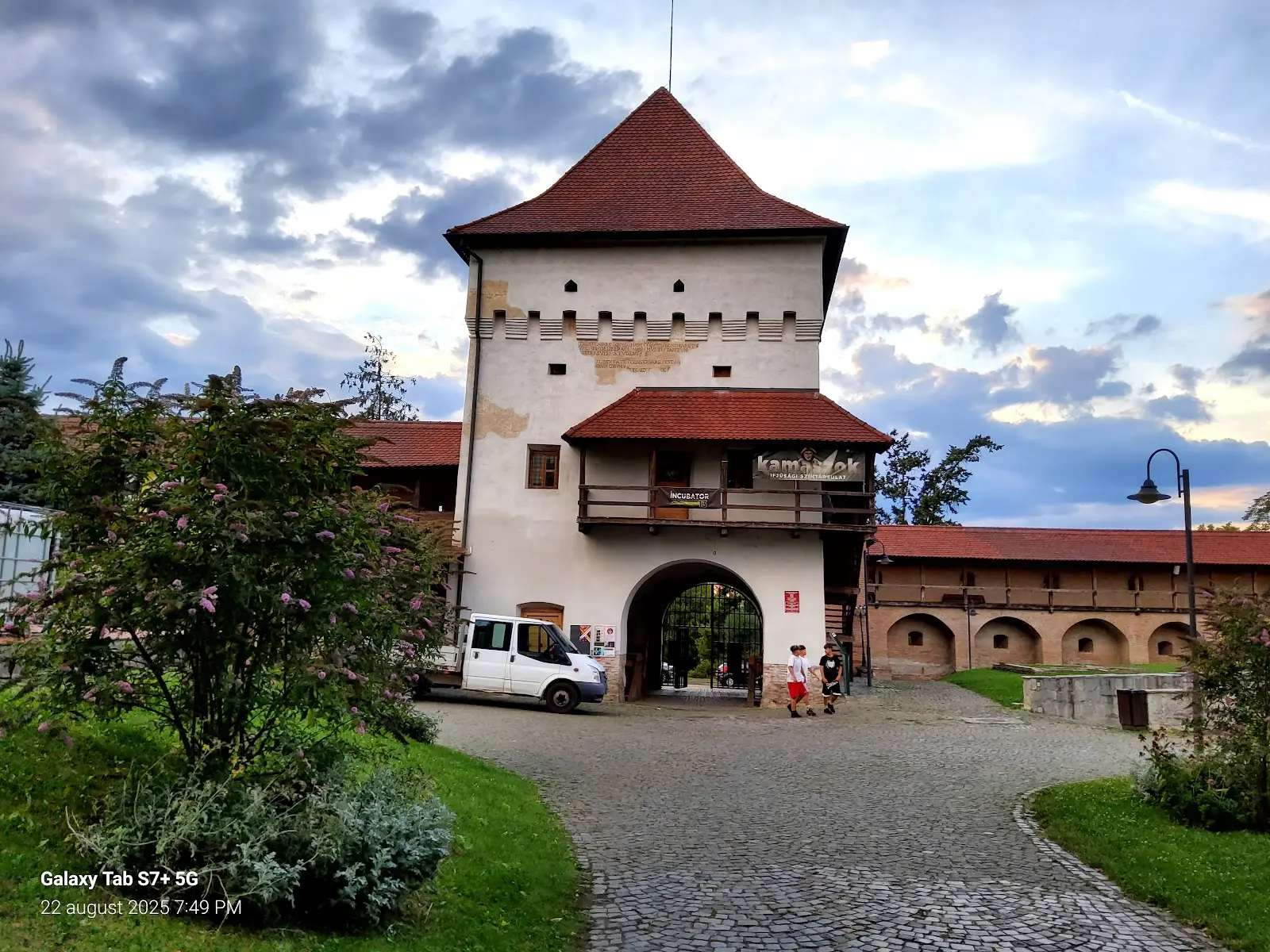
The medieval citadel is the city's other face, minutes from the Secession façades. Restored and handed back to the city, its inner courtyard now works as public space, with paths, grass and buildings used for exhibitions and events.
The detail that sticks: the bastions carried the names of the guilds that maintained them. Defending the town was divided among the trades, and the names outlived the stone. A slow circuit of the walls also gives you the best shots.
The Clock Tower
The Clock Tower is the fortification's vertical landmark and its historic entrance. It is the angle in every photograph of the city, and the best spot from which to picture how the whole complex looked when the walls were a necessity rather than a backdrop.
Look at it twice: once from the inner courtyard, where it reads as a gateway, and once from the streets below, where you see how far its silhouette once dominated the town. The best photographs come late in the day, when the stone takes on a warm colour.
Piața Trandafirilor
Piața Trandafirilor is not a square but a long esplanade standing in for a city heart: cafés, shops, institutions, benches in the shade, and the big landmarks anchoring the ends. Walk it end to end with stops — it is where the city's rhythm is most obvious, including the fact that the next table may well be speaking a different language from yours.
- Breakfast in one of the patisseries along it
- In the evening the square turns into a promenade
- In December it fills with the winter market
The Orthodox and Roman Catholic cathedrals
The Orthodox Cathedral and the Roman Catholic cathedral stand face to face across the same square. It is the best single image of the bilingual city: two denominations, two communities, one shared public space, and no ceremony about it.
The Orthodox cathedral impresses through scale and its painted interior; the Roman Catholic one is soberer, closer to the Transylvanian baroque tradition. Visit them one after the other, inside ten minutes, and the contrast says more than any information panel.
The wooden church on the hill
The wooden church on the hill is the opposite of the monumental centre: timber darkened by weather, small proportions, quiet. Brought here from the surrounding region, it is a surviving piece of Transylvanian peasant architecture in a city that, a few hundred metres downhill, was building Secession palaces. Seeing both in one afternoon is exactly what makes Târgu Mureș interesting.
The zoo and Cornești Plateau
Cornești Plateau is the wooded hill locals climb for air and a view. At the top sits the zoo, one of the largest in Romania, spread over sloping, tree-covered ground — walked at an easy pace, and the safest bet of all if you are travelling with children.
- Give it half a day, not an hour
- Comfortable shoes: the ground rises and falls
- Combine it with a walk on the plateau for the panorama over the city
The Botanical Garden and the Natural Science Museum
Two good cards for a rainy day, or for a break from architecture. The Botanical Garden is a quiet space tied to the city's university tradition, ideal for an unhurried hour. The Natural Science Museum rounds out the city's museum roster and works surprisingly well with school-age children.
The riverbank and the evening in town
The Mureș runs along the foot of the city and supplies the walk that closes the day: paths, bridges, water, and towards sunset the light falling on the façades behind the centre. It is not a sight in the classical sense, but it is the best half hour in a crowded day's programme.
In the evening the city moves back to Piața Trandafirilor, where the terraces stay open late and the bilingual cultural life shows up on the posters: theatre and concerts in Romanian and in Hungarian, sometimes in the same building on different nights. If you catch an active season, an evening at the theatre or the philharmonic is the best local experience going — not a box ticked.
- Check the theatre and philharmonic listings before fixing your evening plan
- In summer, events move outdoors
- For dinner, look for the older places in the centre rather than passing-trade terraces
Castles nearby: Gornești and Ogra
With a car, Târgu Mureș becomes the base for one of Transylvania's loveliest castle runs. Teleki Castle at Gornești is the grand one: a noble estate set in the Mureș valley, with parkland and the melancholy air of the great Transylvanian family houses. Haller Castle at Ogra is smaller and far less visited — exactly the kind of stop you make for the quiet and for photographs with nobody in the frame.
- Check visiting arrangements before you drive out; both are sights that change over time
- String them into a single outing along the Mureș valley
- Add lunch in one of the villages along the way
With children
- The zoo and Cornești Plateau, half a day
- The Natural Science Museum for the rainy day
- The citadel courtyard, where they can run
- The banks of the Mureș for the evening walk
If you only have one day
- Morning: the Palace of Culture and the Hall of Mirrors
- Lunch: in the centre, paprikash or goulash
- Afternoon: Piața Trandafirilor, both cathedrals, the citadel and the Clock Tower
- Evening: dinner in town and a stroll along the esplanade
Castles and day trips
- Gornești — Teleki Castle, in the Mureș valley
- Ogra — Haller Castle, small and quiet
- The villages along the Mureș, for the drive itself
- The rest of Transylvania: Sighișoara, Sibiu and Cluj, all a few hours away
For orientation, context and a full itinerary, read the city guide; to choose a base, see where to stay in Târgu Mureș.
Plan your trip
Stays nearby
Stays in Romania
Experiences
Tours & activities
Guided tours, day trips and hand-picked experiences via GetYourGuide — free cancellation on most.
See all experiencesGetting to Romania
Flights, transfer & car
Fly into Romania
Compare fares to Bucharest Otopeni (OTP) and regional airports — Cluj, Sibiu, Iași, Timișoara.
Airport transfer
Private, fixed-price door-to-door transfer — driver waiting from the moment you land.
Rent a car — see the real Romania
A rental car is the key to Romania: the Transfăgărășan, the painted monasteries of Bucovina, mountain roads and the villages of Maramureș that no train reaches.
Find a car











