
Complete guide to Ștei
A small Bihor town built in the 1950s for uranium mining, with an atypical planned architecture. For travellers, the value lies around it: the Galbena Gorges in Padiș and the ruins of Finiș Fortress.
Ștei doesn't look like the rest of Bihor, and there is a precise reason for that: it was built from scratch in the 1950s as a workers' town serving the uranium mining in the area. The result is a planned town of low blocks, wide avenues and a geometry quite unlike the old market towns around it. For a traveller, almost all of its value lies in the nature outside the town — let's be clear about that from the start.
A town designed, not grown
Most Romanian towns grew around a market, a fortress or a church. Ștei did not. It appeared in the 1950s as a new settlement, built for the workers and specialists employed in extracting uranium ore in the Bihor mountains. For several decades it even carried the name Dr. Petru Groza.
What remains today is a lesson in the urbanism of that era: a regular street grid, administrative buildings monumental for the town's size, generous green space between blocks, a central square conceived as a stage. If you are interested in the architecture and social history of the 1950s and 60s, Ștei is honestly a more interesting object of study than many a picturesque centre.
If that doesn't interest you, there is nothing here to see. Said plainly, so you plan your time well.
Why travellers come anyway
For the mountains. Ștei is one of the western gateways into the Apuseni, and from town you set out for two places that genuinely justify the drive.
The Galbena Gorges
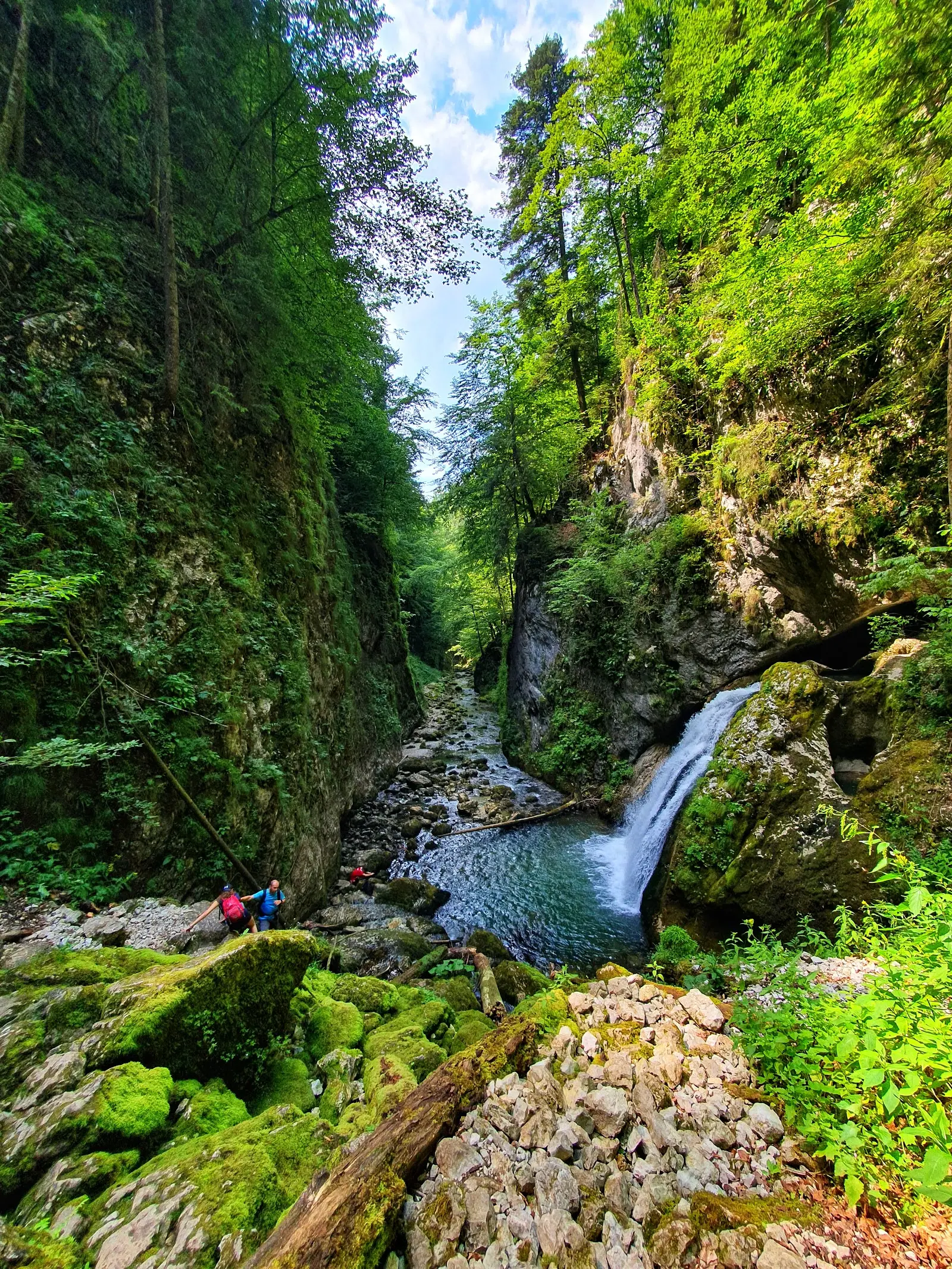
The Galbena Gorges are, for many, the most spectacular gorge section in Padiș: a narrow defile cut by water into limestone, with waterfalls, rock steps, cable-assisted passages and metal ladders, on a route running from the Galbena resurgence upstream.
It is beautiful, but it is not a stroll:
- the route needs proper hiking gear and free hands;
- the cable and ladder sections are taken one person at a time, not as a tight group;
- high water after rain makes the route dangerous — postpone it, don't force it;
- allow a generous margin on timings, because the exit onto the plateau climbs.
Check the state of the route before setting out, and start early. For route descriptions, access variants onto the Padiș plateau and conditions on the ground, head to munte.online.
Finiș Fortress
North of Ștei, in the village of Finiș on the road to Beiuș, stand the ruins of Finiș Fortress — a medieval fortification reduced to walls and fragments of a tower, set on a rise with a view across the depression.
It is a short visit with no elaborate facilities, but it has atmosphere and is the easiest stop "with history" in the area. A good break between town and mountain.
The rest of the area
From Ștei you can also easily reach the other landmarks of the western Apuseni: the Bears' Cave at Chișcău, the villages of the Beiuș Land, Stâna de Vale. The cultural context of the whole region — the Moți people, the crafts, mountain village life — is in our guide to the Apuseni and Țara Moților.
Getting there and where to sleep
Ștei is on the main road between Oradea and Deva, in the Crișul Negru depression, about an hour and a half from Oradea by car. A car is necessary: public transport towards Padiș and the mountain villages is rare or absent, and the final road sections demand care.
Accommodation in town is simple and cheap, guesthouse or small-hotel style. If Padiș is the main goal, many people prefer to sleep closer to the mountains, in the villages along the access road or in the chalets on the plateau.
When to go
The season decides almost everything, because the real sights are in the mountains:
- Summer and early autumn — the only window in which the Galbena Gorges can reasonably be walked: long days, low water, passable access roads.
- Spring — snowmelt raises the water and makes the gorges risky. Save them for another time and see the villages, the fortress and the surroundings instead.
- Winter — the Padiș plateau becomes terrain for those with winter gear and experience; getting up there from Ștei is hard.
- Rainy days — the obvious alternative is the Bears' Cave, fully developed and weather-proof.
Planning the day
Three versions that work:
- Ștei as a base, Padiș as the goal. Sleep in town or closer to the mountains, leave at dawn, return in the evening.
- A stop in passing. Ten minutes looking at 1950s architecture, then Finiș Fortress and on towards Beiuș.
- A western Apuseni weekend. The Galbena Gorges one day, the Bears' Cave and the Beiuș Land villages the next.
For any version that includes the gorges, set out with a plan B in your pocket: it is a route easily cancelled by water.
Honest verdict
Ștei isn't a tourist destination and doesn't pretend to be. It is an atypical town, interesting for anyone who reads the architecture of its era, and a practical base for the Apuseni. The real reason to come to this area is what surrounds it: the Galbena Gorges, the Padiș plateau, the fortress at Finiș and the villages in between. Arrive with those expectations and the area will give you far more than the map promises.
Plan your trip
Stays nearby
Stays in Romania
Experiences
Tours & activities
Guided tours, day trips and hand-picked experiences via GetYourGuide — free cancellation on most.
See all experiencesGetting to Romania
Flights, transfer & car
Fly into Romania
Compare fares to Bucharest Otopeni (OTP) and regional airports — Cluj, Sibiu, Iași, Timișoara.
Airport transfer
Private, fixed-price door-to-door transfer — driver waiting from the moment you land.
Rent a car — see the real Romania
A rental car is the key to Romania: the Transfăgărășan, the painted monasteries of Bucovina, mountain roads and the villages of Maramureș that no train reaches.
Find a car











