
Complete guide to Reșița and the Banat mountains
Reșița is the historic ironworking centre of the Banat mountains and, at the same time, the gateway to one of the wildest corners of Romania: Cheile Nerei–Beușnița National Park, the lakes at Văliug and the Semenic plateau. A complete guide to three or four days between heavy industry and beech forest.
Reșița looks like nowhere else in mountain Romania. It is a town of furnaces and locomotives, stretched along a narrow valley at the foot of mountains that hide limestone gorges, turquoise lakes and endless beech forest. The Banat mountains are best visited exactly that way: one day of industry, two of wilderness.
Why Reșița and the Banat mountains
Reșița is the historic steel and ironworking centre of the Banat mountains, with one of the longest industrial traditions in Romania. Iron was smelted and locomotives were built here at a time when most of the country was still rural, and the town still has the shape of an industrial valley: long workshops, neighbourhoods climbing the slopes, bridges over the water, and a technical memory few places in Romania can match.
What makes the region memorable, though, is the contrast. Less than an hour past the last industrial halls begins one of the wildest corners of the country: Cheile Nerei–Beușnița National Park, with limestone walls, waterfalls and lakes of an almost unnatural turquoise. Reșița is not the destination, it is the gateway — and that is precisely what makes it useful as a base for three or four days.
- Genuine industrial heritage — a town that shows its past without dressing it up.
- A first-rate national park — Cheile Nerei–Beușnița, with Beușnița Waterfall and Ochiul Beiului.
- Mountain lakes — Gozna and Crivaia at Văliug, Buhui in the forests near Anina.
- Accessible mountains — the Semenic resort, a few hairpins above town.
- Spectacular karst — gorges, springs and caves, among them Comarnic Cave.
The town and its steelmaking legacy
Reșița reads along a valley rather than around a central square. The town grew according to the works, and you can see it in the way the districts climb the hills and in the fact that the centre has several nuclei rather than one. A walk along the water, with the old halls on one side and apartment blocks on the other, says more about industrial Romania than any museum could.
Do not come expecting a restored baroque core like other Banat towns. Reșița is a working town with a rough elegance and a real technical pride. If industrial architecture, heavy machinery and the logic of a settlement built around a foundry interest you, it opens up quickly. If not, use it as a logistical base — it has everything you need before the days you spend in the park.
The Steam Locomotive Museum
The town's best tourist idea is also its simplest: the locomotives built here were set out in the open air as a collection you walk through. The Steam Locomotive Museum is the only one of its kind in Romania, and the one attraction in the Banat mountains nobody should skip, whether or not they care about trains.
You see heavy cast-iron and steel machines side by side, with rods, boilers and wheels fully exposed. For children it is a playground for the imagination; for adults it is a lesson in engineering and a testimony to what the town produced. Give it a solid hour and come in good light — outdoors, in morning sun or late afternoon, the metal looks like a different material.
Gateway to Cheile Nerei–Beușnița
Cheile Nerei–Beușnița is the main reason most visitors reach the Banat mountains. Across a large, hard-to-access territory, the national park gathers limestone gorges, old-growth forest, karst springs and two famous landmarks: Beușnița Waterfall, which falls in steps over travertine and moss, and Ochiul Beiului, a small, spring-fed lake of intense turquoise that barely seems to move.
A few simple rules separate a good day here from a wasted one:
- Start early. Distances on forest roads take far longer than the map suggests.
- Proper footwear. The paths are stony, damp and slippery near the water.
- Carry water and food. Inside the park, count on nothing.
- Follow the marked trails. These are serious gorges, and improvised shortcuts are dangerous.
- Leave nothing behind. This is a national park, not a picnic area.
Bigăr Waterfall, with a necessary note
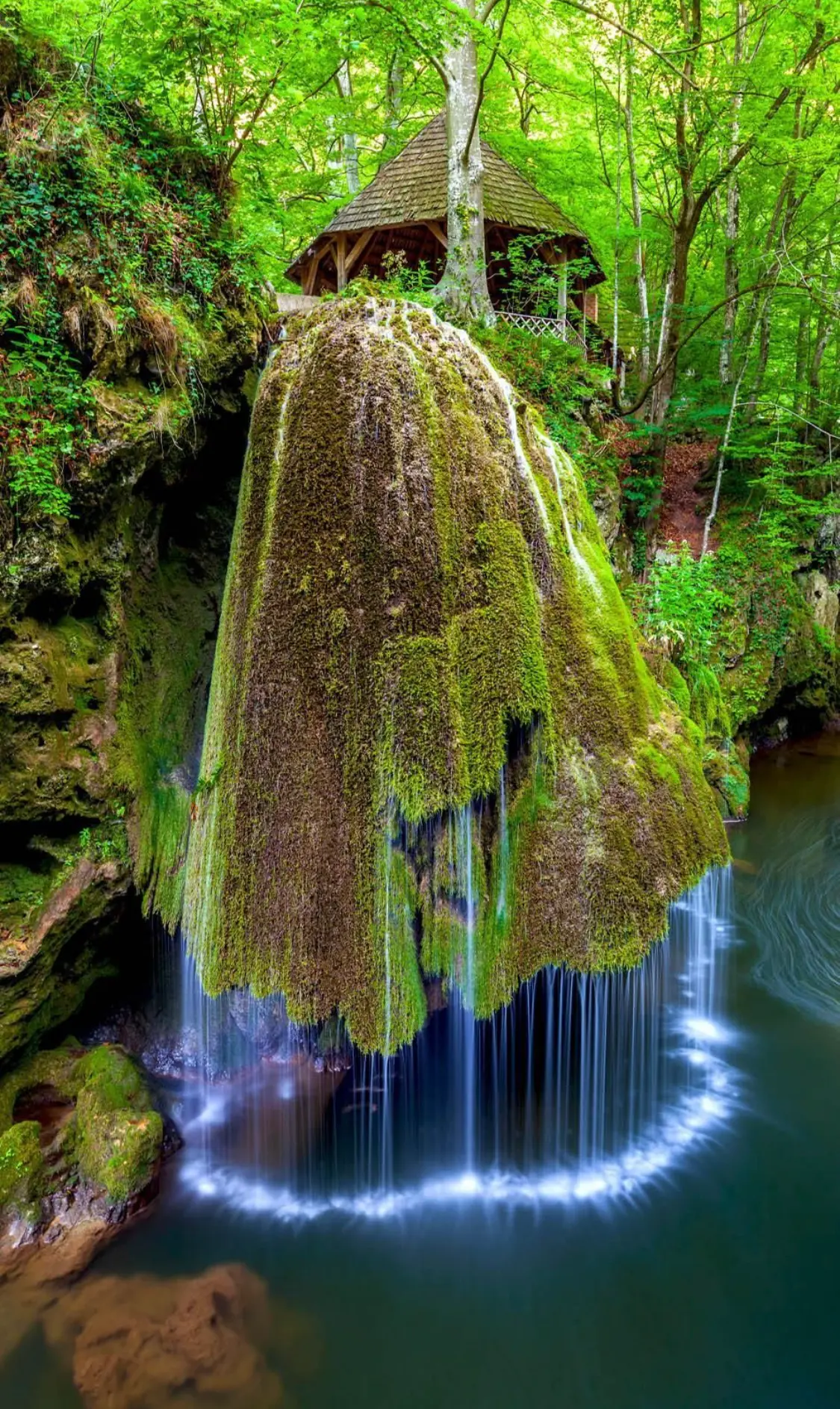
Bigăr Waterfall was for years the most photographed waterfall in Romania, famous for the unusual way the water spread across a dome of moss like a curtain. In 2021 the formation partly collapsed, so the postcard image no longer matches what you find on the ground.
It is still worth a stop if you are passing through: the spring, the water and the limestone setting remain, and it sits a few steps from the road. The point is to arrive with accurate expectations and not to build a whole day around it — treat it as a stop on the way, not the centrepiece of the trip.
The lakes: Gozna, Crivaia and Buhui
Barely half an hour from town, Lake Gozna changes the register completely: blue-green water between wooded hills, with the small resort of Crivaia right on the shore. It is the easiest indulgence in the region — a walk along the water, a terrace with a view, an afternoon with no schedule.
Further on, towards Anina, Lake Buhui hides in the forest, an old dam ringed by beech, harder to reach and far quieter. Together, the lakes give the region a character that is rare in Romania: mountains, water and dense forest, all within a short drive of one another.
Semenic, the mountain above town
Semenic is the mountain resort of the Banat range, set on a high plateau of pasture, dwarf pine and wide views. In winter it is snow country; in summer it becomes a starting point for walks across the plateau, with beech forest on the slopes and cold air even in August. For trails, routes and mountain conditions, munte.online is the place to look — Semenic and Cheile Nerei are exactly its territory.
Comarnic Cave and the limestone world
Geologically, the Banat mountains are limestone country, and that means caves. Comarnic Cave is the best known of them, with galleries and formations that explain why cavers hold this karst in such high regard. Bring a jacket even in summer: cave temperatures stay low all year.
Getting there and getting around
A car is by far the best solution. Reșița connects easily by county roads to Timișoara and Lugoj, and the nearest major airport is Timișoara. Without a car the town itself is manageable, but the national park and the lakes become complicated.
Once there, respect the terrain: many of the finest places are reached on narrow gravel forest roads. Allow generous driving times, fill up in town, and do not count on a phone signal inside the gorges.
When to go
- Spring — high water, powerful waterfalls, fresh green forest; forest roads still soft.
- Summer — the best season for hiking and lakes, though weekends crowd the famous sights.
- Autumn — beech colour turns the Banat mountains into one of the most beautiful regions in the country.
- Winter — town, museums and Semenic; the national park becomes hard to access.
Three days, a simple plan
- Day 1 — the town: industrial heritage and the Steam Locomotive Museum, then an evening in Reșița.
- Day 2 — the national park: Ochiul Beiului and Beușnița Waterfall, leaving at first light.
- Day 3 — Văliug, Lake Gozna and Semenic, with a stop at Comarnic Cave or Bigăr Waterfall on the way back.
Read next
For the detailed list of sights, read What to see in Reșița and around. To choose your base — town, lakeside or a guesthouse at the edge of the park — see Where to stay in Reșița and the Banat mountains.
Plan your trip
Stays nearby
Stays in Romania
Experiences
Tours & activities
Guided tours, day trips and hand-picked experiences via GetYourGuide — free cancellation on most.
See all experiencesGetting to Romania
Flights, transfer & car
Fly into Romania
Compare fares to Bucharest Otopeni (OTP) and regional airports — Cluj, Sibiu, Iași, Timișoara.
Airport transfer
Private, fixed-price door-to-door transfer — driver waiting from the moment you land.
Rent a car — see the real Romania
A rental car is the key to Romania: the Transfăgărășan, the painted monasteries of Bucovina, mountain roads and the villages of Maramureș that no train reaches.
Find a car











