
Complete guide to Râmnicu Vâlcea
Everything you need for Râmnicu Vâlcea and Vâlcea county: the monastery chain, the Olt valley, the spa resorts, the Transalpina, how to get there, when to go and a 1–2 day plan.
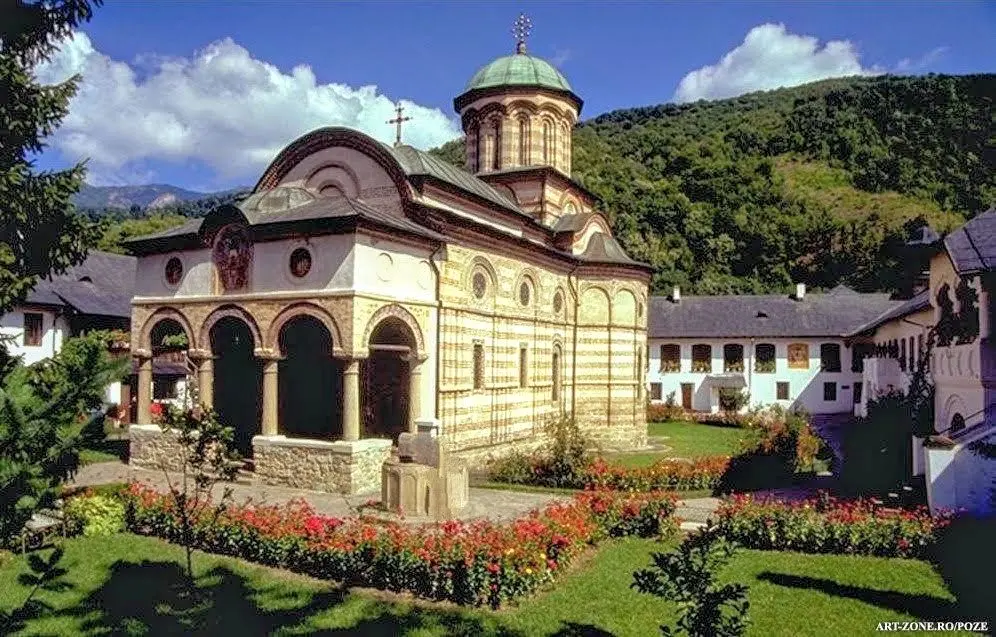
Râmnicu Vâlcea sits on the banks of the Olt, right where the subcarpathian hills of Oltenia start climbing into real mountains. Most travellers drive straight through on the road between Pitești and Sibiu, missing one of the densest chains of medieval monasteries in Romania, two long-established spa resorts and the start of the highest road in the country. This guide shows you how to use Râmnicu Vâlcea as a base for all of it.
Why go
Râmnicu Vâlcea is not a classic city break with a photogenic old town on every corner. It is something else, and that is exactly why it works: a mid-sized county capital on the Olt that you can cover on foot in a couple of hours, used as a bridgehead into a county unusually rich in religious heritage, mineral water and mountains.
Within an hour's drive you have monasteries founded by the first rulers of Wallachia, an open-air village museum, show caves, two spa resorts and roads that climb to the crest of the Southern Carpathians. The town gives you the beds, the restaurants and the late-opening pharmacy; the county gives you the reasons to drive.
- Heritage: one of the densest concentrations of medieval monasteries in Romania.
- Nature: the Olt valley, the Cozia massif, the wooded hills of Vâlcea.
- Spas: Călimănești-Căciulata and Băile Olănești, both less than half an hour away.
- Mountains: the Transalpina, Romania's highest road, starts in this county.
The monastery chain of Vâlcea
If there is one single reason to come, this is it. Vâlcea holds one of the densest chains of monasteries in Romania, and many of them are not modest village churches but princely foundations with fortress walls, old frescoes and centuries of archives.
The headline sight is Cozia Monastery, built by Mircea the Elder on the bank of the Olt. The prince is buried there, and the alternating bands of brick and stone make the church instantly recognisable. Nearby, on the same stretch of valley, stand Turnu Monastery, a secluded foundation at the foot of the Cozia massif, and Ostrov Monastery, built on an island in the Olt — one of the most unusual monastery settings in the country.
West of town, among the hills, are Govora Monastery, tied to the history of printing in Wallachia, and Dintr-un Lemn Monastery, whose name comes from the legend of an icon found in an oak, from whose timber the first church here is said to have been carved. All five can be seen in two days with a car, and each has a different character: Cozia is monumental, Turnu is silent, Ostrov is picturesque, Govora is scholarly, Dintr-un Lemn is intimate.
The Olt valley, the drive that makes the trip
To the north, the Olt cuts a long gorge through the mountains and the road follows it bend for bend towards Sibiu. It is one of the finest stretches of main road in Romania and, at the same time, the region's main artery: the monasteries, the resorts and the viewpoints are strung along it like beads on a cord.
On this section, between Călimănești and the point where the river leaves the mountains, you get beech forest, rock walls, reservoirs and marked trails climbing into Cozia. Even on a two-day trip, drive the gorge once to the top and back — it is worth doing for its own sake.
Sights in town
In Râmnicu Vâlcea everything revolves around St Nicholas Cathedral and the central avenue, Calea lui Traian, an easy walk end to end. The Vâlcea History Museum puts the county in context before you head out into the field, and Zăvoi Park, stretching towards the river, is where the town spends its summer evenings.
On the northern edge of town, on the road towards Călimănești, the Vâlcea Village Museum at Bujoreni gathers houses, mills, a wooden church and workshops from villages across the county. It is one of the best introductions to traditional architecture south of the Carpathians and an ideal stop with children, since the whole visit is outdoors.
The spa resorts
North of town, on the Olt, Călimănești-Căciulata is the best-known resort in the area: mineral springs, hotels with treatment facilities and a promenade, plus the advantage of sitting right next to Cozia and Ostrov. To the west, on a different road, Băile Olănești is Vâlcea's other spa landmark, a quieter valley resort surrounded by forest.
Even if you are not coming for treatments, both remain useful: they are the best places to sleep in the county outside the town itself, and excellent bases for day trips.
The Transalpina and the mountains
The Transalpina (DN67C), the highest road in Romania, starts in Vâlcea and climbs over the mountain crest through Urdele Pass. It is a warm-season road: the high section closes in winter, so check conditions before you set out and never plan it as a shortcut — treat it as a full-day objective.
The surrounding ranges, Căpățânii and Parâng, are serious hiking country, with long ridges and few huts; for trails, refuges and mountain conditions, our dedicated portal is munte.online. If you are only driving, stop at the saddles and viewpoints: the landscape changes completely every few hundred metres of altitude.
Getting there and getting around
- By car: the town sits on the axis linking Pitești to Sibiu along the Olt valley. From Bucharest, take the motorway to Pitești, then the main road up the river; from Sibiu, come down through the gorge.
- By train: the station is on the line that climbs the Olt valley; check timetables in advance, as services vary.
- By air: the most useful airports are Sibiu, Craiova and Bucharest.
- Locally: a rental car is effectively essential. The hill monasteries and the Transalpina are not realistic by public transport, and taxis get expensive once you chain several sights together.
When to go
- May–June: green hills, monasteries without crowds, mountain roads about to open.
- July–August: the only period when the Transalpina is reliably open; in exchange, the resorts are full.
- September–October: the best choice for photography, with autumn colour along the Olt valley.
- Winter: spa and monastery season, with the high mountain road closed.
A 1–2 day plan
Day 1 — the town and the Olt valley. Spend the morning in the centre: the cathedral, Calea lui Traian, the history museum. At midday head up to Bujoreni, then carry on along the Olt to Călimănești for Cozia, then Ostrov and, if you still have energy, Turnu. Sleep in town or in the resort.
Day 2 — the hills and the western monasteries. Leave early for Govora and Dintr-un Lemn, stopping in villages along the way. In the afternoon you have two options: Băile Olănești, for forest and mineral water, or a longer drive to Women's Cave if you also want a show cave. Details for each sight are in our article on what to see in Râmnicu Vâlcea and Vâlcea.
With three days, give the third one entirely to the Transalpina, starting at dawn.
Practical basics
- Dress code at monasteries: shoulders and knees covered; many monasteries lend a skirt or shawl at the gate.
- Photography: permission is usually required inside painted churches; follow the signs and avoid flash.
- Visiting hours: monastery services take priority; mid-morning and early afternoon are the best windows.
- Cash: handy for monastery shops, candles, small car parks and village guesthouses.
- Roads: good asphalt on the main axes, variable on hill roads; in the mountains, suitable tyres and a full tank.
- Where to sleep: see the area-by-area comparison in our article on where to stay in Râmnicu Vâlcea and Vâlcea.
In short — the checklist
- Cozia, with the tomb of Mircea the Elder: the one sight not to miss.
- Two more monasteries of your choice: Dintr-un Lemn, Govora, Turnu or Ostrov.
- The Vâlcea Village Museum at Bujoreni, for traditional architecture.
- One day on the Olt valley, up the gorge and back.
- One spa resort, either as a base or as a stop.
- The Transalpina, if you come in the warm season.
- A rental car, and spare time for the hill roads.
Plan your trip
Stays nearby
Stays in Romania
Experiences
Tours & activities
Guided tours, day trips and hand-picked experiences via GetYourGuide — free cancellation on most.
See all experiencesGetting to Romania
Flights, transfer & car
Fly into Romania
Compare fares to Bucharest Otopeni (OTP) and regional airports — Cluj, Sibiu, Iași, Timișoara.
Airport transfer
Private, fixed-price door-to-door transfer — driver waiting from the moment you land.
Rent a car — see the real Romania
A rental car is the key to Romania: the Transfăgărășan, the painted monasteries of Bucovina, mountain roads and the villages of Maramureș that no train reaches.
Find a car











