
What to see in Râmnicu Vâlcea and Vâlcea county
The sights worth the effort in Râmnicu Vâlcea and across the county: the cathedral and centre, the village museum at Bujoreni, Cozia, Dintr-un Lemn, Govora, Turnu and Ostrov monasteries, Women's Cave and the Transalpina.
In Vâlcea the sights do not cluster inside one historic centre — they string out along valleys and over hills, about twenty minutes apart. The town gives you a few good stops for a morning; the rest of the day you spend driving between monasteries, caves and spa resorts. Below are the sights worth the effort, grouped the way you actually visit them.
St Nicholas Cathedral and central Râmnicu Vâlcea
The natural starting point is St Nicholas Cathedral, the town's religious landmark and the easiest sight to find. From there you walk Calea lui Traian, the central avenue, lined with 19th and 20th century buildings, cafés and shops. It is an hour's stroll, maybe two if you wander into the side courtyards, and it gives you the measure of the place quickly: quiet, green, free of tourist crowds.
Combine it with a coffee downtown and a stop at the Vâlcea History Museum, which orders everything you are about to see in the field: the county's history, its archaeology, and the context in which the surrounding monasteries appeared.
Zăvoi Park and the river
Zăvoi Park is Râmnicu Vâlcea's green lung, stretching towards the Olt, with broad alleys, a lake and playgrounds. It is not a sight you fly in for, but it is exactly what you want after a day on hill roads, and in the evening it becomes the town's meeting point.
From here you get easy access to the riverbank, where it becomes obvious why the town is where it is: the river cut the route, the route brought the trade, and the trade built the town.
The Vâlcea Village Museum at Bujoreni
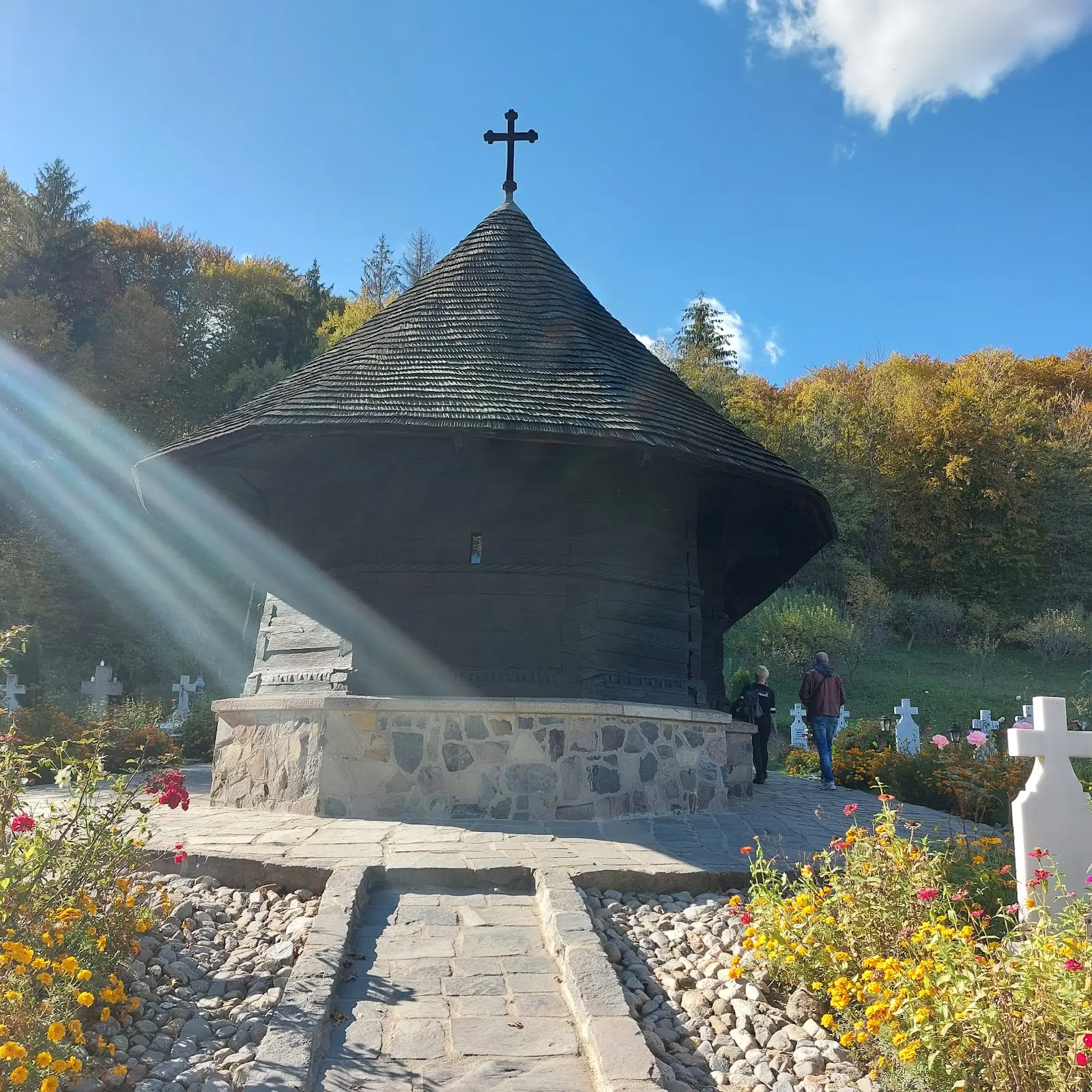
On the northern edge of town, the Vâlcea Village Museum at Bujoreni brings together houses, outbuildings, mills, workshops and a wooden church moved here from villages across the county. The whole visit is outdoors, on a sloping site among orchards.
It is one of the best museums of its kind south of the Carpathians and, in practice, the most efficient lesson in what a local household looked like before concrete: shingle roofs, porches on carved wooden posts, stone cellars, wooden tools for every job. Allow at least an hour and a half, and wear comfortable shoes.
Cozia Monastery
If you visit only one sight in the county, make it this one. Cozia Monastery was founded by Mircea the Elder on the bank of the Olt, and the prince himself is buried inside the church — a rarity in Romania, where princely tombs are scattered across the country. The alternating bands of brick and stone, the porch and the monastic courtyard make it the most photographed monument in Vâlcea.
Visit mid-morning, when light reaches the courtyard, and take time to look outside the church too: the setting, squeezed between road, river and the forest climbing Cozia, says as much as the frescoes. The wider historical context is in our complete guide to Râmnicu Vâlcea.
Turnu and Ostrov monasteries
Also on the Olt valley, a short distance from Cozia, are two monasteries that could not be more different. Turnu Monastery sits secluded at the foot of the Cozia massif, at the end of a short road off the highway — a silent place, forest above it and mountain paths starting behind the cells.
Ostrov Monastery is the opposite: built on an island in the Olt, water on both sides, it is one of the most unusual monastery settings in the country and a fifteen-minute stop nobody regrets. Since it is in Călimănești, it pairs naturally with sleeping in the resort — see where to stay in Râmnicu Vâlcea and Vâlcea.
Dintr-un Lemn Monastery
West of town, among hills and villages, Dintr-un Lemn Monastery has the finest name in the county — literally "from one timber" — and a legend to match: an icon of the Virgin is said to have been found in an oak, and the first church here carved from the wood of that same tree.
Legend aside, it is a convent with a well-kept courtyard, low walls and a far more intimate atmosphere than Cozia. The drive out here, through the hills of Vâlcea, is part of the visit: long villages, porched houses, orchards and wells at the roadside.
Govora Monastery
Govora Monastery is the one you recommend to people who have already seen plenty of monasteries. Tucked into a valley west of Râmnicu Vâlcea, it is tied to the history of printing in Wallachia: one of the oldest printing presses in this part of Europe operated here, and the place still feels more like a seat of learning than a tourist attraction.
The architecture is sober, the courtyard small, and outside service hours the silence is almost total. Combine it with Dintr-un Lemn, since both sit on the same loop through the hills.
Women's Cave (Peștera Muierilor)
If you want a natural sight as well, Women's Cave is the most accessible option in the area: it lies at Baia de Fier, in neighbouring Gorj county, just over the boundary from Vâlcea on the road towards the mountains. The cave is set up for visitors, with galleries, formations and recognised palaeontological importance.
It makes a half-day trip from Râmnicu Vâlcea, best combined with a drive towards the Transalpina. Bring a jacket: inside it is cold and damp all year, however hot it is outside.
The Transalpina and Urdele Pass
The Transalpina (DN67C) is the highest road in Romania and it starts in this county, climbing over the crest through Urdele Pass. It is not a sight to tick off in passing: give it a full day, leave in the morning and accept that you will stop often.
Important: the high section is open only in the warm season and closes in winter, so check conditions before you go. How to fit it into an itinerary is covered in our complete guide.
Călimănești-Căciulata and Băile Olănești
Vâlcea's two spa resorts are worth seeing even if you are not coming for treatments. Călimănești-Căciulata is the livelier one, on the Olt, with a promenade, springs and immediate access to Cozia and Ostrov. Băile Olănești is quieter, in a wooded valley west of town, with walking alleys and captured springs.
Both work well as an afternoon stop: a walk, a glass of mineral water at the spring, a coffee on a terrace, then back to town.
If you only have one day
- Morning: the cathedral and central Râmnicu Vâlcea.
- Midday: the Vâlcea Village Museum at Bujoreni.
- Afternoon: Cozia and Ostrov, on the Olt valley.
- Evening: a stroll in Călimănești or in Zăvoi Park.
For monastery enthusiasts
- Cozia, for Mircea the Elder's foundation and his tomb.
- Govora, for the printing history and the quiet courtyard.
- Dintr-un Lemn, for the legend and the convent atmosphere.
- Turnu, for its seclusion at the foot of the massif.
- Ostrov, for the island setting.
With children
- The Vâlcea Village Museum at Bujoreni, where they can run free.
- Zăvoi Park, for playgrounds and the lake.
- Women's Cave, if they are past toddler age and not afraid of the dark.
- The Călimănești promenade, with ice cream.
In bad weather
- The Vâlcea History Museum.
- The monastery interiors along the Olt valley, all easy to reach by car.
- Women's Cave, where the weather outside is irrelevant anyway.
- A treatment base or a hotel pool in Călimănești.
Plan your trip
Stays nearby
Stays in Romania
Experiences
Tours & activities
Guided tours, day trips and hand-picked experiences via GetYourGuide — free cancellation on most.
See all experiencesGetting to Romania
Flights, transfer & car
Fly into Romania
Compare fares to Bucharest Otopeni (OTP) and regional airports — Cluj, Sibiu, Iași, Timișoara.
Airport transfer
Private, fixed-price door-to-door transfer — driver waiting from the moment you land.
Rent a car — see the real Romania
A rental car is the key to Romania: the Transfăgărășan, the painted monasteries of Bucovina, mountain roads and the villages of Maramureș that no train reaches.
Find a car











