
Complete guide to Piatra Neamț
The pearl of Moldavia, a town between mountains on the Bistrița: a Stephen-era core in the centre, a cable car to Cozla, and an open road to Ceahlău, the Bicaz Gorges and the monasteries of Neamț.
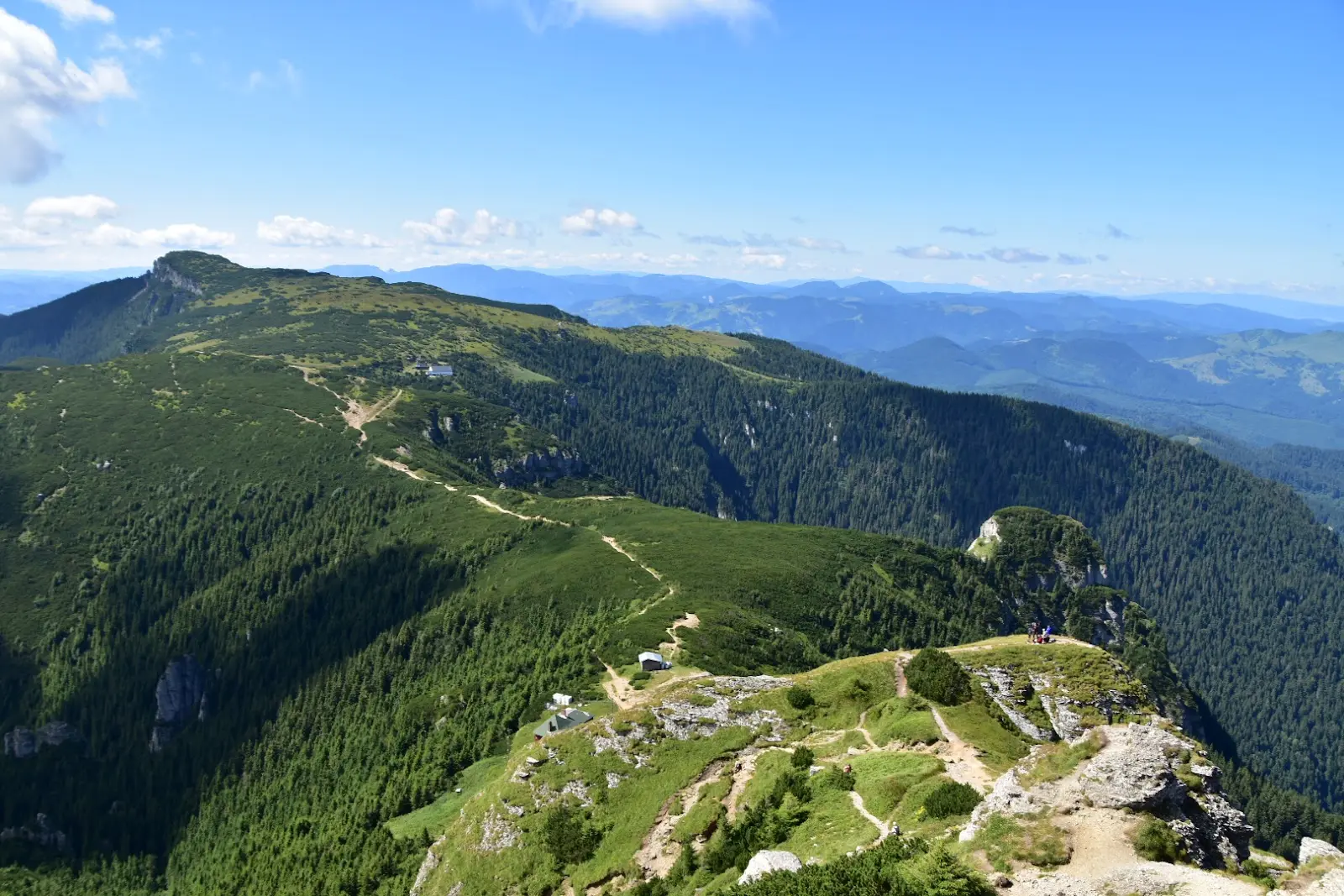
Piatra Neamț is called the pearl of Moldavia, and the name fits: a human-scale town pressed between forested hills on the valley of the Bistrița river. In its centre stand a princely court and a church founded by Stephen the Great, and from the edge of town a cable car climbs straight into the woods of Mount Cozla. A short drive away, the Ceahlău massif and the Bicaz Gorges begin.
Why Piatra Neamț is worth it
Few Romanian towns manage to put an authentic medieval ensemble, a serious archaeology museum and a cable car to a wooded ridge within minutes of one another. Piatra Neamț works on two levels at once: as a short city break with concentrated history and easy walking, and as a base camp for a week in the mountains.
Take either half on its own and the town still rewards you. Combine them and you have found its ideal formula: a morning on the trail of Stephen the Great, an afternoon on a limestone ridge or on the shore of a reservoir. You need no car to see the town and no mountaineering background to see the mountains, which is exactly why it suits families, couples and first-time visitors to sub-Carpathian Moldavia.
Orientation: how the town sits
The Bistrița runs below town, while the old core gathered on a high terrace, with the hills of Cozla, Pietricica and Cernegura closing the horizon on every side. The historic centre — the main square, the museums, the princely ensemble — is covered on foot in a single unhurried walk.
From the centre every direction leads somewhere useful: up, to the cable car and the forest; down, to the banks of the Bistrița; west, along the road that climbs to Bicaz, the lake, the gorges and Ceahlău; north, along the monastery road through hills and beech woods.
History in the middle of town
The old nucleus is the Princely Court, the residence founded by Stephen the Great, of which the court ruins, the church and above all Stephen's Tower survive — the silhouette on almost every photograph of the town. Beside it stands St John's Princely Church, with its layered masonry and glazed ceramic discs, one of the clearest lessons in Stephen-era architecture anywhere in Moldavia.
A few steps away, the History and Archaeology Museum gathers Cucuteni-culture pieces found in the area. Even if archaeology is not your thing, this is where the rest of the town starts making sense.
The mountain inside the town: Cozla and the cable car
The cable car leaves essentially from town and climbs Mount Cozla, into a forested area with laid-out paths, viewpoints over the Bistrița valley and a view across the rooftops. If you only have an hour in Piatra Neamț, this is the single most efficient thing to do: ride up, walk the plateau, ride down.
From up there the geography of the whole region reads clearly — where the valley narrows, where the dam begins, where the road to Ceahlău disappears. With children, it is the one hike that needs no negotiation.
Gateway to Ceahlău and the Bicaz Gorges
This is where the town's position really pays off. The Ceahlău massif — the symbolic mountain of Moldavia, with Toaca Peak and the Duruitoarea waterfall — is approached from Durău or Izvorul Muntelui and makes a full day of serious hiking, not a stroll. Further along the same road the Bicaz Gorges open up, including the stretch known as Hell's Throat, where vertical walls close over the roadway.
Between town and mountain lies Lake Izvorul Muntelui (Bicaz), the largest reservoir in the Romanian Carpathians, good both for a boat trip and for a simple stop on the shore. For trails, ridge conditions and planning actual mountain days, our dedicated portal munte.online covers precisely this terrain.
The monasteries of Neamț, and Humulești
North of town runs one of the densest chains of monasteries in Romania: Agapia and Văratec, large and luminous in beech-fringed clearings; Sihăstria and Sihla, withdrawn and austere in the forest; Bistrița, tied to the history of the Mușatin dynasty. Two or three in a day is a comfortable pace.
In the same direction is Humulești, the childhood village of the writer Ion Creangă, today part of Târgu Neamț. The memorial house is small and exactly as much as it needs to be: afterwards, his Childhood Memories read differently.
What to eat
The cooking is Moldavian — substantial and unpretentious:
- tochitură moldovenească, a pork stew with polenta, cheese and a fried egg
- sarmale, cabbage rolls in soured leaves, with sour cream
- borș, a sour soup, usually with poultry
- poale-n brâu and other baked home-made pies
- trout, cooked plainly, around Bistricioara and Durău
- a glass of vișinată or afinată, sour-cherry or blueberry liqueur, to finish
Getting there and getting around
The town is linked by road along the Bistrița valley and towards Roman, where it joins Moldavia's main north-south axis. The most useful nearby airport is Bacău; Iași and Cluj work if you arrive on an international flight and rent a car. The railway station and the coach station are both in town, with frequent bus links to Bacău, Roman, Târgu Neamț and Bicaz.
In town you manage on foot. For the mountains, the monasteries and the gorges, a car is the only comfortable solution — public transport exists, but it sets your timetable for you, and the interesting points are thinly spread on the map.
When to come
- Summer — the best season for Ceahlău, the gorges and the lake, and the busiest at weekends.
- Autumn — beech and hornbeam turn the town's hills and the monastery road into the most beautiful drive of the year.
- Winter — the town is quiet and photogenic, the cable car remains the main attraction, and the alpine routes on Ceahlău become proper winter work requiring proper gear.
- Spring — high water on the Bistrița, powerful waterfalls, forest roads still soft.
A one-day and a two-day plan
One day: morning at the Princely Court and the princely church, then the archaeology museum; tochitură for lunch in the centre; afternoon on the cable car to Cozla with a walk on the plateau; evening by the Bistrița.
Two days: on the second day leave town — either west to Bicaz, the lake and the Bicaz Gorges, or north to Agapia, Văratec and Humulești. Do not try to mix the two: they are different directions, and you would spend the day driving.
Practical basics
- The centre is walkable; parking in the old quarter is limited at weekends.
- At the monasteries, dress modestly and keep service times in mind.
- On the mountain the weather turns fast: an extra layer, water and a headlamp, even for a short outing.
- Phone signal disappears in stretches of the gorges and in the Ceahlău valleys — download the map offline.
- On summer and holiday weekends, beds sell out first in Durău and by the lake, not in town.
In short
- What it is: a town between mountains on the Bistrița, the pearl of Moldavia, with an intact Stephen-era core
- Unmissable: Stephen's Tower, the princely church, the cable car to Cozla
- With a car: Ceahlău, the Bicaz Gorges, Lake Bicaz, the monasteries, Humulești
- How long: two nights for the town plus one excursion; four for town plus mountains
- Next: what to see in Piatra Neamț and where to stay
Plan your trip
Stays nearby
Stays in Romania
Experiences
Tours & activities
Guided tours, day trips and hand-picked experiences via GetYourGuide — free cancellation on most.
See all experiencesGetting to Romania
Flights, transfer & car
Fly into Romania
Compare fares to Bucharest Otopeni (OTP) and regional airports — Cluj, Sibiu, Iași, Timișoara.
Airport transfer
Private, fixed-price door-to-door transfer — driver waiting from the moment you land.
Rent a car — see the real Romania
A rental car is the key to Romania: the Transfăgărășan, the painted monasteries of Bucovina, mountain roads and the villages of Maramureș that no train reaches.
Find a car











